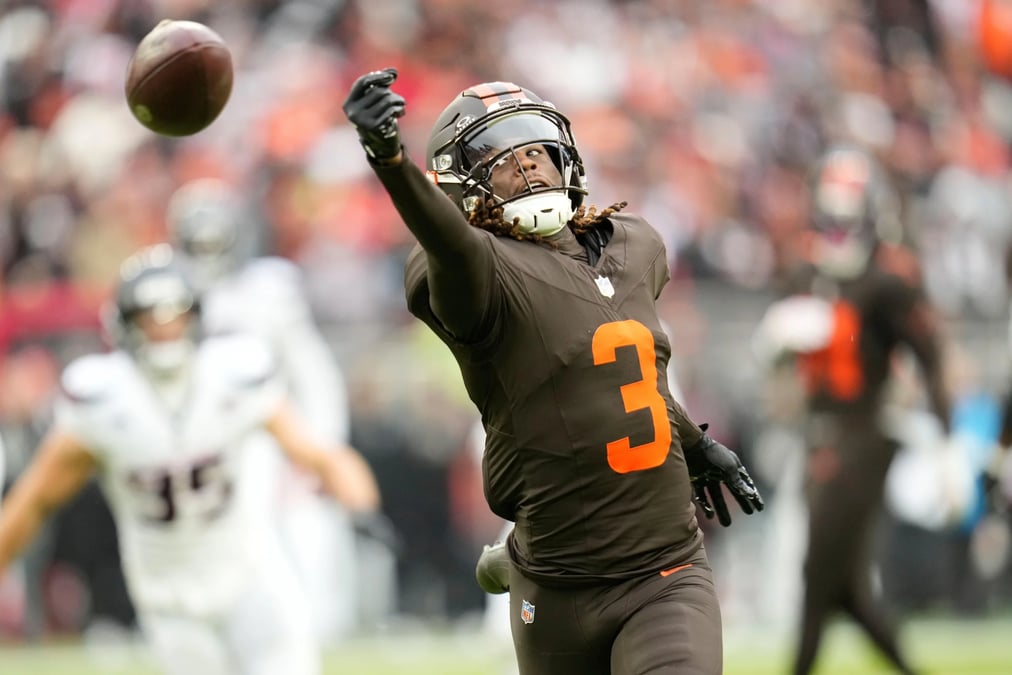
- Rough sledding for Jerry Jeudy: Jeudy has fallen to third in Cleveland's target pecking order behind two touted rookies.
- Darnell Mooney hasn't solidified his place in New York: The former Falcon has averaged only 0.74 yards per route run with the Giants.
- Chris Godwin‘s targets have been exceedingly short: His 4.0-yard average depth of target is the lowest among qualified receivers.

Offer valid for new subscribers on annual plans only
A receiver can run routes all afternoon and finish with a fantasy line that suggests he spent Sunday helping the grounds crew. Playing time creates the possibility of production, but fantasy managers still need the ball to arrive.
These five wide receivers have each run at least 200 routes while attracting relatively few targets. Target rates below are calculated by dividing targets by routes run, and fantasy totals use full PPR scoring.
Their grades, receiving efficiency and scoring opportunities help explain why all that work has produced so little.
Jerry Jeudy, Cleveland Browns
Jeudy has run 292 routes and drawn 30 targets, a target rate of just 10.3%. He has caught 20 passes for 282 yards without a touchdown, totaling 48.2 PPR points through 10 games.
His 61.0 PFF receiving grade and 0.97 yards per route run have provided little reassurance. Cleveland’s quarterback performance has also been an obstacle, with Deshaun Watson earning a 58.7 PFF passing grade.
However, other Browns receivers have attracted substantially more involvement. Denzel Boston has received 60 targets and KC Concepcion 59, compared with Jeudy’s 30.
The scoring opportunities have been especially limited: Two red-zone targets and none in the end zone. Jeudy’s 49.7 expected fantasy points closely resemble his actual total, indicating that the chances he has received have offered limited fantasy value.
A rebound would need to begin with a larger share of the passing-game opportunities.
Cooper Kupp, Seattle Seahawks
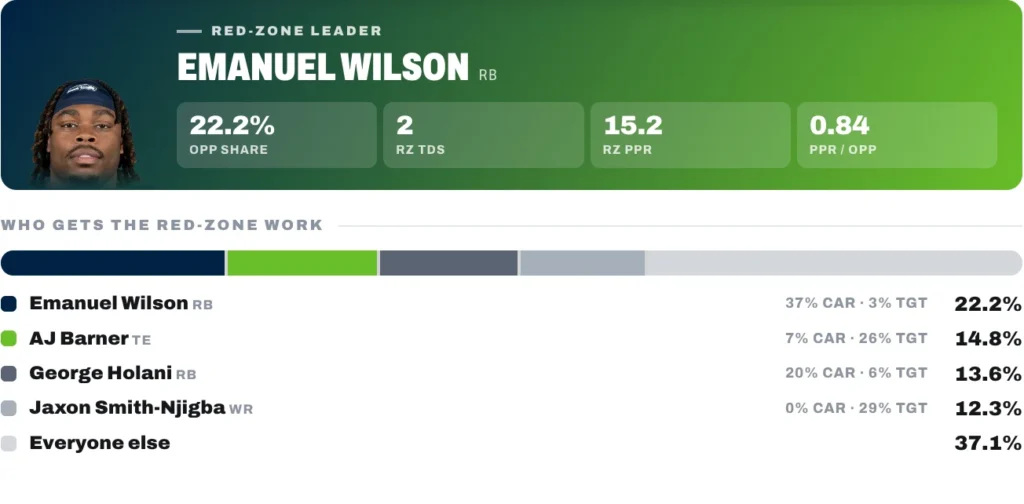
Kupp has run 281 routes, only 36 fewer than Jaxon Smith-Njigba. Their target totals have been separated by a much wider margin.
Smith-Njigba has drawn 104 targets on 317 routes, a 32.8% target rate. Meanwhile, Kupp has received 33 targets, putting his rate at 11.7%.
That difference has left Kupp with 23 receptions for 272 yards. His three touchdowns have helped him reach 68.2 PPR points, but his 63.5 PFF receiving grade and 0.97 yards per route run describe a modest receiving contribution.
Kupp has retained some scoring involvement, drawing nine red-zone targets and five end-zone tries. Those opportunities offer a route to occasional useful fantasy performances, although the limited target volume has made his value more dependent on converting them.
His presence in the Seattle offense has been considerably more consistent than his opportunities to score fantasy points.
Quentin Johnston, Los Angeles Chargers
Johnston has run 243 routes across eight games and attracted 28 targets, a rate of 11.5%. His 14 catches for 266 yards and one touchdown have contributed to just 47.4 PPR points.
The passing environment has been difficult. Justin Herbert’s 42.5 PFF passing grade has accompanied only six passing touchdowns, making it harder for receivers to build dependable fantasy production.
Johnston’s own performance has also required improvement. He has notched a 55.2 PFF receiving grade and dropped three passes, producing a 17.6% drop rate on catchable targets.
His 15.1-yard average depth of target has offered opportunities for larger gains, but infrequent targets have left little margin for wasted chances. Johnston’s 49.0 expected fantasy points sit only slightly above his actual total.
Greater involvement and cleaner execution would each strengthen the case for trusting him.
Darnell Mooney, New York Giants
Mooney has garnered 29 targets on 238 routes, a 12.2% target rate. Those chances have produced 14 catches for 175 yards and no receiving touchdowns.
Including his rushing contribution, he has scored 34.3 PPR points across nine games. Mooney’s 54.4 PFF receiving grade and 0.74 yards per route run have highlighted how little production has followed his time on the field.
There has been some room for better conversion: His 49.2 expected points exceed his actual output by 14.9. Even that projected total, however, amounts to only 5.5 points per game.
Malik Nabers has commanded 83 targets in the same offense, with Malachi Fields receiving another 38. Mooney’s five red-zone targets and two end-zone targets have presented relatively little opportunity to rescue his fantasy value through touchdowns.
The workload itself would need to improve significantly before a scoring correction could make him a dependable option.
Chris Godwin, Tampa Bay Buccaneers
Godwin has attracted targets more frequently than the other receivers here, but his 14.1% rate has still yielded only 37 opportunities from 262 routes. He has caught 29 passes for 259 yards without a touchdown, contributing to 57.9 PPR points through nine games.
Godwin’s role has also supplied limited downfield opportunities. A 4.0-yard average depth of target has placed considerable emphasis on reception volume and yards after the catch. Although he has averaged 6.5 yards after the catch per reception, the overall workload has culminated in just 0.99 yards per route run.
A 64.0 PFF receiving grade and only five red-zone targets, including one end-zone target, have offered little support for a major fantasy turnaround.
Godwin’s short targets could become useful in PPR formats with greater volume. For now, 4.1 targets per game have left too little work to build around. Across this group, a rising target rate would provide a meaningful signal that the second half could produce more than additional mileage.

 © 2026 PFF - all rights reserved.