The NFL draft has come and gone. There is a clear consensus on who should go in the first round of dynasty rookie drafts, but everything after that is largely unpredictable. More than 30 wide receivers were selected, and managers will weigh them differently — some prioritizing draft capital, others landing spot and others pre-draft rankings. Several tight ends went off the board early, but most project as blockers rather than receivers. Fewer running backs were selected than usual, and while most were not taken early, positional scarcity could push them up boards.
Here are two running backs, two wide receivers and a tight end projected to go in the third round or later of dynasty rookie drafts based on early consensus rankings. Each has a chance to factor into his team’s rotation as a rookie and provide fantasy value in his first few years in the league.
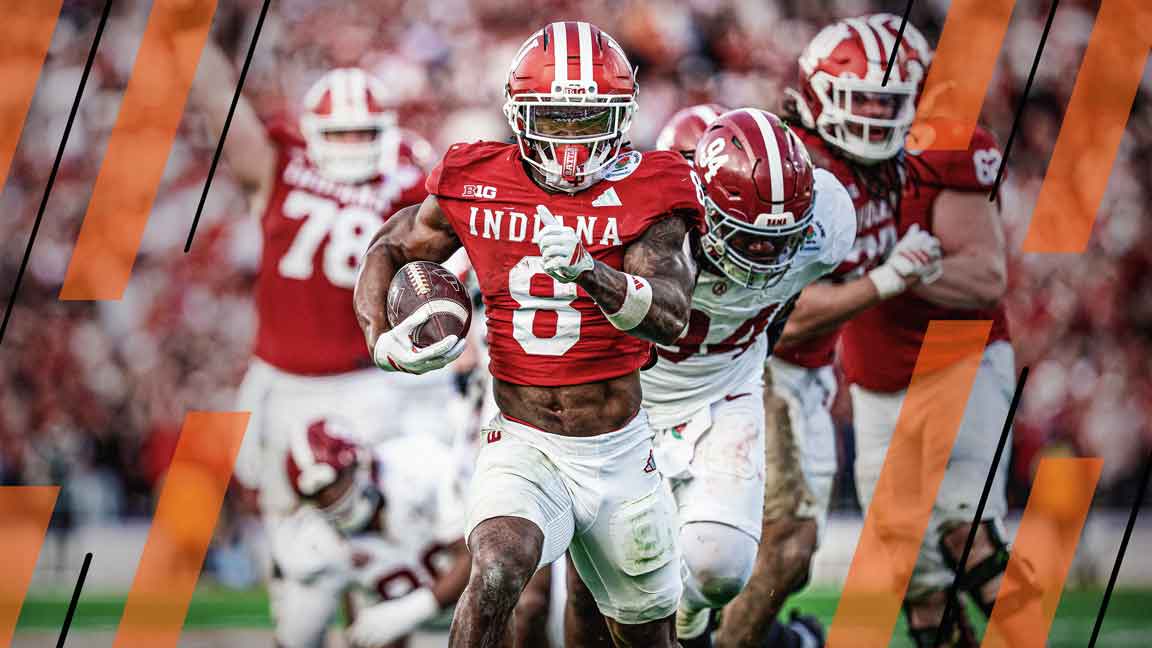
RB Kaelon Black, San Francisco 49ers
Black has the size and speed of a three-down back. He is near the middle of the pack in height and weight, while his speed, acceleration and change of direction all rate above average compared to running backs in this draft class.
His first concern is a lack of receiving production at Indiana. He posted a solid 1.38 yards per route run in his final season at James Madison, but he rarely ran routes and was targeted even less frequently after transferring. His snap rate also never exceeded 45%, as he saw the field primarily on passing downs.
Our draft guide noted he is better suited to zone-blocking schemes, and the data supports that: he averaged 5.5 yards per attempt on zone runs compared to 4.7 on gap concepts. The guide also noted that he has occasionally been a half-step late in identifying running lanes when operating in power concepts and that his run game lacks true difference-making creativity.
Black was the only running back selected on Day 2 of the draft and is a strong fit for Kyle Shanahan’s zone-blocking scheme. San Francisco has used a third- through fifth-round pick on a running back in five of the past six drafts, and the first four have not worked out. There is a real chance Black earns the backup job ahead of Jordan James and Isaac Guerendo. Shanahan has said he wants to get Christian McCaffrey help, and Black could fill that role. Given McCaffrey’s injury history, Black would be a strong fantasy option if he misses time, which has happened in multiple seasons.
RB Adam Randall, Baltimore Ravens
Derrick Henry has been one of the biggest running backs in the NFL throughout his career, listed at 6-foot-2 and 252 pounds on the Ravens’ website. Baltimore drafted Randall, who measured 6-foot-3 and 232 pounds at the combine. A former wide receiver with limited experience at running back, Randall could see a sizable workload if Henry misses time.
The Ravens used Henry and Keaton Mitchell as their early-down backs last season, with Justice Hill and Rasheen Ali handling receiving work. Baltimore let Mitchell walk in free agency, and Randall was the team’s only addition at the position.
Randall makes this list because he appears to be one of the few handcuffs drafted on Day 3. Nicholas Singleton and Demond Claiborne project as third on their depth charts, while Emmett Johnson, Jonah Coleman and Kaytron Allen are expected to be part of committees. Mike Washington Jr. will serve as a handcuff for the Las Vegas Raiders, but he is likely to be selected in the second round of dynasty rookie drafts. If Henry misses time this season, Randall would be the favorite to lead the team in carries.
WR Caleb Douglas, Miami Dolphins
The second and early third rounds were not kind to fantasy managers holding early second-round picks in dynasty rookie drafts. No running backs were selected in this range, and most wide receivers landed with teams that did not have a clear need at the position. Antonio Williams of the Washington Commanders and Malachi Fields of the New York Giants project as backups, while Germie Bernard will likely be limited to three-receiver sets.
Douglas may have the best chance among Day 2 wide receivers to play in two-receiver sets as a rookie, outside of Denzel Boston, who landed with the Cleveland Browns after falling out of the first round. Douglas was not especially productive in college but posted excellent measurables, including a 6-foot-4 frame, a 4.39-second 40-yard dash, a 10-foot-6 broad jump and 10.13-inch hands.
He projects as an X receiver, and Miami does not have a clear option at that position. The three most notable receivers on the roster — Tutu Atwell, Jalen Tolbert and Malik Washington — all profile more as Z or slot types. New offensive coordinator Bobby Slowik has a track record of developing productive X receivers, including Brandon Aiyuk with the San Francisco 49ers and Nico Collins with the Houston Texans.
Miami also drafted Chris Bell 19 picks later, but he suffered an injury late last season that could limit his availability early. Douglas may not be the best long-term option, but he should outproduce a typical third-round wide receiver.
WR Brenen Thompson, Los Angeles Chargers
The Chargers have a new offensive coordinator in Mike McDaniel. During his time with the Miami Dolphins, McDaniel’s offense emphasized speed, with De’Von Achane, Raheem Mostert, Tyreek Hill, Jaylen Waddle, Jonnu Smith and Darren Waller all ranking among the fastest players at their positions based on tracking data.
McDaniel inherits a Chargers team with several fast players — Omarion Hampton, Quentin Johnston, Ladd McConkey and Oronde Gadsden — but none with the elite speed he had in Miami. Los Angeles addressed that in free agency by adding running back Keaton Mitchell and made a similar move in the draft by selecting Thompson.
Thompson ran a 4.26-second 40-yard dash at the combine, and his tracking data indicates he is among the most athletic wide receivers in the class. Most notably, he ranked highest in acceleration. Tre Harris is currently penciled in as the Chargers’ Z receiver. A second-round pick last season, Harris played significant snaps in 21 and 22 personnel while backing up Keenan Allen in 11 personnel. He ran a 4.54-second 40-yard dash at the combine, and his tracking data indicates average speed.
If McDaniel continues to prioritize speed, there is a strong chance Thompson becomes the Chargers’ primary Z receiver at some point this season.
TE Max Klare, Los Angeles Rams
The Rams ran 13 personnel on 46% of their offensive plays over the second half of last season, the highest rate by any team over the past 20 years by a wide margin. Despite leaning heavily on that grouping, Los Angeles still passed the ball at a 42.6% rate.
Los Angeles already has longtime tight end Tyler Higbee, Colby Parkinson, whom they signed to a sizable free-agent contract last offseason, 2025 second-round pick Terrance Ferguson and blocker Davis Allen. None excelled as receivers last season. Of the 56 tight ends who ran at least 150 routes, a group that included all four Rams, none ranked in the top 15 in PFF receiving grade, and Parkinson was the only one to rank in the top 25.
The Rams drafted Klare in the second round. He is the lightest tight end among the top five on the depth chart and is the most likely to specialize in receiving work. Klare could fail to climb the depth chart and end up with a minimal role, but dynasty rookie sleepers should be drafted for their upside, and his is significant. He has a chance to develop into one of the league’s better receiving tight ends on a team that features the position heavily within one of the NFL’s top offenses.

 © 2026 PFF - all rights reserved.