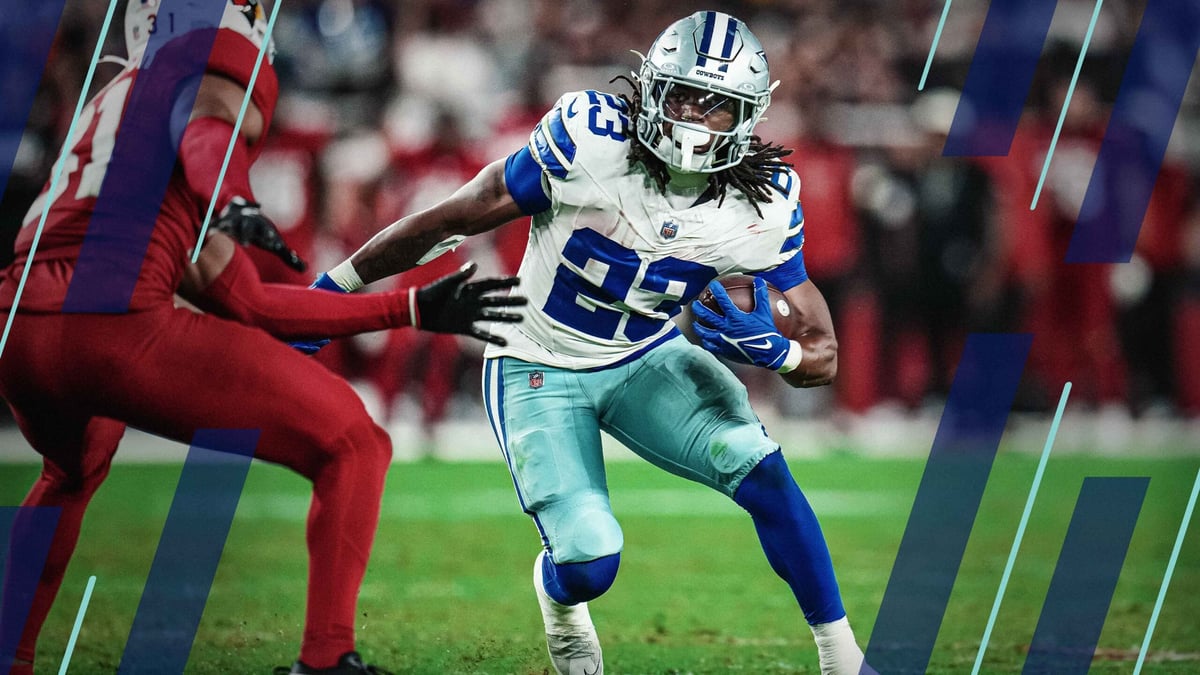
- RB Jaydon Blue, Dallas Cowboys: Blue is earning the coaching staff’s trust in his second NFL training camp.
- RB MarShawn Lloyd, Green Bay Packers: Lloyd spent the offseason rewiring his poor mechanics stemming from a 2020 knee injury.
- Get more from PFF+ for less: PFF+ is now $9.99 per month or $99.99 per year, with access to PFF+ content and tools, fantasy and betting resources, the Mock Draft Simulator and more — all at a new lower price.

The NFL’s recent run-heavy shift should allow more No. 2 running backs to generate standalone flex value this season. Backup running backs capable of such a feat ideally play in creatively designed, fantasy-friendly offenses and possess explosive dual-threat traits that allow them to maximize their limited touch counts.
The article below breaks down three backup running backs to target in 2026 fantasy football drafts.
RB Jaydon Blue, Dallas Cowboys
The Dallas Cowboys’ coaching staff continues to heap praise on second-year running back Blue, heralding the youngster for his substantially improved maturity, studiousness and on-field performance. Blue made headlines for all the wrong reasons last year and earned just a 56.9 PFF offense grade.
After watching “Blue [dominate] the first-half snaps” in Dallas’ preseason Week 1 game against the Seattle Seahawks, PFF’s Nathan Jahnke believes the usage “[suggests] the No. 2 job is his to lose.”
Blue (5-foot-9, 196 pounds) began the following practice week sidelined by a shoulder injury, which is worth tracking closely. Should the ailment be diagnosed as a minor issue, Blue can be treated as the Cowboys’ expected change-of-pace rusher and primary running back on passing downs.
As detailed in “How no-huddle trends shape 2026 fantasy football value,” Dallas should be considered the favorite to lead the league in offensive snaps per game, theoretically giving the No. 2 running back access to a larger-than-normal workload.
Blue, 22, was a tantalizing talent in college. Over his final two seasons at Texas in 2023-24, Blue averaged 0.28 missed tackles forced per rushing attempt and 3.6 yards after contact, contributing to his 82.1 PFF rushing grade.
His 58 targets in 2024 were the fourth-most among Power Four running backs that year. Blue produced a 25.3% target rate while averaging 1.59 yards per route run (YPRR) and 9.8 yards after the catch per reception, culminating in a 64.7 PFF receiving grade.
Blue is a candidate to deliver standalone flex value and RB2 viability if operating as a fill-in starter.
RB Keaton Mitchell, Los Angeles Chargers
Los Angeles Chargers running back Mitchell received starter treatment in the preseason opener, with the coaching staff choosing to rule the speedy player inactive for the team’s preseason Week 1 game against the Houston Texans. Although Mitchell, 24, has largely operated as a run-centric player in his NFL career, he should be expected to handle a change-of-pace rushing role while contributing meaningfully as a receiver.
Earlier this month, new Chargers offensive coordinator Mike McDaniel said Mitchell is “as dynamic as they come with the ball in his hands in space,” capable of creating “a matchup issue for every defense.” McDaniel added that Mitchell “has a lot of pass-game value that he hasn't been able to really represent in his career, but it's showing so far in camp.”
As explained in “Must-draft best-ball players in Rounds 11-15,” “Mitchell’s 13.5% explosive run play rate ranks ninth and his 5.0 yards per rushing attempt rank seventh” among 88 NFL running backs with at least 70 rushing attempts in 2024-25. He has notably “earned a 70.7 PFF receiving grade on eight screen pass targets over the past two seasons.
Expect Mitchell to thrive in McDaniel’s exceptionally fantasy-friendly offensive scheme. He profiles as a reliable flex starter with high-end upside.
RB MarShawn Lloyd, Green Bay Packers
Lloyd, the Green Bay Packers’ No. 2 running back, made it through spring practices fully healthy for the first time in his career after spending “multiple months” at the Meyer Institute of Sport correcting compensatory mechanics stemming from his 2020 ACL tear that put undue stress on his ankle and hip while weakening his quad.
Conversely, Packers starting running back Josh Jacobs has been rehabbing a groin strain while awaiting word on a potential suspension stemming from an offseason domestic violence arrest. Jacobs earned an 86.4 PFF offense grade last year while experiencing year-to-year drops in missed tackles forced per rushing attempt (0.24 to 0.19), yards after contact per rushing attempt (3.5 to 3.0), YPRR (1.44 to 1.22) and yards after the catch per reception (11.3 to 8.5).
Lloyd has logged just 22 offensive snaps since entering the NFL as a 2024 third-round pick due to a thigh contusion, two hamstring strains, a likely high-ankle sprain, an inguinal groin strain and a calf strain.
Lloyd fared well in preseason Week 1 play and is drawing positive reviews from teammates. Expect Lloyd to significantly improve on the 53.3 PFF offense grade he earned last year.
In his final 2023 season at USC, Lloyd generated an 80.8 PFF offense grade while averaging 0.4 missed tackles forced per rushing attempt, 4.0 yards after contact per rushing attempt, 1.22 YPRR and 16.3 yards after the catch per reception via 13 receptions.
Lloyd could return standalone flex value this season. If healthy and thrust into a starting role, he could warrant RB1 treatment.

 © 2026 PFF - all rights reserved.