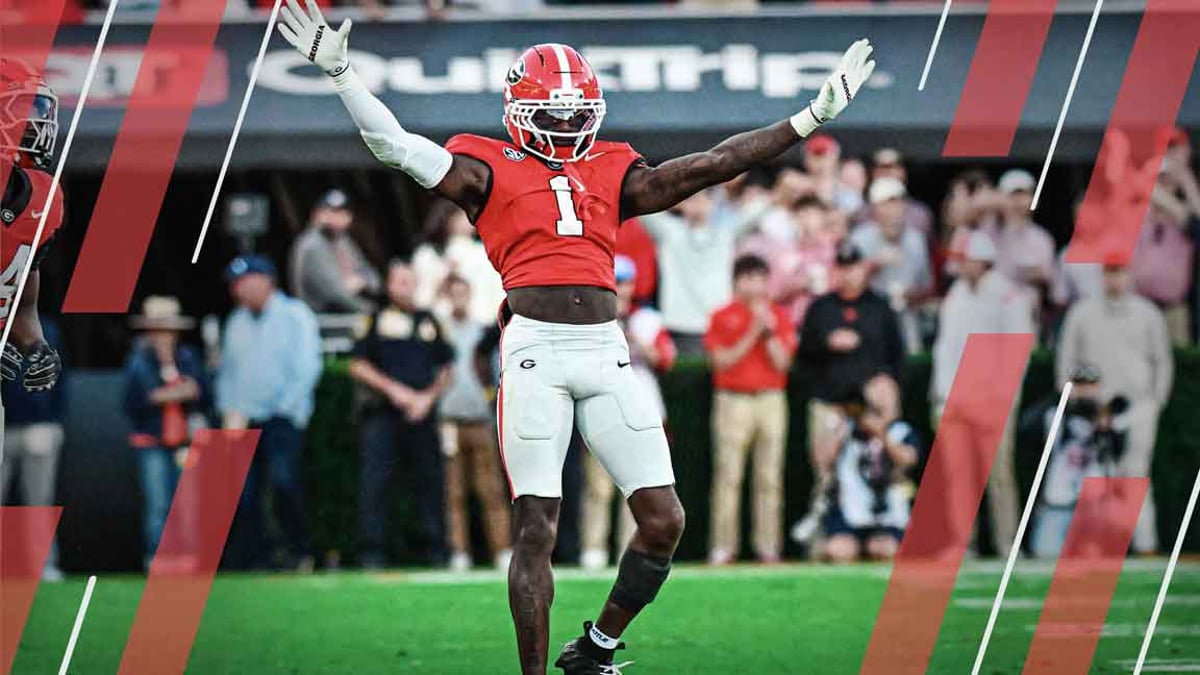
- Rising 2027 NFL Draft prospect: Georgia cornerback Ellis Robinson IV has climbed from 18th to sixth on PFF's big board and is projected as a first-round selection.
- Strong coverage skills and physicality: Robinson has allowed a 36.7% completion rate in man coverage and earned a 74.9 PFF run-defense grade as a freshman.
- Deep coverage and penalties remain concerns: Robinson has committed seven defensive pass interference penalties over the past two seasons, while 228 of his 490 career receiving yards allowed have come on deep throws.

Notre Dame cornerback Leonard Moore has long been established as the top cornerback prospect in the 2027 NFL Draft class, but several players are vying for the No. 2 spot in what is a fairly deep class at the position.
Multiple cornerbacks were selected in the top 10 in each NFL draft from 2022 to 2024. And given the premium value placed on the position across the league, it could well happen again in 2027, with Georgia’s Ellis Robinson IV perhaps the leading candidate to hear his name called after Moore.
Other prospects, including Mississippi State’s Kelly Jones and Clemson’s Ashton Hampton, have boosted their draft stock throughout the 2026 season, but so has Robinson, who began the year ranked 18th on PFF’s big board and has since climbed to sixth overall.
Ellis Robinson IV: Draft info
- Height: 6 feet
- Weight: 180 pounds
- Projected draft position: First round
- Best film: 2024
First and foremost, Ellis Robinson IV absolutely passes the pedigree test. He was the No. 2 overall recruit in the 2024 recruiting class. In high school, he was a two-year starter for an undefeated team at IMG Academy, which has sent more players to the NFL than any other high school over the past decade. From there, Robinson went to the school that has produced more defensive players selected in the NFL Draft than any other over the past seven years: the Georgia Bulldogs. So, his career trajectory has been about as seamless as it gets.
Robinson is still just a redshirt sophomore. If he wanted to, he could remain in Kirby Smart’s defense for another two years and enter the NFL draft in 2029. That possibility can't be entirely ruled out in the current era, when college athletes can earn more through NIL deals than they would on a rookie contract.
Regardless, Robinson will likely declare for the NFL draft, with multiple productive college seasons under his belt. His age is another attractive part of his scouting profile, as scouts see him as a natural athlete who can continue to improve throughout his early 20s.
Where Ellis Robinson IV excels
Listed at just 180 pounds, Robinson doesn’t look overly intimidating at first glance, but once you watch the film, you can see his style quickly resembles that of a hard-hitting strong safety. His tackles pack a punch, and Robinson is extremely willing to get involved against the run. His career missed-tackle rate sits around 10%, a more-than-respectable figure for a college cornerback and better than that of several other top prospects.
This is an area where he comfortably stands out above Notre Dame’s Leonard Moore. We noted how Moore’s lack of enthusiasm on rushing downs will be a problem for some NFL teams. Those teams will love how Robinson plays every down with the intention of making a stop. Robinson earned a 74.9 PFF run-defense grade as a freshman and has maintained that quality of play so far in 2026.
NFL franchises don’t draft cornerbacks in the first round to clean up on outside zone runs, though. Robinson is one of the best cover corners in college football, and his loose hips and quick feet set him apart from many other prospects in the class.
He’s an incredibly fluid mover, the kind of player who will stand out from the crowd in on-field drills at the scouting combine. Coaches who believe they can mold a player into an All-Pro-level cornerback as long as that prospect has the requisite athleticism will absolutely adore what Robinson brings to the table.
His naturally low center of gravity is reminiscent of former first-round draft pick Jaire Alexander. Like Alexander, Robinson isn’t the biggest or longest defensive back, but few can match his ability to turn and run with a wide receiver and stick to his man like glue through route breaks. Robinson is currently allowing a completion percentage of just 36.7% on targets in man coverage.
Despite his limited length, Robinson has managed to match up with bigger-bodied wide receivers throughout his career. In the SEC, he has frequently faced wideouts with three or four inches of height advantage. It hasn’t been a problem. Robinson is physical at the catch point and appears to have an outstanding vertical leap.
His positioning at the catch point is first-class. Robinson understands how disrupting a wide receiver’s leverage while the ball is in the air can throw off the rest of the catch process. While many cornerbacks focus exclusively on playing the ball at the catch point, Robinson isn’t afraid to force incompletions by playing the receiver to some extent. This, of course, comes at a price, which we’ll cover later.
All of this is not to say Robinson doesn’t play the ball. When the opportunity presents itself, he will absolutely snag an interception. As of mid-2026, he has five career interceptions and has let just one interception opportunity slip through his fingers. Robinson is a high-IQ player with a deep understanding of passing concepts and has used that knowledge to jump routes throughout his career. Quarterbacks have a passer rating of just 58.3 when throwing in Robinson’s direction.
Areas for improvement
Robinson is naturally a hands-on, grabby cover corner. As noted above, he tends to disrupt wide receivers through physical contact, which can lead to penalties. Robinson’s seven defensive pass interference penalties over the past two seasons are the most of any cornerback ranked inside PFF’s top 50.
Robinson can also fall victim to surrendering penalties or completions on underthrown deep balls. Because he focuses on playing the receiver, he is reluctant to turn his head early on downfield throws. In these situations, Robinson relies heavily on an accurate pass from the quarterback. When a pass is underthrown, the wide receiver’s adjustment can catch him off guard.
This exact sequence played out just last week against Auburn, when Robinson surrendered a deep touchdown because he didn’t turn his head to track the football. It’s perhaps unfair to call this an area for improvement. It’s simply how Robinson plays the game, and most of the time, his style is effective.
In general, deep routes are the closest thing Robinson has to kryptonite. While he has outstanding instincts to break on routes within 15 yards of the line of scrimmage, he can get beaten badly off the line and lacks the elite deep speed to recover.
Of the 490 receiving yards Robinson has allowed so far as a Bulldog, 228 have come on throws of 20 or more yards downfield. The same is true of three of the four touchdowns he has surrendered in his career. Robinson’s short-area agility is not in doubt — both the eye test and GPS data back that up — but some scouts will be curious to see how his long speed translates to the 40-yard dash.
Best team fits
It’s impossible to predict where Robinson’s draft stock will ultimately land. For now, it’s fair to suggest that any team with a first-round pick could be in play for his services.
The lowest-graded cornerback groups in the NFL currently belong to the Dallas Cowboys and Buffalo Bills. After addressing the secondary in Round 1 last year with Caleb Downs and then acquiring Joey Porter Jr. via trade, the Cowboys may look to address another area of need.
Every current Bills cornerback remains under contract for next season. The issue is that they simply aren’t playing very well. Buffalo will likely remain patient with second-round rookie Davison Igbinosun, but Robinson looks like a much more polished prospect overall.
The third-lowest-graded cornerback group belongs to the Las Vegas Raiders. This would be an interesting scheme fit for Robinson. Defensive coordinator Rob Leonard ranks in the top third of the league in man coverage usage, which suits Robinson’s experience in Kirby Smart’s defense.
Former Georgia cornerback Eric Stokes also played under Smart and has found a new lease on life in Las Vegas over the past couple of seasons. The Raiders could also find themselves in position in the draft to select the second cornerback off the board.
NFL outlook
There’s an awful lot to like about Ellis Robinson IV as a prospect. It’s difficult to find a cornerback who combines his natural athleticism with such a willingness to get physical. Teams will want to see him add a few pounds and get stronger for the next level, while also hoping to iron out some bad habits without losing the aggression that makes Robinson so effective.
NFL quarterbacks are considerably better at identifying when a cornerback has lost a step, particularly when they don’t have the Georgia defensive line bearing down on them. That pass rush has masked Robinson’s mistakes on a few occasions.
There’s a difference between a cornerback who gets beaten because he lacks the athleticism to compete and one who gets beaten because he’s overly aggressive. Robinson falls much closer to the latter category, and NFL scouting departments have shown in the past that they are willing to live with that.
Ultimately, Robinson has the makings of a very good NFL cornerback, and potentially a great one. He’s not quite the complete lockdown corner that Leonard Moore appears to be, but there’s a legitimate argument that Robinson has an equally high ceiling.
Georgia has made a habit of producing defensive talent that translates seamlessly to the NFL. Robinson looks well-positioned to continue that tradition.

 © 2026 PFF - all rights reserved.