
- The Packers defense has dealt with key injuries along the defensive line: Lukas Van Ness and now Devonte Wyatt are both expected to miss extended time. In recent weeks, Green Bay has also struggled against the pass in every game that didn’t involve J.J. McCarthy.
- Green Bay’s defense relies heavily on generating quick pressure and converting it into sacks: The Packers are converting pressure to sacks at a top-10 rate and doing so faster than average, but Caleb Williams’ ability to escape, extend plays and avoid negative outcomes gives Chicago a counter to one of Green Bay’s primary defensive strengths.
- Get PFF+ for 30% off: Use promo code HOLIDAY30 to unlock the PFF Player Prop Tool, Premium Stats, fantasy dashboards, the PFF Mock Draft Simulator, industry-leading fantasy rankings and much more — everything you need to win your season.

Many NFL bettors start by looking at individual markets — like spreads, totals, teasers or props — and ask, “Which spread looks good?” or “What totals stand out this week?” This is a bottom-up approach, focusing on specific bets first.
In this space, we’ll take a different approach. We’ll focus on one game each week and use a top-down strategy to break it down. This means starting with the bigger picture — how teams, players or trends are performing — and then finding the best ways to apply that information to different betting markets.
While some of our bets may focus on traditional markets, like spreads or totals, we’ll often explore other opportunities to maximize value.
Chicago Bears moneyline
Let us begin by examining the team fundamentals to establish a baseline for our analysis.
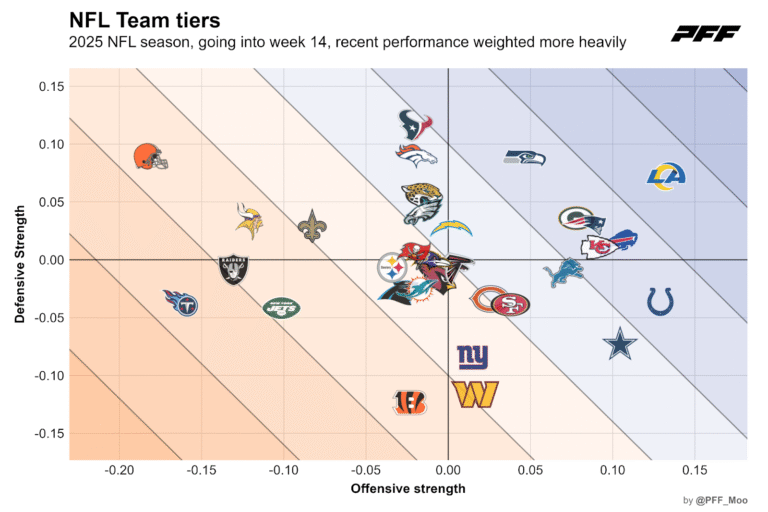
The Green Bay Packers have a clear edge over the Chicago Bears on both offense and defense, with a full tier separating these two teams.
Chicago profiles as an above-average offense with a below-average defense, while Green Bay grades out as solid on both sides of the ball. But with the market implying a 6.5-point spread, it suggests an even wider gap, and a look at Inpredictable supports that — ranking the Packers as the NFL’s fourth-best team with the third-best defense, and the Bears 18th overall with the 14th-best offense and 23rd-ranked defense.
While those season-long rankings justify the 6.5-point spread on paper, factoring in where these teams are right now — and how their strengths and weaknesses match up — shows there may be value on the Bears.
The Packers defense has dealt with key injuries along the defensive line, with Lukas Van Ness and now Devonte Wyatt both expected to miss extended time. In recent weeks, Green Bay has also struggled against the pass in every game that didn’t involve J.J. McCarthy.
While they held the Vikings to -0.7 EPA per play, their other four opponents in this stretch posted dropback EPA marks of 0.08 (Panthers), 0.16 (Eagles), 0.19 (Giants) and 0.31 (Lions), along with yards-per-attempt numbers that would place the Packers among the league’s bottom five pass defenses. None of those opponents profiles as an elite passing attack, yet each found consistent success through the air.
On the ground, Green Bay has remained a top-10 defense in rush EPA both on the season and in recent weeks, but this matchup is different. The Bears offense has not produced a single below-average rushing performance since Week 4, and that consistency has powered Chicago to third in EPA and fifth in success rate over the last six weeks. Given how dominant this run game has been, the current market may be undervaluing the Bears in their present form.
On the defensive side of the ball, the Bears are finally getting healthy. Jaylon Johnson and Kyler Gordon returned to what had been a depleted secondary, and linebacker T.J. Edwards is set to come back as well. With this unit previously allowing the ninth-highest rate of perfect coverage and the tenth-lowest disruption rate, getting those players back should lead to improvement across the board. Taken together, a healthy defense and a dominant run game make Chicago look far stronger in its current form than its season-long averages would suggest — and that creates some value at the current market price.
Diving into the matchup, we’ve already covered how Chicago’s run game holds a clear edge here, but there are reasons to like the Bears in the passing game as well.
Green Bay’s defense relies heavily on generating quick pressure and converting it into sacks, an area where Caleb Williams has shown he can mitigate damage. The Packers are converting pressure to sacks at a top-10 rate and doing so faster than average, but Williams’ ability to escape, extend plays and avoid negative outcomes gives Chicago a counter to one of Green Bay’s primary defensive strengths.
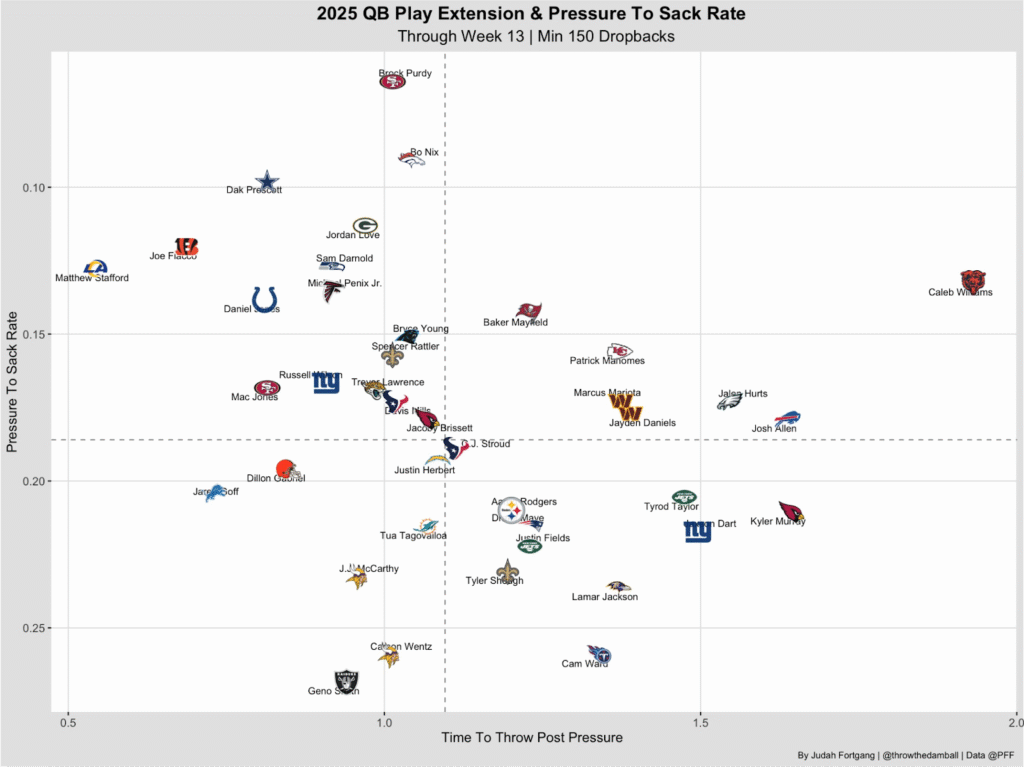
Williams has been the best quarterback in the NFL at extending plays once pressure arrives while also avoiding sacks at a top-tier rate. That skill set directly counters a Packers defense that ranks top 10 in quick pressure and pressure-to-sack conversion, giving Williams the ability to escape and keep Chicago on schedule. Staying ahead of the chains, paired with the Bears’ dominant run game, should give this offense a high floor and a real chance to take advantage of an overrated Packers defense.

 © 2026 PFF - all rights reserved.