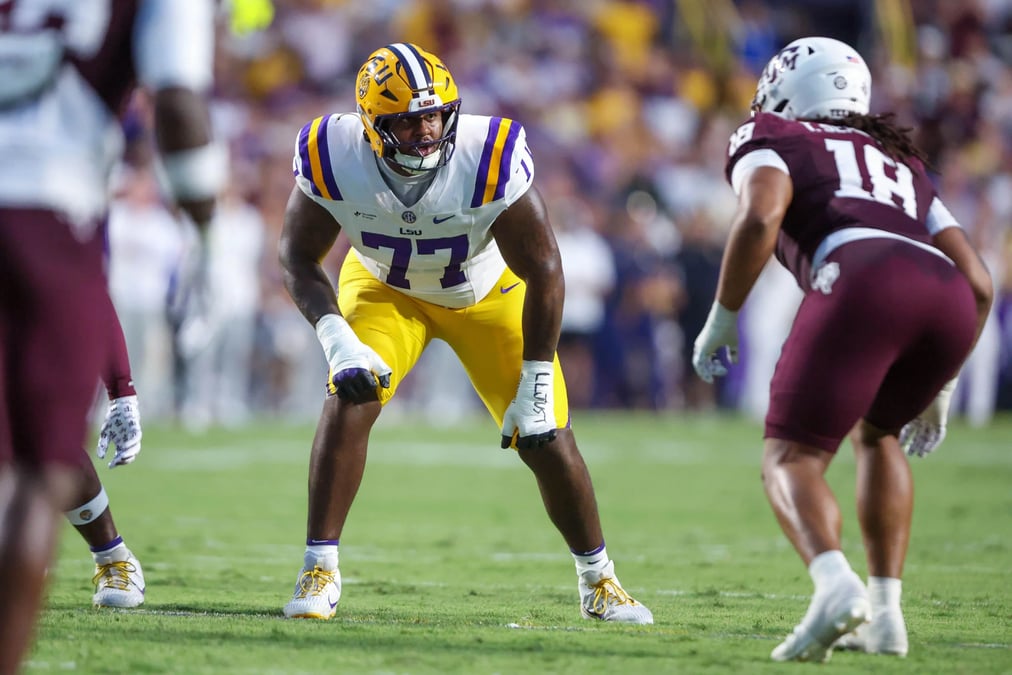
- Jordan Seaton has the makeup of a franchise tackle: Seaton's frame, athleticism and bevy of experience make him a tantalizing prospect.
- Continued work in the run game: While Seaton can reach impressive blocks, he can improve sustaining them downfield.
- A possible addition in Houston: Teams like the Texans could covet Seaton as a long-term protection answer.

Offer valid for new subscribers on annual plans only
Jordan Seaton has been viewed as a future NFL offensive tackle since before he arrived in college football. He was the top-ranked offensive tackle in the 2024 recruiting class and immediately became the starting left tackle at Colorado, taking on one of the most difficult positions on the field as a true freshman.
His development continued during his second season. Seaton earned second-team All-Big 12 honors despite missing Colorado’s final three games due to injury, showing considerable improvement as a pass protector before entering the transfer portal.
A move to LSU has given Seaton the opportunity to test himself against SEC defensive fronts. He has remained the starting left tackle and become one of the Tigers’ most important players, including being named a team captain. His physical talent has always been evident, but his growing experience has helped turn him into one of the top offensive tackles eligible for the 2027 NFL Draft.
Jordan Seaton: Draft info
Height: 6-foot-5
Weight: 311 pounds
Expected draft position: Top 15
Best film: 2026 Week 4 vs. Texas A&M
Seaton grew up in Washington, D.C. and will therefore be a hometown prospect at the 2027 NFL Draft. He transferred to IMG Academy for his senior year of high school and helped the program finish undefeated. His combination of size and athleticism was apparent from the outset of his playing career and made him a consensus five-star recruit as well as the unanimous top offensive tackle in his class.
His freshman season at Colorado was about as good as could be expected. Freshmen being handed the starting role at offensive tackle is not typical in college football, and the outcome isn’t always pretty. Seaton set a program record for starts by a true freshman en route to earning Freshman All-American honours. He allowed just three sacks all year on an extremely pass-heavy Colorado offense featuring Shedeur Sanders and Travis Hunter.
Seaton really grew into future first-round conversations in Colorado’s first nine games of 2025 before an injury ended his season. He let up two sacks and only seven pressures across those appearances, including a six game streak without a pressure in conference play. Seaton was unsurprisingly the top-rated offensive tackle available in the portal over last offseason.
Where Jordan Seaton excels
Seaton’s athleticism immediately stands out above the rest of the top offensive linemen in this class. He moves laterally in comfortable fashion and has the range to meet speed rushers before they can threaten him outside. His feet remain active throughout the rep, allowing him to mirror changes of direction without having to lunge at the defender irrationally.
His movement ability allows him considerable margin for error elsewhere. He can recover when his initial positioning is beaten and possesses the lateral quickness to close inside counter-rushing lanes. Few offensive tackles can lose the first stage of a rep and still prevent the defender from reaching the quarterback as often as Seaton does.
He is comfortable varying his approach in pass protection and adjusting to different styles of pass-rushers. Seaton typically remains patient and waits for the defender to reveal his plan, rather than immediately attempting an early punch which can be countered. He’s able to disrupt the rusher’s timing and latches on like a seatbelt when first contact is made. In his first 10 starts for LSU, Seaton has permitted just one sack and one other quarterback hit.
Seaton processes movement well. He has experience passing off rushers against stunts and has quickly built chemistry with the rest of LSU’s offensive line. His balance allows him to change assignments without losing his base.
Seaton adds value in the running game, particularly when he is asked to block in open space. He can reach defenders who are shaded outside him and has the awareness to cut off backside pursuit on runs to the opposite side. He moves smoothly to the second level and can adjust his path to account for linebackers changing direction.
Seaton can generate pushback with his initial contact and has the raw strength to turn defenders away from the play. His lighter playing weight at LSU appears to have improved his mobility without completely removing his skill holding up against power.
Areas for improvement
Seaton needs to become a more consistent run-blocker overall; while useful, his current ability in the run game is not befitting of a top-10 draft pick. His athleticism puts him in position to make difficult blocks, but he does not always sustain them at the point of attack. Defenders can wriggle free despite the size disadvantage.
Seaton’s pad level can occasionally be too upright after making contact, limiting the amount of power he can generate from his lower body. That makes it more difficult for Seaton to create vertical movement against heavier defensive linemen to really generate interior push. This was particularly apparent against the Ole Miss defensive front, which crowded out every run in Seaton’s direction. He finished that game with a rough 39.9 PFF run-blocking grade.
There are no huge issues in Seaton’s pass protection, but he has occasionally overset against smaller speed rushers in the past and opened an inside lane for the edge defender. As noted above, in many cases, his recovery ability can save the rep. But one would imagine this won’t be as easy against better-equipped NFL edge defenders.
Seaton has already played a significant amount of football, although he remains a relatively young prospect. His technique can fluctuate within games, particularly when defenders force him to deal with different rush plans. More consistency should allow his physical talent to dictate matchups from the opening snap.
Best team fits
Houston Texans: For as long as C.J. Stroud is in town, the Texans will take a pass-first approach to offensive football. The Texans are missing the level of consistency Laremy Tunsil once provided at offensive tackle. Seaton’s comfortability managing 50-to-60 dropbacks per game is reminiscent of Tunsil in his prime.
Philadelphia Eagles: The Eagles like to address high-value positions in the first round of the draft. Having lost the beating heart of their offensive line over the last few months, Seaton makes sense to usher in a new era of physicality for a team that has seemingly always been strong in the trenches.
Green Bay Packers: Something tells me the Packers might finally opt for a more bruising run-blocker when they address the offensive line this offseason to kickstart their rushing attack once again. However, if they feel their electric passing offense is all that’s needed to open a Super Bowl window, then Seaton fits the profile. Green Bay has always coveted players in Seaton’s mold, such as David Bakhtiari and Zach Bako-Bewele.
NFL outlook
Seaton has the athletic makeup teams look for in a franchise left tackle. His profile eliminates any question of a move to guard in the NFL, while his reps against high-level competition should prepare him to contribute immediately. Experience is a huge factor working in his favor. Seaton is now up over 2,000 collegiate snaps and is on pace for his third straight season with a PFF pass-blocking grade above 75.0.
The biggest question will be his development in the running game. Seaton can reach the second level and make blocks in space, but he must become more consistent with his leverage at the line of scrimmage against bigger bodies. Adding functional strength is still possible and will help him handle power more reliably without sacrificing his movement skills.
Seaton projects as an immediate starter with the upside to become one of the best pass-protecting tackles in the league. He is not a finished prospect, but the areas that need improvement are outweighed by the traits he already brings to the table. If his technique continues to progress, he has the potential to become a long-term left tackle and one of the first players selected in the 2027 NFL Draft.

 © 2026 PFF - all rights reserved.