- Subscribe today: Unlock the First Touchdown Finder, PFF Player Prop Tool, AI-driven betting insights and premium tools including Premium Stats 2.0 and the Mock Draft Simulator.

Last year, I introduced a new framework for understanding wide receiver play, quarterback decision-making and offensive potential. This framework relies on an XGBOOST model and PFF’s impressive collection of route-level data. Using machine learning and this breadth of PFF data, we can create models with the goal of predicting where a target should go on a given play.
The resulting metrics, Share of Predicted Targets and Share of Predicted Air Yards, are both more stable than their “actual” counterparts.
Conference Championship Recap
- Jaxon Smith-Njigba: 12 targets, 35.29% target share
- Davante Adams: 6 targets, 17.65% target share
- Jordan Whittington: 0 targets, 0% target share
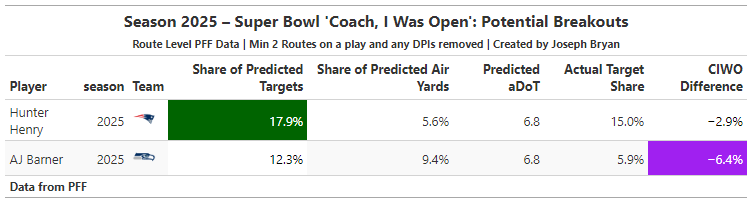
Potential Breakouts: Super Bowl 60
These players were open far more often than they were targeted in the conference championship round. Note: Hunter Henry’s CIWO difference is −2.9%. That would not usually clear the threshold during the regular season, but it’s the largest gap on the Patriots, so he’s included here.
Historically, players who make this list see an uptick in targets per route run and target share relative to both themselves and peers with similar usage.
TE A.J. Barner, Seattle Seahawks
Per PFF Key Insights, Barner is targeted at the fourth-highest rate among tight ends when the defense generates pressure. The Patriots net pressure at the sixth-highest rate in the NFL. This is a great situation for Barner to earn more targets than usual.
TE Hunter Henry, New England Patriots
Per PFF Key Insights, Henry owns the fourth-best PFF receiving grade among tight ends against zone coverage. The Seahawks play zone at the fourth-highest rate and have been a consistent tight end target funnel this season. Seattle has allowed the second-most targets to the position with the 12th-worst team PFF coverage grade against tight ends.
The Year of EPA Efficiency
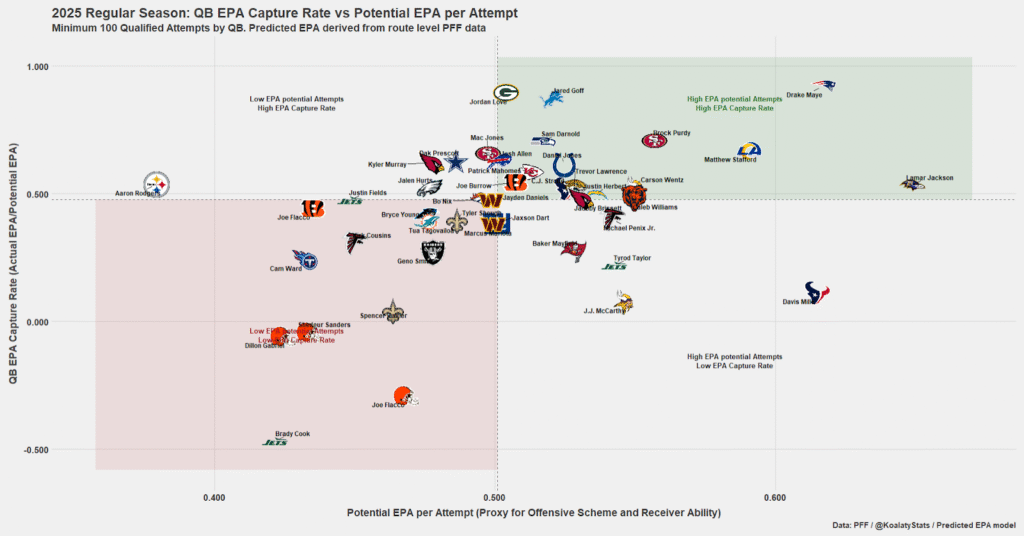
This graph depicts the 2025 regular season Potential EPA per Attempt and the Quarterbacks’ EPA Capture Rate. I have discussed both of these metrics in the past, but as a quick refresher:
Potential EPA per attempt is the result of the sum of maximum predicted EPA on every route. Effectively, this is a proxy for receiver skill and offensive playcalling that maximizes EPA.
EPA capture rate is a quarterback’s actual EPA divided by his potential EPA. This measures how well the quarterback operates the system and leverages available talent.
Drake Maye finished the season with the highest EPA capture in the NFL for 2025. In fact, when looking back to 2019, Maye concluded with the best EPA capture rate throughout my entire dataset.
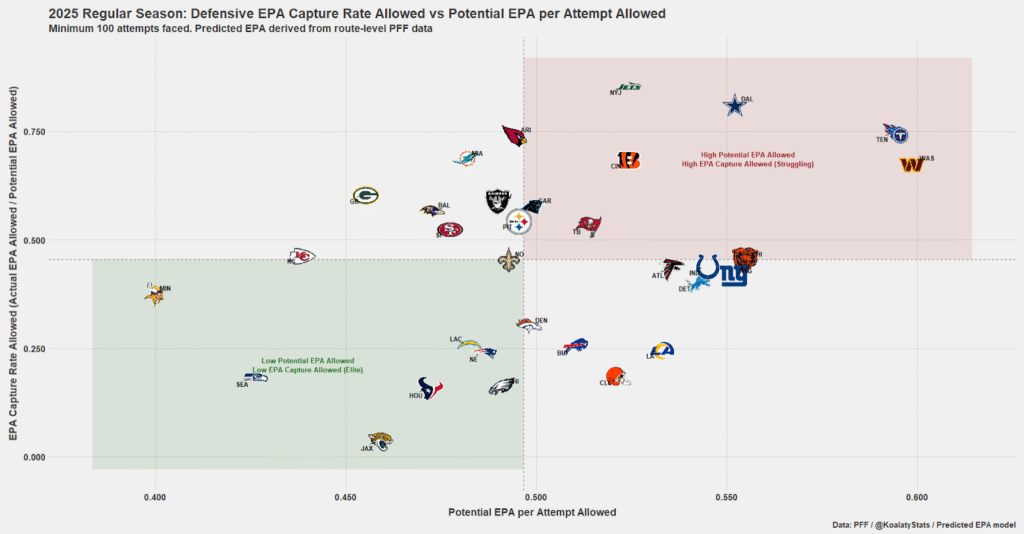
The Seahawks’ defense was also very successful in the 2025 season at preventing EPA from being captured, as well as lowering the opposing offenses’ potential. By season’s end, the Seahawks had the best linear combination of reducing their opponent’s potential EPA per attempt and limiting their opponents’ ability to capture EPA. This results in an extremely effective defense and one that can suppress most offenses in the league.
It’s fitting that the league’s most efficient quarterback and the most suppressive defense meet in the Super Bowl.
Conference Championship “Coach, I Was Open’ Review”
WR Jaxon Smith-Njigba, Seattle Seahawks
As noted before, the “Coach, I Was Open” effect can show up game-to-game, but it can also happen within a game on a play-to-play basis. With 30 seconds left in the half and down 3, the Seahawks needed a touchdown to keep up with one of the league’s best offenses. It was first-and-14, and the Los Angeles Rams were in match coverage.
After motion, safety Quentin Lake ended up covering Jaxon Smith-Njigba, which is a dream matchup for the Seahawks.
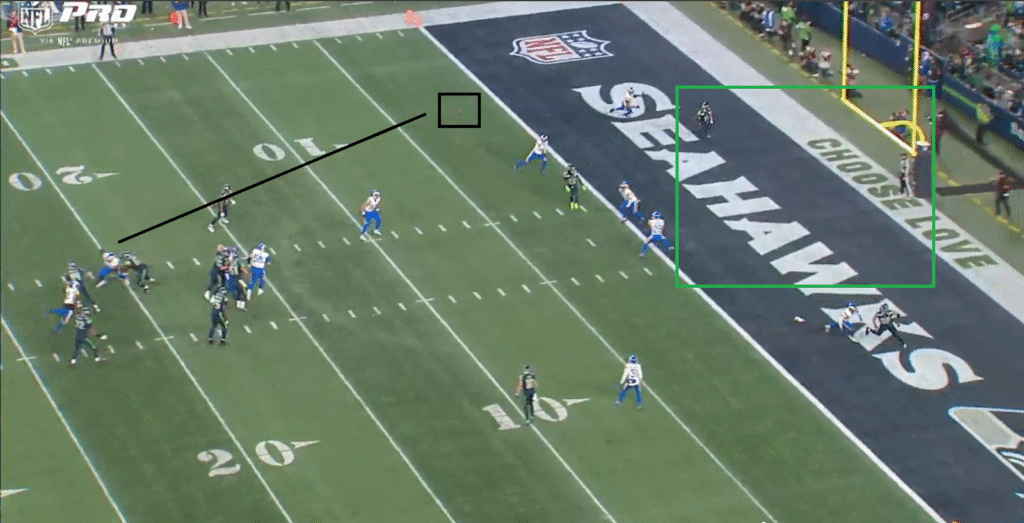
As the play unfolds, Smith-Njigba earned three-to-five yards of clear separation. Sam Darnold threw with great anticipation, and the execution could not be better — except for an overthrow.
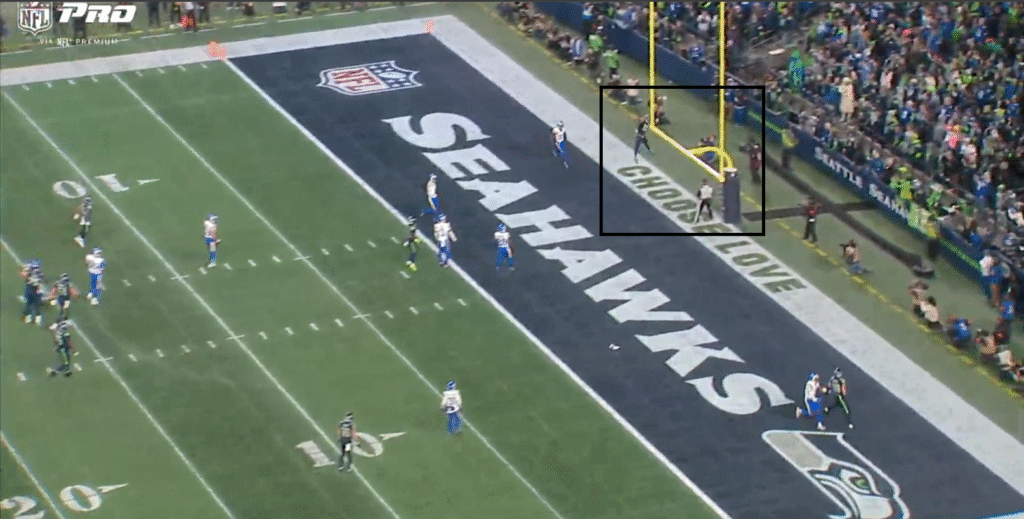
Smith-Njigba secured the ball near the goal post but could not complete the catch inbounds.
Offensive coordinator Klint Kubiak took note of this and called up another touchdown shot for him the very next play. The Rams continued to play match coverage after a motion from the Seahawks. This gave Smith-Njigba an even better matchup against linebacker Nate Landman.
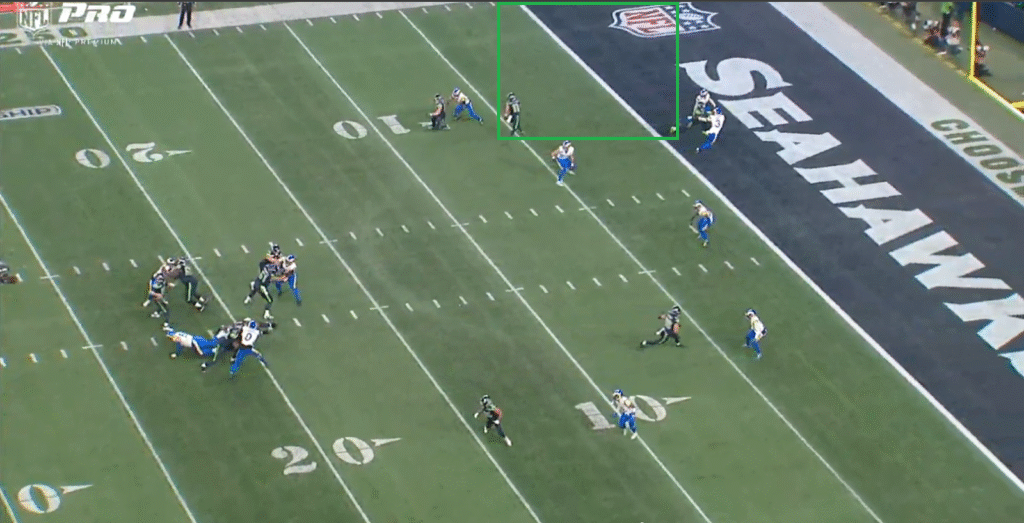
Smith-Njigba ran his route so well on this play that Landman began to run inside. When looking at the screenshot, it doesn’t even appear as though someone is covering the receiver.
This recognition from Kubiak that the Rams might stay in match coverage, and that Smith-Njigba was wide open on the previous play after a motion, is a huge reason this particular call worked. This gave the Seahawks a 4-point lead at the time, and ultimately advanced them to the Super Bowl with a 4-point victory over the Rams.

 © 2026 PFF - all rights reserved.