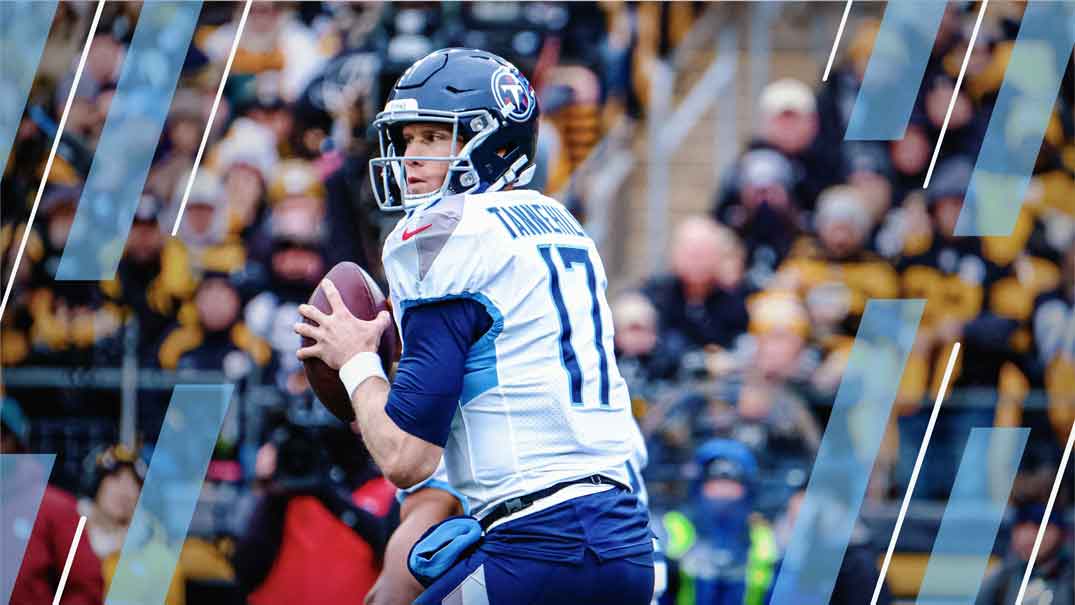
- The Titans' 2019-20 offensive resurgence dominates the roster: Ryan Tannehill, Derrick Henry and A.J. Brown headline a group that helped produce Tennessee's only two top-10 scoring offenses of the PFF era.
- Michael Roos narrowly edged Taylor Lewan for left tackle honors: Similar pass-blocking performance combined with Roos' stronger run blocking gave Roos the franchise's top tackle spot.
- Tennessee's defensive stars emerged across multiple eras: Jeffery Simmons, Jurrell Casey, Kevin Byard III and Keith Bulluck represent standout units that powered several top-five defenses over the past two decades.

As part of PFF's celebration of 20 years of NFL data, we're building an All-Star team for every franchise, highlighting the best players at each position from the PFF era. This installment turns to the Tennessee Titans.
PFF's database dates back to the 2006 NFL season, providing a unique lens for evaluating and comparing players across eras. More details on the methodology used to construct these teams are available at the bottom of the page.
Offense
- QB: Ryan Tannehill (2019-2023)
- HB: Derrick Henry (2016-2023)
- WR: A.J. Brown (2019-2021)
- WR: Nate Washington (2009-2014)
- Slot WR: Corey Davis (2017-2020)
- TE: Delanie Walker (2013-2019)
- TE: Bo Scaife (2006-2010)
- LT: Michael Roos (2006-2014)
- LG: Rodger Saffold (2019-2021)
- C: Ben Jones (2016-2022)
- RG: Jake Scott (2008-2011)
- RT: David Stewart (2006-2013)
The Titans offense posted two top-10 finishes over the last 20 years, in 2019 and 2020, and those offenses are well represented with seven of the 12 players, including quarterback Ryan Tannehill, running back Derrick Henry and wide receiver A.J. Brown.
While the offense wasn’t as strong in the early years of the PFF era, Tennessee still fielded a strong run game with Chris Johnson and their offensive line. The rest of the players on this team are from that era, largely from their ability to help the run game.
Unsurprisingly, the most competitive positions were at the offensive line, often between someone who blocked for Henry and someone who blocked for Johnson. The biggest battle was at left tackle between Michael Roos and Taylor Lewan. Both played over 6,000 snaps with Tennessee, and the third most was at 1,089. The two graded similarly in pass protection, but Roos’ run blocking put him above Lewan. Right tackle was more competitive, with Jake Scott, Nate Davis and Chance Warmack all over 3,000 snaps, but Scott graded the best and had the most snaps from the group.
Defense
- DI: Jeffery Simmons (2019-2025)
- DI: Jurrell Casey (2011-2019)
- ED: Derrick Morgan (2010-2018)
- ED: Brian Orakpo (2015-2018)
- LB: Wesley Woodyard (2014-2019)
- LB: Jayon Brown (2017-2021)
- SLB: Keith Bulluck (2006-2009)
- CB: Jason McCourty (2009-2016)
- CB: Alterraun Verner (2010-2013)
- Slot CB: Cortland Finnegan (2006-2011)
- S: Kevin Byard III (2016-2023)
- S: Michael Griffin (2007-2015)
The Titans' defense has had several ups and downs over the past 20 years, going from a top-five defense to a bottom-five defense and back multiple times. Particular units on the defense peaked at different times: four of the five defensive backs played together in 2010-2011, three of the four defensive linemen played together from 2015-2018, and two of the linebackers played together in 2017-2019.
The one contentious position was linebacker. Seven different linebackers have played at least 2,500 snaps with the Titans, and five of them have earned at least a 65.0 grade. Wesley Woodyard and Keith Bulluck played notably more snaps than the other three, helping them to two of the linebacker spots, while Jayon Brown was the best remaining coverage linebacker.

Methodology
Selections were based on normalized PFF grades adjusted by season. To balance peak performance and longevity, only a player's five best seasons with a franchise from 2006-25 were considered. Any season with an overall PFF grade below 60.0 was excluded, ensuring that strong years helped a player's case while weaker seasons were not held against him. Postseason play was included, though all seasons were capped at a 16-game equivalent to maintain consistency across eras. At each position, the player with the highest score under this methodology earned the spot.
Each team consists of 12 offensive and 12 defensive players. Because 11 personnel and nickel defense were the league's most common alignments over the past two decades, those personnel groupings served as the foundation for every roster. Teams received either a second tight end or a fullback, depending on whether they used more 12- or 21-personnel. Defensively, teams received either a third interior defender or a third linebacker depending on whether they primarily operated from a 3-4 or 4-3 front.
Players who logged significant snaps at multiple positions during their tenure with a franchise were eligible at either spot. In most cases, those players were assigned to the position where they provided the greatest value, though their versatility occasionally influenced the final roster construction.
Unlike some All-Pro teams that group offensive linemen by position type, these rosters were built according to where players actually lined up. If a team's two best tackles both played exclusively on the left side, only the top left tackle was selected. One of the three wide receivers and one of the five defensive backs was also required to have significant slot experience. In a 4-3 defense, one linebacker needed experience at the Sam linebacker position, while in a 3-4 defense, one defensive tackle needed experience at nose tackle.
When multiple players are listed at the same position, the first name represents the top selection. Players designated as slot wide receiver, slot cornerback, nose tackle or Sam linebacker were selected specifically for those roles rather than as the third-best player within their broader position group.

 © 2026 PFF - all rights reserved.