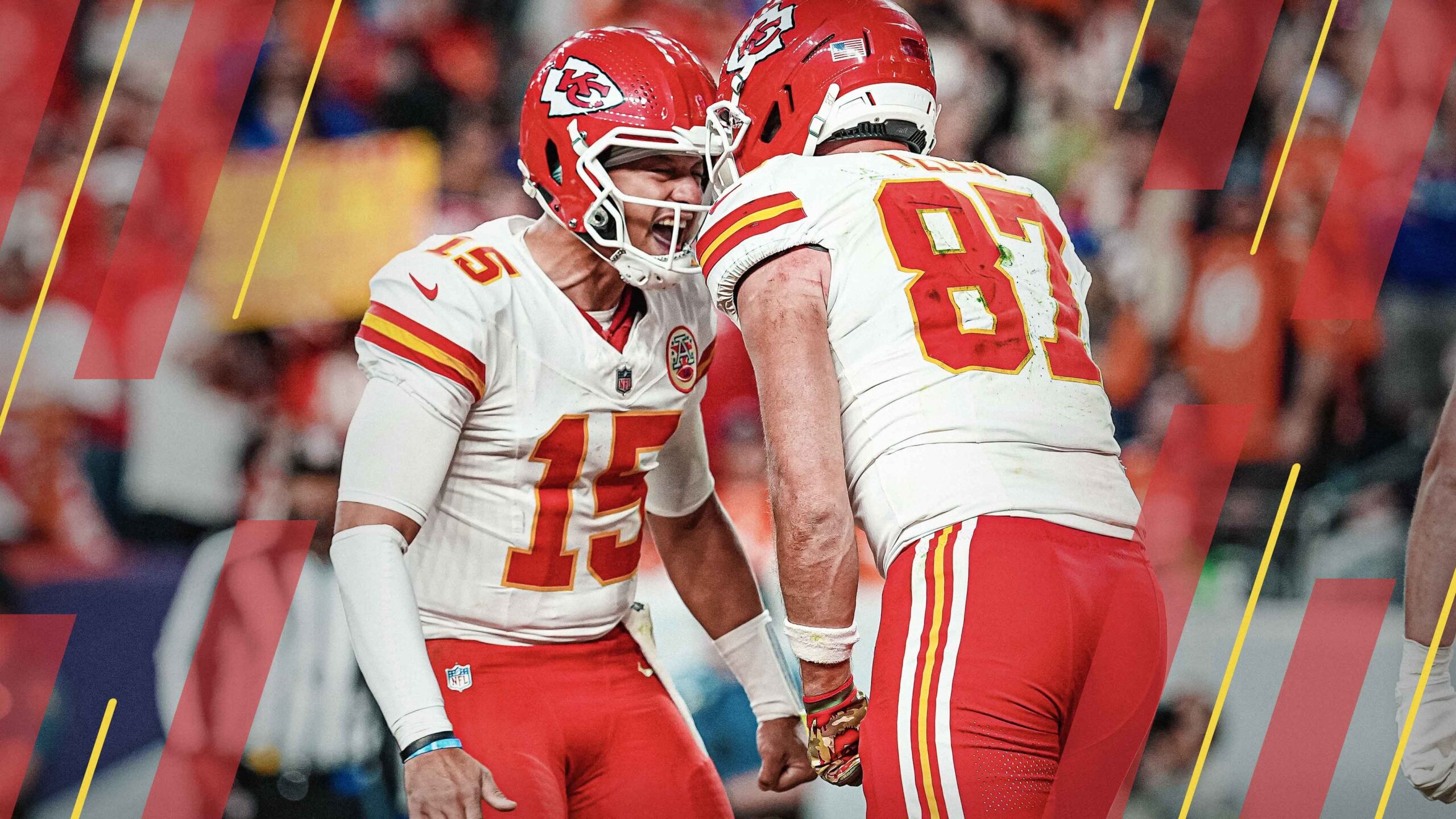
- Patrick Mahomes leads an offense built around a modern dynasty: The Chiefs' run of top-six scoring offenses from 2017-22 produced the core of the roster, including Mahomes, Travis Kelce, Tyreek Hill and a dominant offensive line.
- Kansas City boasts two Hall of Fame-caliber tight ends: Travis Kelce and Tony Gonzalez earned spots on the same roster, giving the Chiefs one of the most accomplished tight end pairings in the series.
- The defense is anchored by stars from both the pre- and post-Mahomes eras: Chris Jones joins franchise defensive pillars Justin Houston, Tamba Hali, Derrick Johnson and Eric Berry to form the foundation of the unit.

As part of PFF's celebration of 20 years of NFL data, we're building an All-Star team for every franchise, highlighting the best players at each position from the PFF era. This installment turns to the Kansas City Chiefs.
PFF's database dates back to the 2006 NFL season, providing a unique lens for evaluating and comparing players across eras. More details on the methodology used to construct these teams are available at the bottom of the page.
Offense
- QB: Patrick Mahomes (2017-2025)
- HB: Jamaal Charles (2008-2016)
- WR: Tyreek Hill (2016-2021)
- WR: Dwayne Bowe (2007-2014)
- Slot WR: Rashee Rice (2023-2025)
- TE: Travis Kelce (2014-2025)
- TE: Tony Gonzalez (2006-2008)
- LT: Eric Fisher (2013-2020)
- LG: Joe Thuney (2021-2024)
- C: Creed Humphrey (2021-2025)
- RG: Trey Smith (2021-2025)
- RT: Mitchell Schwartz (2016-2020)
The Chiefs won three Super Bowls during the PFF era, trailing only the New England Patriots. Kansas City also ranked among the league's top six offenses in points scored every season from 2017-22, so it is no surprise that most of the offensive selections come from that period.
This may be the only franchise team to feature two Hall of Fame-caliber tight ends. Tony Gonzalez has already secured his place in Canton, while Travis Kelce is all but certain to join him once he becomes eligible. The roster also includes Tyreek Hill, who spent much of the past decade among the NFL's premier wide receivers.
The offensive line tells the story of two distinct championship cores. Eric Fisher and Mitchell Schwartz anchored the tackle positions during Kansas City's first Super Bowl run of the Patrick Mahomes era before both were released on the same day in March 2021. The Chiefs quickly rebuilt around a new foundation, signing Joe Thuney the following week and drafting Creed Humphrey and Trey Smith one month later. That trio started together for four seasons and forms the interior of the All-PFF Chiefs offensive line.
Defense
- DI: Chris Jones (2016-2025)
- DI: Mike Devito (2013-2015)
- NT: Dontari Poe (2012-2016)
- ED: Justin Houston (2011-2018)
- ED: Tamba Hali (2006-2017)
- LB: Derrick Johnson (2006-2017)
- LB: Nick Bolton (2021-2025)
- CB: Brandon Flowers (2008-2013)
- CB: Brandon Carr (2008-2011)
- Slot CB: Trent McDuffie (2022-2025)
- S: Eric Berry (2010-2018)
- S: Tyrann Mathieu (2019-2021)
The foundation of this defense was built during Andy Reid's early years in Kansas City, before the arrival of Patrick Mahomes. From 2013-16, the Chiefs finished with a top-seven scoring defense in four straight seasons, including a second-place finish at their peak. Chris Jones is the headliner from Kansas City's Super Bowl era, but many of the defense's other cornerstones came from that earlier stretch. Justin Houston, Tamba Hali, Derrick Johnson, Brandon Flowers and Eric Berry all rank among the franchise's top defenders under this methodology.
While Kansas City's championship teams produced several standout defenders, few remained with the organization long enough to build a strong case for this roster. As a result, many of the final spots featured razor-thin margins. Brandon Carr ultimately earned a cornerback spot over Sean Smith and L'Jarius Sneed. All three logged more than 3,000 snaps in Kansas City and performed at the level of solid starters, but Carr's longevity gave him the edge.
Defensive tackle was one of the thinnest positions on the roster outside of Jones. The Chiefs invested heavily at other spots on defense during the early years of the PFF era and had little reason to prioritize a second interior defender once Jones emerged as a perennial All-Pro. No defensive tackle besides Jones recorded both more than 1,000 snaps and a PFF grade above 67.0. Dontari Poe earned a spot based largely on playing time, ranking second behind Jones in snaps, while Mike DeVito's strong grading profile — including the best run-defense grade among the candidates — secured the final selection.

Methodology
Selections were based on normalized PFF grades adjusted by season. To balance peak performance and longevity, only a player's five best seasons with a franchise from 2006-25 were considered. Any season with an overall PFF grade below 60.0 was excluded, ensuring that strong years helped a player's case while weaker seasons were not held against him. Postseason play was included, though all seasons were capped at a 16-game equivalent to maintain consistency across eras. At each position, the player with the highest score under this methodology earned the spot.
Each team consists of 12 offensive and 12 defensive players. Because 11 personnel and nickel defense were the league's most common alignments over the past two decades, those personnel groupings served as the foundation for every roster. Teams received either a second tight end or a fullback, depending on whether they used more 12- or 21-personnel. Defensively, teams received either a third interior defender or a third linebacker depending on whether they primarily operated from a 3-4 or 4-3 front.
Players who logged significant snaps at multiple positions during their tenure with a franchise were eligible at either spot. In most cases, those players were assigned to the position where they provided the greatest value, though their versatility occasionally influenced the final roster construction.
Unlike some All-Pro teams that group offensive linemen by position type, these rosters were built according to where players actually lined up. If a team's two best tackles both played exclusively on the left side, only the top left tackle was selected. One of the three wide receivers and one of the five defensive backs was also required to have significant slot experience. In a 4-3 defense, one linebacker needed experience at the Sam linebacker position, while in a 3-4 defense, one defensive tackle needed experience at nose tackle.
When multiple players are listed at the same position, the first name represents the top selection. Players designated as slot wide receiver, slot cornerback, nose tackle or Sam linebacker were selected specifically for those roles rather than as the third-best player within their broader position group.


 © 2026 PFF - all rights reserved.