- Brian Urlacher leads the Chicago Bears defense: The Hall of Fame linebacker led one of the top defenses in the league. He and several of his teammates made the All-PFF Bears’ defense.
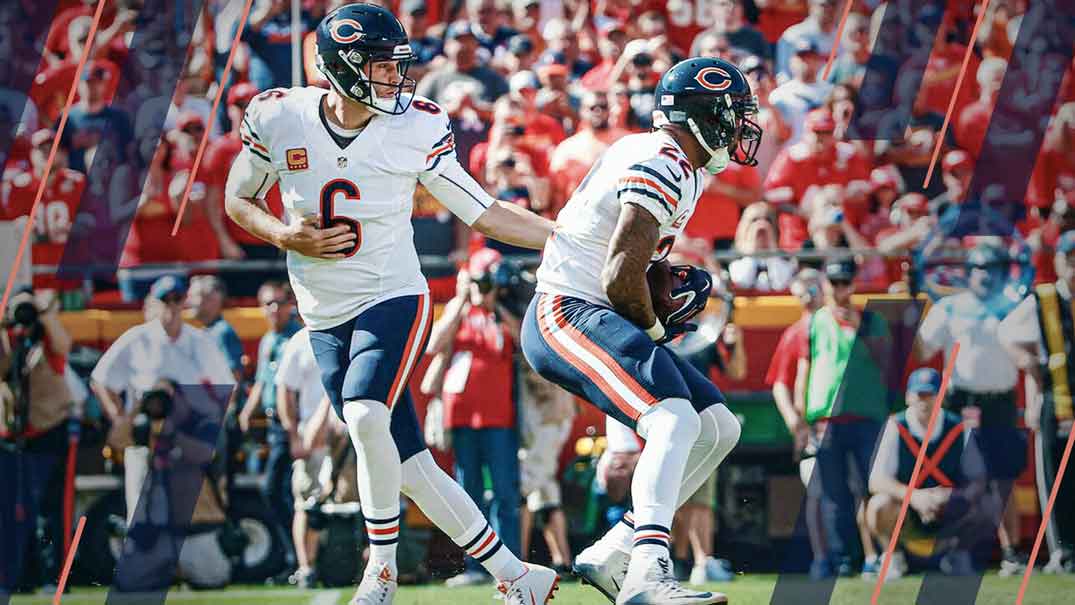
- Jay Cutler and his teammates dominate the offense: The Bears had one of the best offenses in the league in 2013, led by Cutler.
- Cornerback was one of the roster's deepest positions: Charles Tillman, Tim Jennings, Kyle Fuller and Jaylon Johnson all earned major accolades during their times in Chicago. However, because all four spent the vast majority of their careers on the outside, only two could make the team.

As part of PFF's celebration of 20 years of NFL data, we're building an All-Star team for every franchise, highlighting the best players at each position from the PFF era. This installment turns to the Chicago Bears.
PFF's database dates back to the 2006 NFL season, providing a unique lens for evaluating and comparing players across eras. More details on the methodology used to construct these teams are available at the bottom of the page.
Offense
- QB: Jay Cutler (2009-2016)
- HB: Matt Forte (2008-2015)
- WR: Brandon Marshall (2012-2014)
- WR: Alshon Jeffery (2012-2016)
- Slot WR: Allen Robinson (2018-2021)
- TE: Martellus Bennett (2013-2015)
- TE: Cole Kmet (2020-2025)
- LT: Charles Leno Jr. (2014-2020)
- LG: Cody Whitehair (2016-2023)
- C: Roberto Garza (2006-2014)
- RG: Kyle Long (2013-2019)
- RT: Darnell Wright (2023-2025)
The Bears' offense spent most of the past 20 seasons outside the top 20 in points scored. Last season was a notable exception, but most of Chicago’s key contributors are too early in their careers to qualify for this roster. The only exceptions were right tackle Darnell Wright and tight end Cole Kmet.
Another exception came in 2013, when the Bears ranked second in points scored but third in points allowed. Seven of the 12 players on this roster played on that offense. There were few difficult decisions on the offensive side of the ball, though the interior offensive line required some flexibility. Cody Whitehair, Roberto Garza and Kyle Long all played multiple positions during their careers in Chicago, allowing the Bears’ five best offensive linemen to make the team.
Defense
- DI: Akiem Hicks (2016-2021)
- DI: Israel Idonije (2006-2012)
- ED: Khalil Mack (2018-2021)
- ED: Julius Peppers (2010-2013)
- LB: Brian Urlacher (2006-2012)
- LB: Lance Briggs (2006-2014)
- SLB: Leonard Floyd (2016-2019)
- CB: Charles Tillman (2006-2014)
- CB: Tim Jennings (2010-2014)
- Slot CB: Bryce Callahan (2015-2018)
- S: Eddie Jackson (2017-2023)
- S: Adrian Amos (2015-2018)
The Bears entered the PFF era with one of the NFL’s best defenses, led by Hall of Fame linebacker Brian Urlacher. His Defensive Player of the Year season and three of his four first-team All-Pro selections came before the PFF era, but he remained productive enough during the latter half of his career to earn an easy spot on this roster. Longtime teammates Lance Briggs, Charles Tillman and Israel Idonije were also straightforward selections.
Cornerback was one of the roster's deepest positions. Charles Tillman, Tim Jennings, Kyle Fuller and Jaylon Johnson all earned major accolades during their time in Chicago. However, because all four spent the vast majority of their careers on the outside, only two could make the team.

Methodology
Selections were based on normalized PFF grades adjusted by season. To balance peak performance and longevity, only a player's five best seasons with a franchise from 2006-25 were considered. Any season with an overall PFF grade below 60.0 was excluded, ensuring that strong years helped a player's case while weaker seasons were not held against him. Postseason play was included, though all seasons were capped at a 16-game equivalent to maintain consistency across eras. At each position, the player with the highest score under this methodology earned the spot.
Each team consists of 12 offensive and 12 defensive players. Because 11 personnel and nickel defense were the league's most common alignments over the past two decades, those personnel groupings served as the foundation for every roster. Teams received either a second tight end or a fullback, depending on whether they used more 12- or 21-personnel. Defensively, teams received either a third interior defender or a third linebacker depending on whether they primarily operated from a 3-4 or 4-3 front.
Players who logged significant snaps at multiple positions during their tenure with a franchise were eligible at either spot. In most cases, those players were assigned to the position where they provided the greatest value, though their versatility occasionally influenced the final roster construction.
Unlike some All-Pro teams that group offensive linemen by position type, these rosters were built according to where players actually lined up. If a team's two best tackles both played exclusively on the left side, only the top left tackle was selected. One of the three wide receivers and one of the five defensive backs was also required to have significant slot experience. In a 4-3 defense, one linebacker needed experience at the Sam linebacker position, while in a 3-4 defense, one defensive tackle needed experience at nose tackle.
When multiple players are listed at the same position, the first name represents the top selection. Players designated as slot wide receiver, slot cornerback, nose tackle or Sam linebacker were selected specifically for those roles rather than as the third-best player within their broader position group.

 © 2026 PFF - all rights reserved.