
- Shifting the market: After getting franchise-tagged, Kyle Pitts cancompletely shift the tight end market with his upcoming deal.
- Possible trade: Pitts’ high peaks make him a very interesting trade candidate despite stretches of underwhelming play
- 2026 NFL Draft season is here: Try the best-in-class PFF Mock Draft Simulator and learn about 2026's top prospects while trading and drafting for your favorite NFL team.
Estimated reading time: 5 minutes

The Atlanta Falcons franchise tagged tight end Kyle Pitts last week, and as we’ve seen in the past, players generally aren’t too keen on playing on the tag without the promise of an extension. Pitts presents an interesting conundrum. The former fourth overall pick out of Florida has had a very inconsistent five years in Atlanta but has often shown why he was the highest-drafted tight end ever. He earned over 1,000 yards as a rookie, challenging the since-broken rookie receiving record for tight ends that had stood for over 50 years. Pitts has seen his touchdown totals rise every year, but until this past season, his receiving totals had significantly dropped off.
In 2025, Pitts caught a career-high 90 passes for 967 yards and five scores while going 12 of 21 on contested catches and earning an 82.0 PFF receiving grade that narrowly missed his rookie year grade (82.3).
A lot of those numbers were inflated by a monster performance in Week 15 against the Tampa Bay Buccaneers, where he caught 11 passes for 166 yards and three touchdowns for a 92.3 PFF receiving grade that was the best since his rookie year.
However, Pitts also had a midseason stretch where he had five straight games with a sub-60.0 PFF receiving grade before finishing the season with a sub-60.0 grade just once in six games. If you remove Pitts’ dominant Week 15, his PFF receiving grade drops from 82.0 down to 76.4, which is in line with his more mediocre campaigns. Pitts isn’t a great blocker either, which can put some limits on his value. This type of inconsistent play will make a potential contract extension very interesting.
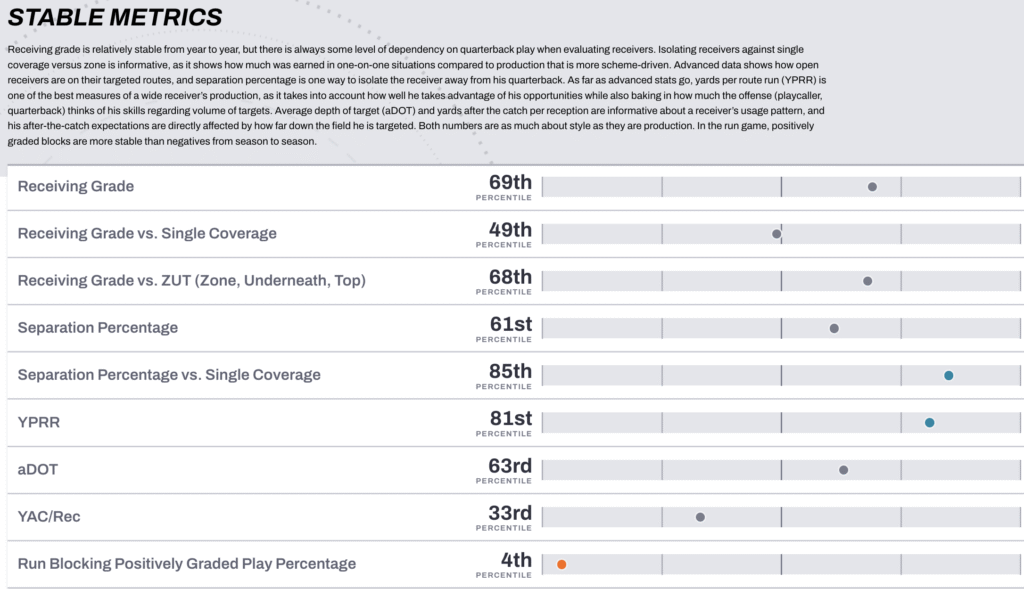
In terms of stable metrics, Pitts was above average in most categories in 2025. His PFF receiving grade ranked in the 69th percentile among tight ends, and his separation percentage ranked in the 61st percentile, but that gets even better when facing single coverage, as he’s finished in the 85th percentile. However, he hasn’t done a lot with that separation, as his PFF receiving grade against single coverage is only 49th percentile, hovering around league average. His YAC per reception is also a bit underwhelming, as his 4.5 yards after catch per reception ranked in just the 33rd percentile.
Whatever the Falcons decide to do with Pitts could have long-lasting implications for the rest of the tight ends in the league. The current highest-paid tight end in the NFL is the San Francisco 49ers’ George Kittle, who averages $19.1 million per year on his current deal. On the franchise tag, Pitts is set to make a little over $15 million in 2026, making him the fourth-highest-paid tight end in the league, pending whatever deal Travis Kelce may get. Pitts is seven years younger than Kittle and has shown flashes of being a potentially dominant receiving threat, so it’s not crazy to think that he might get a contract that could reset the market for the position.
The Falcons could also trade him to a team that would give him an extension. However, what kind of trade value does a tight end with the peaks and valleys in performance, like Pitts, have? The last high-profile trade of a star tight end was in 2022 when the Detroit Lions shipped T.J. Hockenson and two fourth-round picks to the division rival Minnesota Vikings for a second-rounder in 2023 and a third in 2024. Given that Hockenson was soon to reach free agency and was roughly the same age that Pitts is now, it feels similar to what Pitts’ value potential value in a deal. While Hockenson hadn’t reached the heights as a receiver that Pitts has, he was also a lot more consistent, not only at the time of the trade but since, as his PFF grade regularly hovers in the 70.0’s with a lot more consistent blocking.
Two teams that come to mind in a potential Pitts trade are the Washington Commanders and CIncinnati Bengals. Both teams need a tight end and should have plenty of cap space to give Pitts the extension he’s looking for. The Commanders currently have $71 million in cap space, according to Over the Cap, while the Bengals are looking at $50 million right now. Pitts would be a massive upgrade to both tight end rooms, as the Commanders trotted out a 35-year-old Zach Ertz, John Bates and Ben Sinnott at tight end last year. while the Bengals primarily used a rotation of Mike Gesicki, Drew Sample and Noah Fant, none of whom are exactly spring chickens. Both teams would also be picking in the top half of the second round, making them much more tantalizing for a Falcons team that doesn’t have a first-round pick thanks to last year’s draft-day trade with the Los Angeles Rams to select James Pearce Jr.
Whether the Falcons choose to extend Pitts or trade him to another team could have major ramifications for what the potential market for a tight end could look like. Pitts is about as volatile a tight end as can be in terms of productivity, and however the Falcons choose to proceed with him should have every tight end around the league very interested for when it’s their time to get paid.


 © 2026 PFF - all rights reserved.