
- Unlock your edge with PFF+: Access Premium Stats, dominate fantasy with in-season tools and projections and make smarter bets with the new PFF Player Prop Tool. Get 25% off your PFF+ annual subscription with code PFFFANTASYPODCAST25.
Estimated Reading Time: 5 minutes

Fantasy and DFS enthusiasts, bettors and analysts often rely on a wide array of statistics and models to gain a competitive edge. These range from basic box score stats to advanced metrics available in PFF's Premium Stats 2.0 and models like Josh Hermsmeyer‘s Buy Low model and WOPR (Weighted Opportunity Rating).
There is always room for new insights and analyses to help bettors and fantasy managers refine their strategies. That’s why I developed a new metric that offers several advantages over WOPR. Click here for an in-depth explanation of the model, my process and its advantages.
Week 5 Recap
- DeVonta Smith: 19.4 PPR Points – WR10
- Chris Olave: 12.9 PPR Points – WR27
- Zay Flowers: 12.2 PPR Points – WR30
- Brian Thomas Jr.: 12.0 PPR Points – WR31
- A.J. Brown: 9.3 PPR Points – WR47
- Jakobi Meyers: 7.2 PPR Points WR55
- Jerry Jeudy: 3.5 PPR Points WR75
- Brock Bowers: DNP
Potential Breakouts: Week 6
As a quick refresher on how regression-to-the-mean models work: A player’s fantasy points per game (FPpG) are projected based on their three-week PWOPR average (explained more here).
PWOPR is significantly more stable than FPpG and serves as a stronger indicator of future performance. To help identify potential breakout candidates, the residual is calculated by subtracting a player’s predicted FPpG from their actual FPpG. Players with a strong PWOPR and a residual of -3.0 or lower are included on this list. Players remain on the list until one of the following conditions is met:
- They fulfill their PWOPR potential with a big game
- Their PWOPR decreases to match their expected FPpG
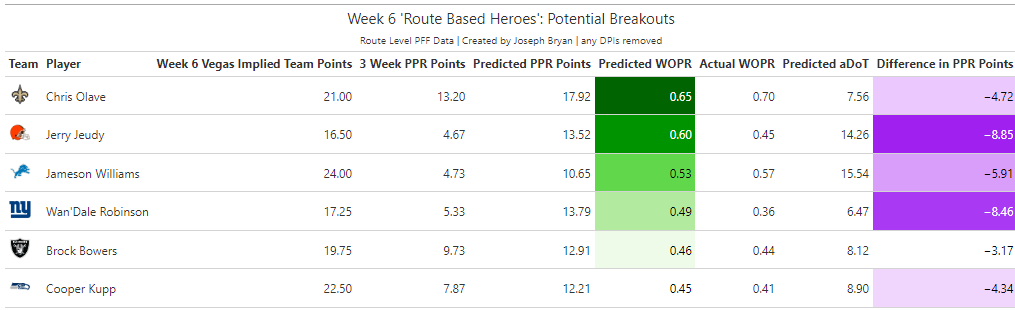
Chris Olave is producing outstanding PWOPR and actual WOPR, but is being let down by a poor offensive passing attack. When the Saints’ offense is clicking, big games are in store for Olave.
The Saints play the Patriots in Week 6, who have the ninth-worst PFF coverage grade and the 12th-best team PFF pass-rush grade. The Patriots play the eighth-most man coverage in the NFL, where Olave has a very impressive 34.8% THREAT, but a less stellar 64.7 PFF grade. This is a reasonable spot for Olave to see plenty of targets and potentially plenty of one-on-one opportunities.
Jerry Jeudy had a disappointing performance last week, but still put up the 17th highest PWOPR in Week 5. Dillon Gabriel had a tough assignment for his first game against a very stout defense in a different country. He recorded the 24th-best PFF grade (min 10 dropbacks) under these circumstances.
The Browns play the Steelers in Week 5, who rank 21st in team PFF coverage grade and 10th in team pass-rush grade. The Steelers’ defense slots in the top 10 for quick pressure and blitzes, which might pose problems for Gabriel. Shockingly, Gabriel was the best quarterback in the NFL while under pressure in Week 5 with an 88.2 overall PFF grade. If this is a sign of what’s to come, the Steelers’ pressure might be mitigated by Gabriel and the Browns.
Additionally, the Steelers play the fourth-most man coverage in the NFL. Jeudy has struggled against man coverage in 2025 (48.2 PFF grade), but was decent in that realm last season (76.3 PFF grade). Jeudy will not project well in median outcomes, but I believe he has a decent chance for a big game if Gabriel can maintain his stellar play under pressure versus a poor coverage unit.
Jameson Williams draws potentially the most difficult matchup on the list this week. The Kansas City Chiefs rank second in team coverage grade, seventh in team quick pressure rate and first in PFF grade on passes that travel more than 10 air yards. For a deep specialist like Williams, this is a nightmare matchup. This does not mean Williams cannot succeed, but it does mean a breakout performance is less likely.
Wan’Dale Robinson gets the Eagles, who hold the 10th-best team coverage grade, fifth-best team pass-rush grade, 15th-highest quick pressure rate and rank as the 10th-worst team by PFF grade on passes that travel more than 10 air yards. Robinson had a 5.4-yard average depth of target (aDoT) in 2023 and a 5.4 aDoT in 2024, but has a whopping 10.1 aDoT in 2025. With a relatively new rookie quarterback in Jaxson Dart, it is unclear if the Giants will push the ball downfield. But with Darius Slayton out, Robinson might see a bigger role at all depths of the field.
Brock Bowers is recovering from an injury and was on the list last week but did not play, which garners him a spot this week. Bowers draws the Titans, who rank 14th in team PFF coverage grade, 17th in team pass-rush grade and 16th in quick pressure rate. The Titans possess the 11th-worst PFF grade as a team when the tight end is targeted, as Tennessee has run the eighth-most Cover 2 and sixth-most Cover 4. When a tight end sees these coverages, their THREAT typically increases from a base rate of 19.4% to 20.7%. This is a good matchup, assuming Bowers is moderately healthy.
Jaxon Smith-Njigba is having a great season, but so is Cooper Kupp — who is on the list this week! Kupp and Smith-Njigba have run the same number of routes this season while both being classified as “Open” or with a “Step” of separation at the exact same rate in 2025. Sam Darnold has preferred to target Smith-Njigba, but Kupp has been getting open; given the right circumstances, he should be in store for some positive regression.
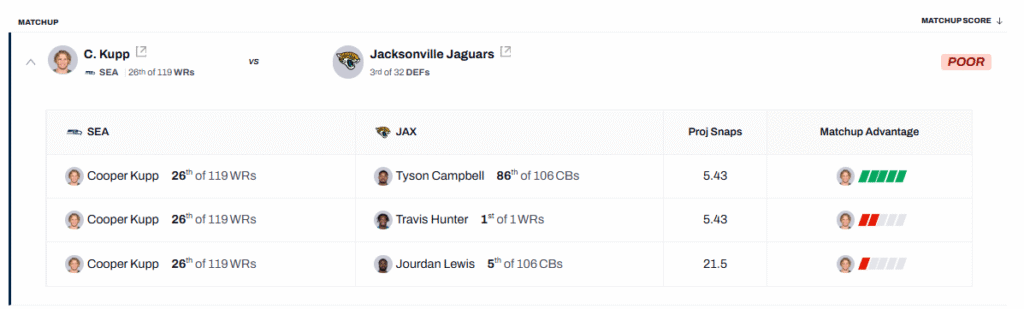
Cooper Kupp has a very tough matchup against the Jaguars this week, who rank No. 1 in team PFF coverage grade — but 23rd in team pass-rush grade — and blitz at the 15th-highest rate in the NFL. The Jaguars play the sixth-most zone coverage, and Kupp’s THREAT actually diminishes versus zone coverage this season.

 © 2026 PFF - all rights reserved.