
- Unlock your edge with PFF+: Access Premium Stats, dominate fantasy with in-season tools and projections and make smarter bets with the new PFF Player Prop Tool. Get 25% off your PFF+ annual subscription with code PFFFANTASYPODCAST25.

Last year, I introduced a new framework for understanding wide receiver play, quarterback decision-making and offensive potential. This framework relies on an XGBOOST model and PFF’s impressive collection of route-level data. Using machine learning and this breadth of PFF data, we can create models to predict where a target should go on a given play.
The resulting metrics, Share of Predicted Targets and Share of Predicted Air Yards, are both more stable than their “actual” counterparts.
Week 9 Recap
- WR Wan‘Dale Robinson: 11 Targets, 34.38% target share
- TE George Kittle: 4 Targets, 19.05% target share
- TE T.J. Hockenson: 3 Targets, 13.04% target share (1 touchdown)
- WR Jameson Williams: 6 Targets, 16.67% target share (1 touchdown)
- WR Cooper Kupp: Did not play
Potential Breakouts: Week 10
These are players who were open far more often than they were targeted in Week 8. Historically, players who appear on this list tend to see an increase in both target rate and target share in the weeks that follow, relative to their own prior usage and to other players with comparable roles.
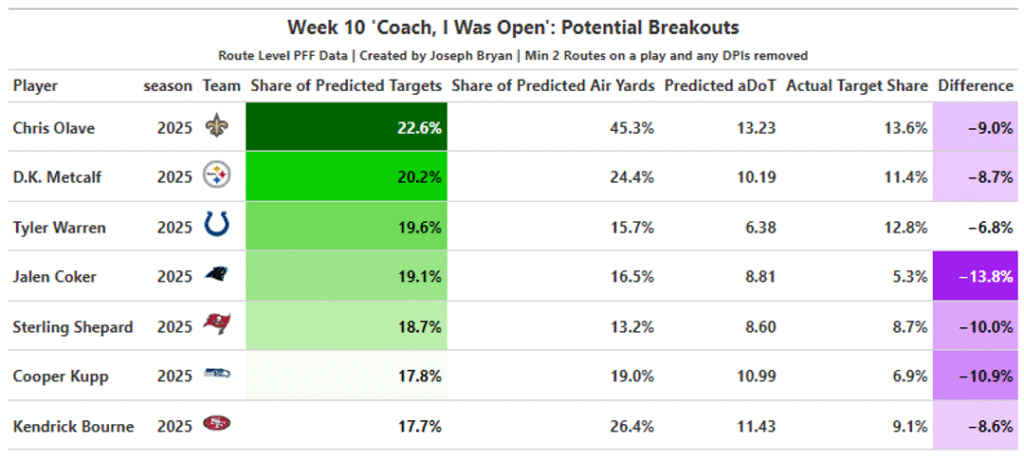
With Tyler Shough making his first career start last week, Chris Olave saw season lows in both targets (four) and target share (16.7%). If that trend continues with Shough under center, it could become a concern for Olave’s consistency.
D.K. Metcalf has had a superb season in projected target share, but Aaron Rodgers — who owns the second-shortest average time to throw (2.57 seconds) — has struggled to connect with him as Metcalf runs deeper routes (13.23 predicted average depth of target).
Tyler Warren has had only one other game with a target share below 15% (Week 5). The following week, he rebounded with a 30% share and nine targets, tying his season high.
Week 9 review
WR Chris Olave, New Orleans Saints
The Saints trail 27-10 with four minutes remaining in the third quarter. Tyler Shough, making his first NFL start, continues to develop as an NFL quarterback. New Orleans lines up in an empty set, while the Rams show a disguised coverage — shifting from a two-high look to a single-high shell at the snap.
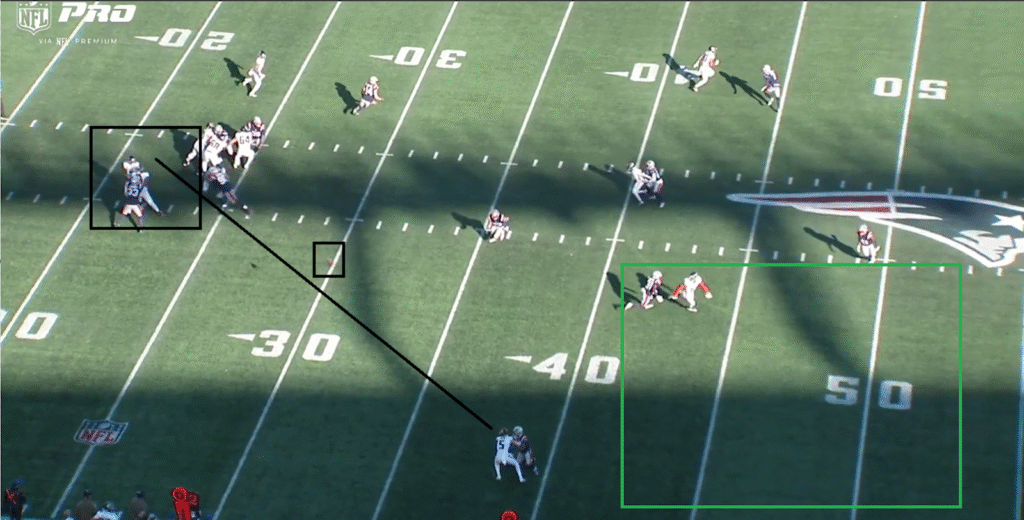
Chris Olave runs a post-seam route against a standard Cover 3 look. One of the coverage’s weaknesses — the seam — leaves Olave wide open on the play. Juwan Johnson is also uncovered underneath for an easy first-down opportunity.
On this play, Johnson had the higher target probability (.57) compared to Olave (.48), but if an accurate ball had been delivered to Olave, it could have resulted in a much bigger gain for the Saints. It was still a solid decision by Shough in the moment, but in tighter games where an explosive play can swing the outcome, Olave may be the better read.
WR Darius Slayton, New York Giants
The Giants trail 17-7 with 29 seconds remaining in the first half. It’s second-and-10, and Jaxon Dart rolls out to his right.
Slayton comes open early on a skinny post, earning a 40% target probability, but Dart never sees him. After extending the play, Dart checks down to Tyrone Tracy, who drops the pass, resulting in a -0.14 EPA.
The Giants end the drive with a missed field goal. Had Dart delivered the throw to Slayton with NFL-level accuracy, New York likely would have entered halftime down 17-14 instead of 17-7 — a play that could have shifted the trajectory of the game.
TE Kyle Pitts, Atlanta Falcons
The Falcons trail 14-7 with 8:41 remaining in the second quarter. The Patriots are in Cover 1.
Michael Penix Jr. locks onto Drake London in tight single coverage and releases the throw immediately. London is unable to separate from Christian Gonzalez, resulting in an incompletion (-0.66 EPA). Meanwhile, Kyle Pitts runs a corner route and gains clear separation with room to operate away from the free safety. With an accurate throw, Pitts could have scored or at least picked up 25-plus yards.
London continues to be targeted at a higher rate (31.2% target share) than his predicted target share (24.4%) suggests. While that volume benefits his fantasy outlook, it may be limiting the overall efficiency of Atlanta’s passing offense.

 © 2026 PFF - all rights reserved.