- Unlock your edge with PFF+: Access Premium Stats, dominate fantasy with in-season tools and projections and make smarter bets with the new PFF Player Prop Tool. Get 25% off your PFF+ annual subscription with code PFFFANTASYPODCAST25.

Last year, I introduced a new framework for understanding wide receiver play, quarterback decision-making and offensive potential. This framework relies on an XGBOOST model and PFF’s impressive collection of route-level data. Using machine learning and this breadth of PFF data, we can create models to predict where a target should go on a given play.
The resulting metrics, Share of Predicted Targets and Share of Predicted Air Yards, are both more stable than their “actual” counterparts.
Week 8 Recap
- D.K. Metcalf: 7 targets, 22.58% target share and a touchdown
- Chimere Dike: 8 targets, 21.62% target share
- Arian Smith: 1 target, 3.45% target share
- Lil’Jordan Humphrey: 0 targets (Darius Slayton returned from injury and filled the position Lil’Jordan Humphrey was playing)
Potential Breakouts: Week 9
These are players who were open far more often than they were targeted in Week 8. Historically, players who appear on this list tend to see an increase in both target rate and target share in the weeks that follow, relative to their own prior usage and to other players with comparable roles.
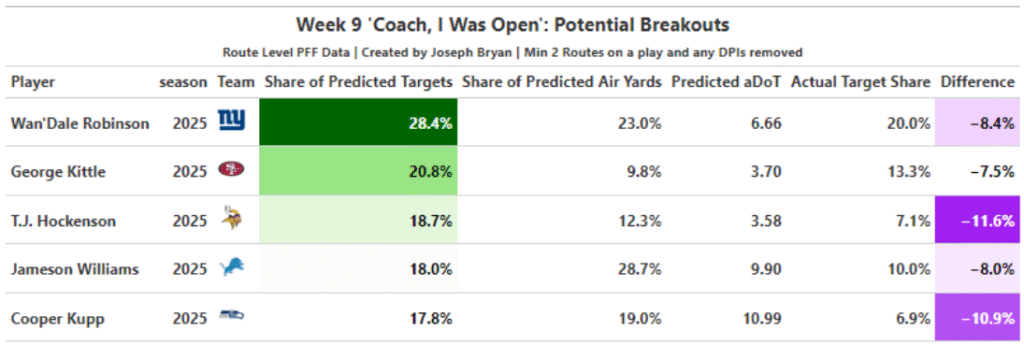
With Jaxon Smith-Njigba enjoying a stellar breakout season, Cooper Kupp is no longer the primary target in this offense. Still, he’s been getting open consistently and playing at a high level. That trend — being open but not heavily targeted — is likely to continue as long as Smith-Njigba maintains his elite form.
“Coach, I have been open!”
This week, I wanted to take a closer look at the players with the largest cumulative deficits and surpluses between their actual target share and their predicted target share. Each week, I calculated the difference between a player’s actual target share and their share of predicted targets. A larger negative number indicates a player has been open more often than they’ve been targeted, while a larger positive number suggests they’ve been targeted more often than they’ve been open.
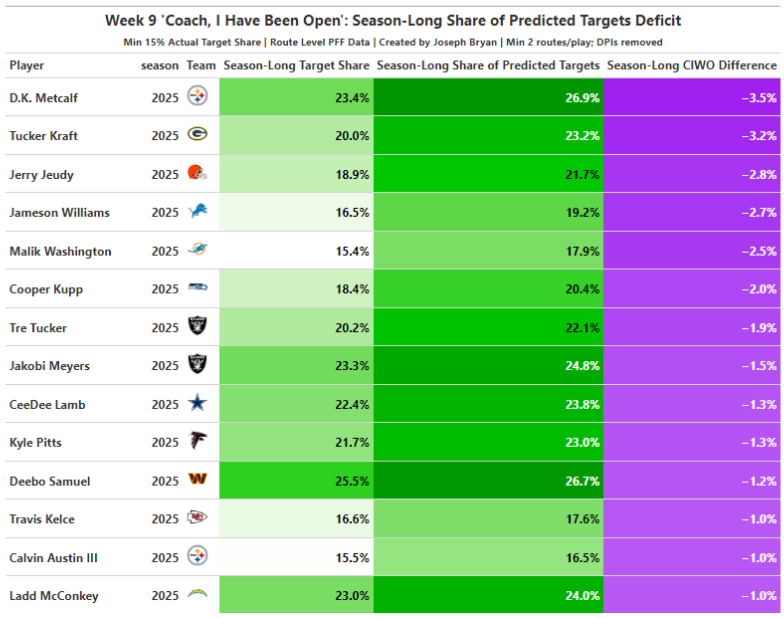
D.K. Metcalf, who was a potential breakout candidate last week, appears as the player with the largest deficit. This indicates that Metcalf has consistently created separation this season but hasn’t been targeted as frequently as his level of openness would suggest.
Tucker Kraft is another name that has appeared on the “Coach, I Was Open” list multiple times this year. He’s trending toward a top-five tight end designation — a rise supported by his strong share of predicted targets.
Ladd McConkey started the season slowly from a production standpoint while Quentin Johnston was breaking out. However, McConkey never stopped getting open, and his target volume has increased in recent weeks as a result.
Now, shifting focus to players who have been targeted more often than their share of predicted targets would suggest — these are typically receivers who can create windows even when covered. It’s important to note that the model defines “open” relative to the league-average receiver. In practice, certain players are effectively open the moment they draw single coverage, and a quarterback’s accuracy and touch can also influence a receiver’s ability to earn targets in ways the model cannot fully quantify.
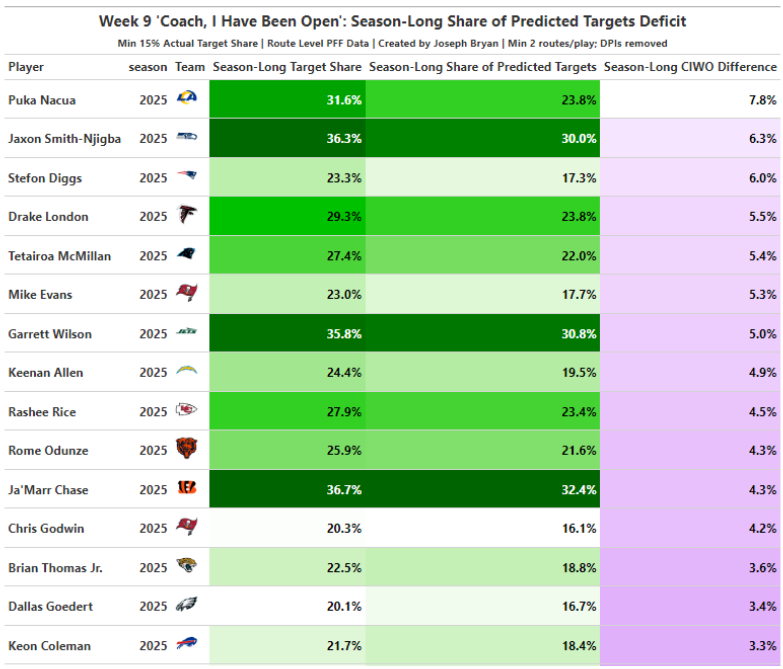
Puka Nacua has been elite this season, with Matthew Stafford and Sean McVay consistently feeding him the ball. He’s the engine of the Rams’ offense, and Stafford’s arm talent allows Nacua to be open in nearly any situation. There’s little reason to expect his target share to regress this season.
Rashee Rice’s return has reignited Kansas City’s offense, which now looks nearly unstoppable. Per Premium Stats, Rice owns the seventh-best PFF grade among wide receivers this season, and the Chiefs appear intent on getting him involved early and often.
Tetairoa McMillan is the lone rookie on this list — and it’s an impressive group to be part of. Nearly every wideout featured here would be considered elite by most metrics. McMillan also ranks seventh among wide receivers in PFF WAR (wins above replacement), an incredible indicator of his early impact and long-term potential.
Week 8 review
D.K. Metcalf and the Steelers turned in a respectable showing on Sunday Night Football, with Metcalf recording five receptions for 55 yards and a touchdown in Pittsburgh’s 25-point effort. Metcalf currently holds the largest deficit between his actual target share and his share of predicted targets. He also posted the highest probability of earning a target 15-plus yards downfield in Week 8.
Midway through the third quarter, the Steelers held a 16-14 lead with seven minutes remaining and the ball at their own 49-yard line. At that point in the game, Pittsburgh’s win probability sat at 64%.
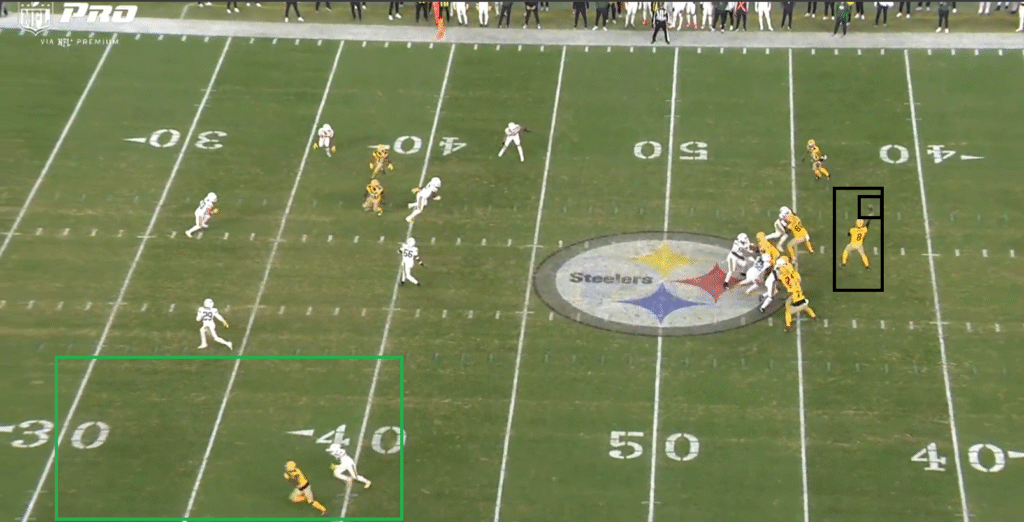
Metcalf ran an out-and-up route while Aaron Rodgers enjoyed excellent protection following a play-action fake. Rodgers initially looked to Metcalf as his first read but quickly checked down to Jaylen Warren. With accurate ball placement, this likely would have been a touchdown to Metcalf, putting the Packers up two possessions late in the third quarter.
Rodgers currently has the fourth-quickest average time to throw, while Metcalf owns a relatively high average depth of target (12.3 yards). That combination can create situations like the one above, where Metcalf separates just a fraction of a second later than Rodgers is ready to release the ball.

 © 2026 PFF - all rights reserved.