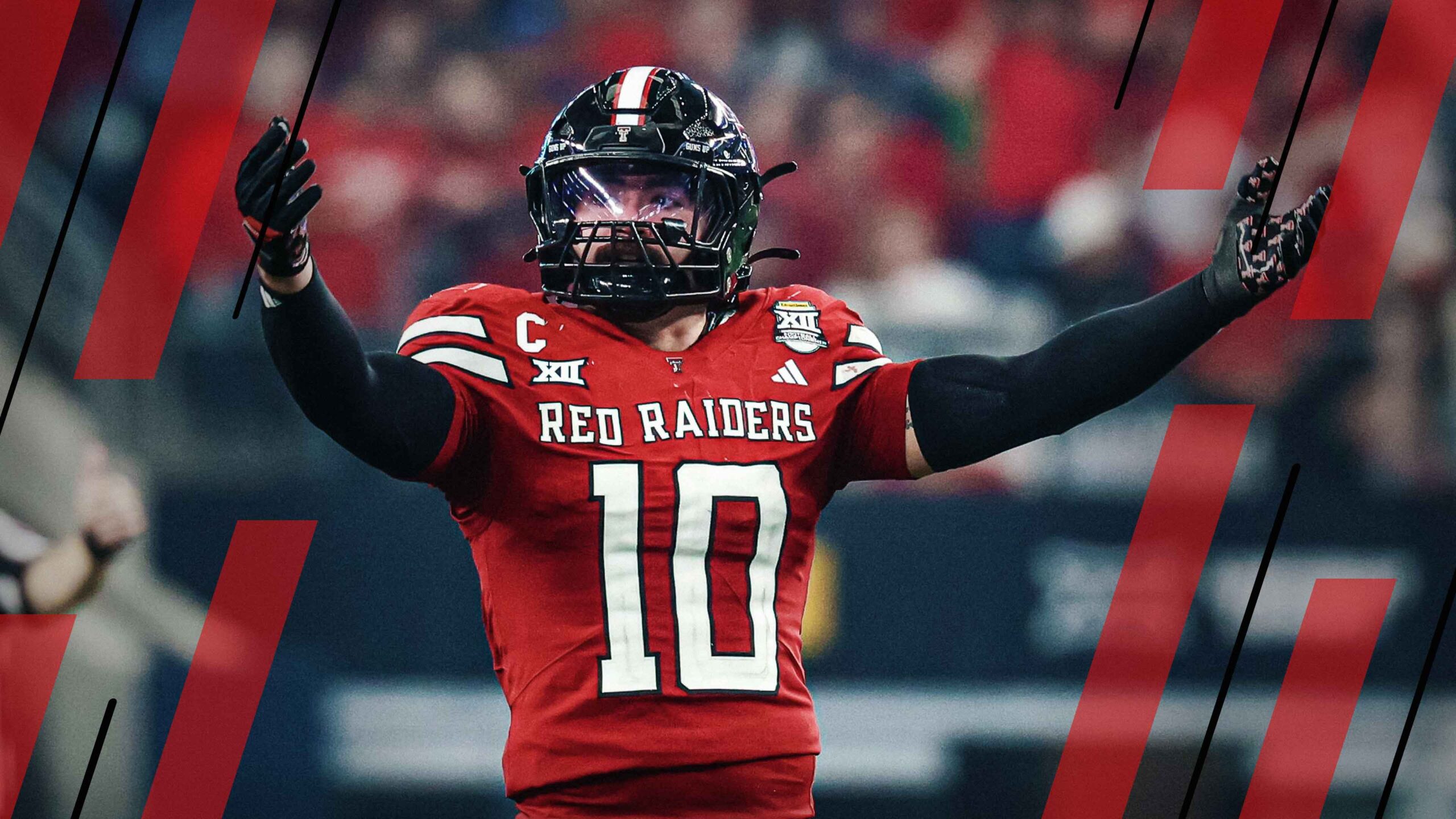
- Jacob Rodriguez thrives in this model, checking every box: Based on this model, it wouldn’t be a surprise to see Rodriguez eventually emerge as the IDP LB1 from this year’s class.
- Choosing between the two Ohio State first-round picks: Arvell Reese and Sonny Styles will contend to be the first linebacker taken in rookie drafts this season.
- Unlock your edge with PFF+: Access Premium Stats, dominate fantasy with in-season tools and projections and make smarter bets with the new PFF Player Prop Tool. Get 25% off your PFF+ annual subscription with code PFFFANTASYPODCAST25.
Estimated Reading Time: 14 minutes
NFL draft season is in full swing, which naturally comes with a plethora of ways to evaluate how potential talent coming out of college will translate to the next level. This article series is no different, as we’ll add a fantasy football spin to the evaluation process to identify which incoming prospects have a shot to become fantasy-relevant early on in their NFL careers.
Next up is the linebacker position for IDP fantasy football, which has long been one of the trickier positions to find stable and quantifiable metrics worth trusting in prospect evaluation. After years of tinkering, I have identified a combination of metrics that have correlated best with IDP success at the next level, leading to this prospect model that takes into account those factors and metrics for each player to devise a prospect score, not unlike the edge position that was covered recently. Again, like any position, no single metric will tell us whether a college prospect will be good or not in the NFL, but this model's purpose is to combine the metrics and factors that data has proven to be most relevant, providing weight to those that are more important than others.
For the linebacker position, in no particular order, we’re looking at career PFF grades, run-defense grades, coverage grades, draft capital, tackle efficiency, athleticism and level of competition faced. Underlying metrics were found to be much more reliable than overall production when accounting for all prospects. While production often comes with strong underlying metrics, one can exist without the other, and the underlying metrics have a better success rate than overall production alone.
Note: This is the pre-NFL combine version of the article and will be updated with athletic testing scores and any shifts in expected draft capital next month.
Keys
- The prospect pool for this model consists of 364 past linebacker prospects dating back to 2018.
- Twenty-seven linebackers drafted since 2018 have become a top-12 IDP finisher for their position at least once (7.4%).
- Among those 27 top-12 finishers, 17 (63%) finished as top-12 finishers within their first three NFL seasons, though that number increases to 90% for those who score 8.50 or higher in the model.
- Also, among those 27 top-12 finishers, 10 (37%) have been repeat top-12 finishers, though that number increases to 60% for those who score 8.50 or higher in the model.
- Forty linebackers drafted since 2018 have become top-24 IDP finishers for their position at least once (10.9%).
- Fifty-five linebackers drafted since 2018 have become top-36 IDP finishers for their position at least once (15.1%).
- This is an important context when understanding hit rates, as many more prospects will not become fantasy-relevant than most, given such a large pool of players.
- However, using this model, the higher the prospect score, the better the success rate will be for each prospect, as highlighted below.
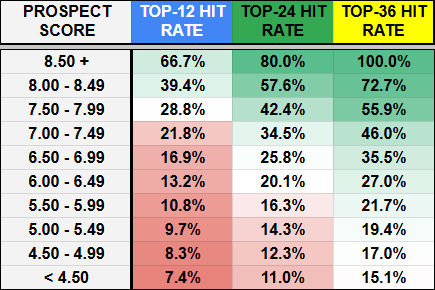
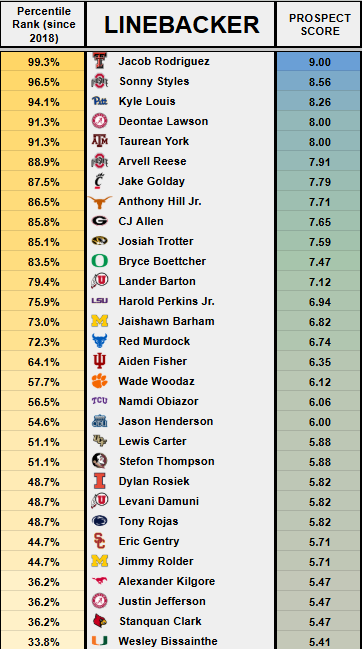
With all this in mind, it’s time to look at this year’s linebacker prospects to identify our future IDP contributors. It should also be noted that these scores should not necessarily be used so much as your rankings, as they should be more of a guide toward the quality of the player. Draft capital and landing spot can and will play a big part in actual rankings, though these scores can help us determine which players to trust or not when it comes time to pull the trigger on these players in our rookie drafts.
Arvell Reese, Ohio State
- Consensus draft capital: 2nd overall
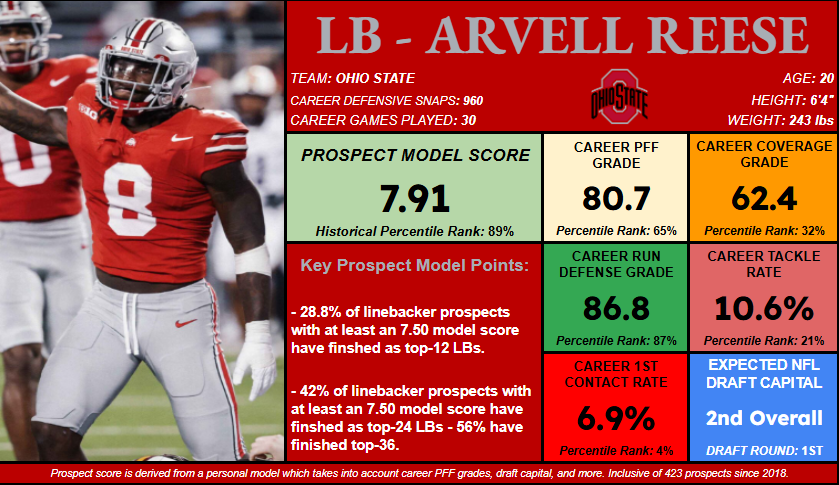
- Reese comes into this draft as the potential second overall pick, which is incredibly rare for the linebacker position, though Reese isn’t your typical linebacker.
- Reese has spent a high 36% of his defensive snaps on the edge, due to his strong pass-rushing ability.
- While he’s often compared to Micah Parsons, Reese isn’t quite on the same level of prospect in terms of his overall college performance, as Parsons was an elite performer in this model (9.04 score).
- Parsons also did the majority of his pass-rushing from a true off-ball linebacker position, while Reese is doing so more off the edge.
- As a result of his role, Reese’s key tackle and production metrics don’t necessarily match up to some of the best IDP linebacker prospects of years past, or even in this class.
- This creates some concern for his role at the next level, if he remains in a hybrid deployment, or if he’ll stick to one role, both can massively swing his IDP value.
- Parsons spent just one season as a hybrid player at the next level before transitioning to a full-time edge defender, while last year’s first-round hybrid Jalon Walker played exclusively at edge to start his NFL career.
- We likely won’t know the plan for Reese until we see it, though, because of the high NFL draft capital likely to be invested in him, he’s also going to be valuable for IDP, even if not necessarily the overall first IDP option to target in rookie drafts this season.
Sonny Styles, Ohio State
- Consensus draft capital: 12th overall
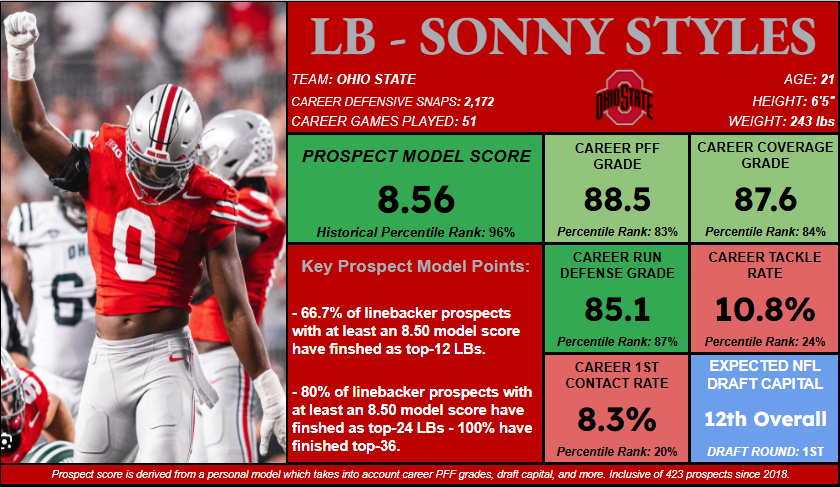
- Styles, also out of Ohio State, is a much more typical off-ball linebacker prospect compared to Arvell Reese, and a high-end one at that.
- Styles scores very well in the prospect model, delivering high grades for his college career, putting him in an ideal bucket of past top IDP finishers, including Fred Warner, Jordyn Brooks, Nick Bolton, and Zack Baun.
- Styles, much like Reese, and even Warner, Brooks, and Baun, has spent an above-average rate of his defensive snaps in college on the edge (15.1%), which limited some of his key tackle and production metrics. Depending on his landing spot in the NFL, we can likely expect him to play a more orthodox off-ball linebacker role.
- Styles’ encouraging coverage and run-defense grades during his college career, along with his expected first-round draft capital, are going to lead to plenty of opportunities to deliver as an every-down linebacker in the NFL, which will always be of value for IDP.
- Considering the expected first-round capital and a high score in the model, Styles might be the safest bet to be LB1 for IDP in this year’s class.
CJ Allen, Georgia
- Consensus draft capital: 29th overall
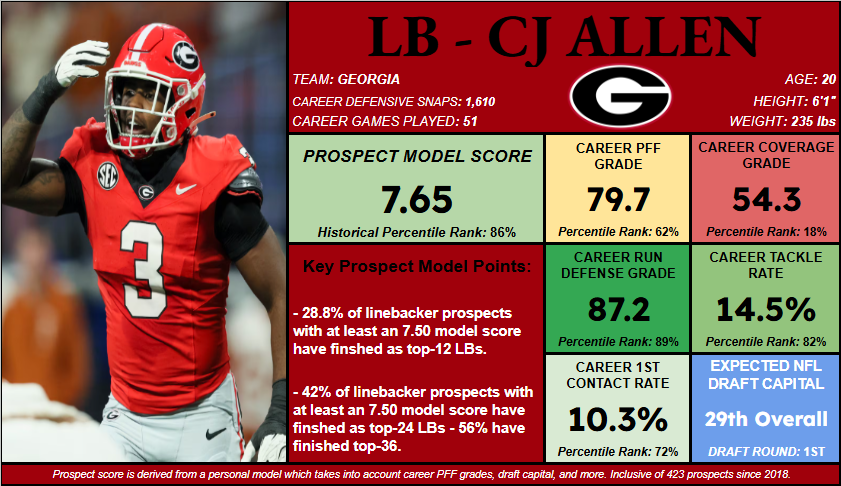
- Allen currently sits on the fringe of being a first-round pick this year, and while he doesn’t necessarily come with a perfect profile, he’ll certainly be worthy of consideration early on in IDP rookie drafts.
- First-round capital matters more than anything else when it comes to our linebacker prospects for IDP, as they’ll often continue to get opportunities regardless of whether they were actually worth that capital.
- Another former Georgia linebacker, Quay Walker, is a good example of not scoring highly in the model (7.29) but still being a perfectly viable top-24 IDP option through his first few years in the league.
- Allen comes out of Georgia as a better tackler and run defender than Walker in this model, and that’s helped him earn a slightly higher score with comparable draft capital.
- Allen doesn’t perform as well as Walker in coverage, scoring just an 18th percentile mark in that regard for his career, and creating at least some concern for his every-down potential early in his career.
- Since 2018, Allen owns the lowest career coverage grade (54.3) among all first-round prospects, behind only Jalon Walker (58.5), who became a full-time edge, and Arvell Reese (62.4), who also spent a lot of time on the edge in college.
- Allen has been an exclusive off-ball linebacker for his college career and will likely do the same at the next level, which will put his coverage skills to the test and force him to develop in that regard if he’s going to be a weekly IDP option for us.
Anthony Hill Jr., Texas
- Consensus draft capital: 37th overall
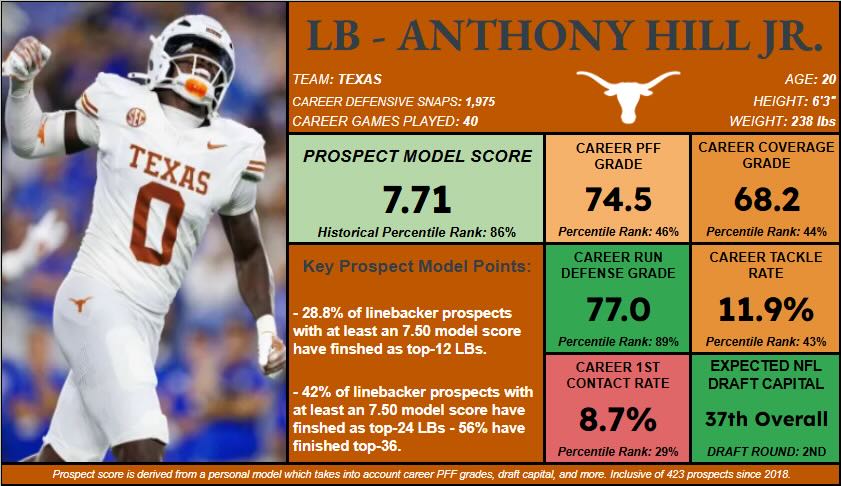
- Hill is the first of five potential Day 2 linebacker picks in this year’s class, highlighting why it is considered one of the potentially stronger position groups in 2026.
- Further highlighting the position group’s strength is that Hill is one of 10 linebacker prospects in this year’s class to currently score 7.50 or higher – the first class to have that many since 2020, when there were also four first-round off-ball linebackers.
- Hill thrives defending the run, though he has concerns in coverage and with his key production metrics.
- As a potential early second-round pick, Hill’s IDP value isn’t guaranteed, as highlighted by the likes of Troy Andersen and Pete Werner, though there are enough good examples of consistent performers like Shaquille Leonard, Nick Bolton and now potentially Carson Schwesinger and Edgerrin Cooper to feel hopeful about Hill.
- While Hill doesn’t score quite as high as Schwesinger or Cooper, if he gets second-round draft capital, he’ll get a similarly strong path to potential playing time, even if not immediately in Year 1.
- As a result, Hill’s IDP rookie draft value begins in the third round for the most part and depends on the landing spot, though he can drop a bit considering there are other strong options at the position.
Jake Golday, Cincinnati
- Consensus draft capital: 51st overall
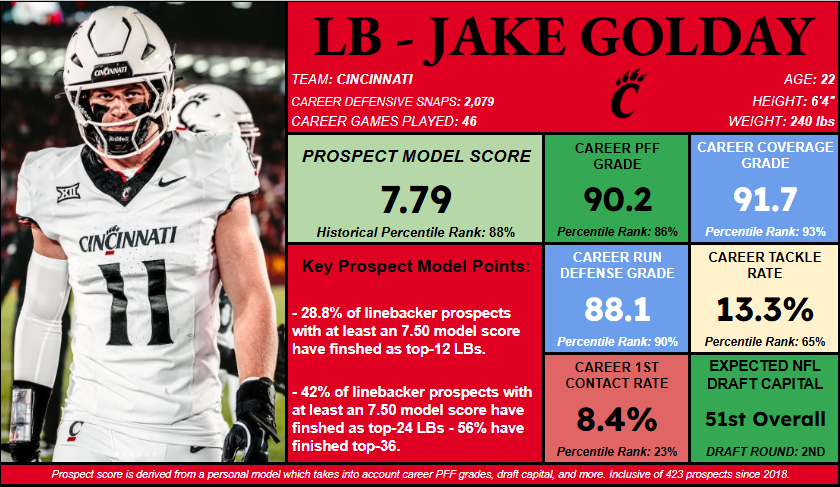
- Golday owns some of the more encouraging career PFF grades among the Day 2 prospects, and as a result, he scores slightly better than some of his comparable peers going ahead of him in mock drafts right now.
- Golday comes out of college with one of the best career coverage and run-defense grades in this class, creating hope that he can develop into an every-down linebacker at the next level.
- Golday is also one of the more versatile linebackers in this class, spending about 29% of his snaps on the edge and 27% in the slot, making his strong career PFF grades even more impressive.
- Even with Golday’s varying alignments, he still managed a good enough tackle rate despite not often being put in a position where he could make first contact.
- Assuming that an NFL team plays him in a more typical off-ball role, he’ll ideally be more productive at the next level, making him a slightly more intriguing IDP prospect in the mid-late rounds of rookie IDP drafts.
Jacob Rodriguez, Texas Tech
- Consensus draft capital: 61st overall
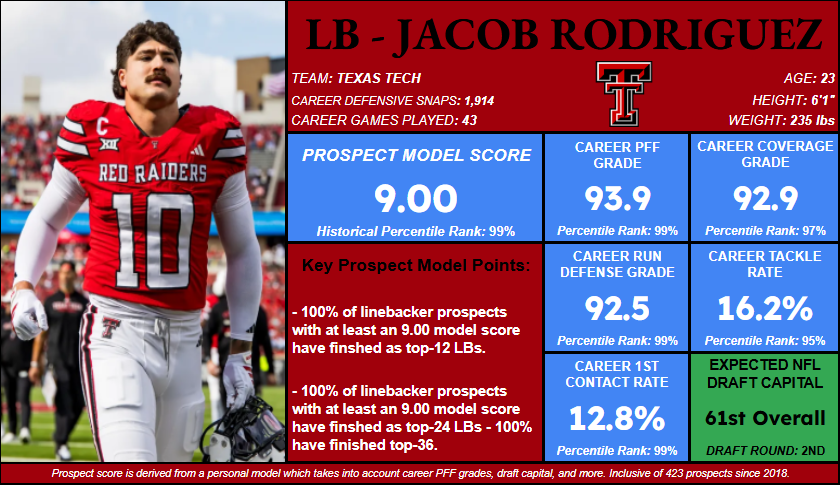
- While we’ve mostly just been covering the top five expected players to be drafted in detail for these prospect model articles, this one requires an exception, as Jacob Rodriguez has a legitimate claim to be one of, if not, the top IDP linebacker[s] in this class.
- As a fringe second-third round pick as of right now, Rodriguez boasts some of the most impressive metrics across the board coming out of college, making him just the fourth player since 2018 to score a 9.00 or higher in the model.
- The other three players are Roquan Smith (9.32), Micah Parsons (9.04), and Jack Campbell (9.03) – all of whom hit on their top-12 IDP potential within the first three years of their careers.
- Rodriguez scores no worse than the 75th percentile in any one collected metric for this model, often scoring among the very best of all time in his career marks.
- While there’s still athletic testing and final draft capital to bake into Rodriguez’s score, even if he doesn’t come out with an ideal 9.00 score, he is absolutely deserving of being one of the top IDP rookies drafted this season, to the point where it is tempting to put him as the overall LB1 depending on how the draft shakes out.


 © 2026 PFF - all rights reserved.