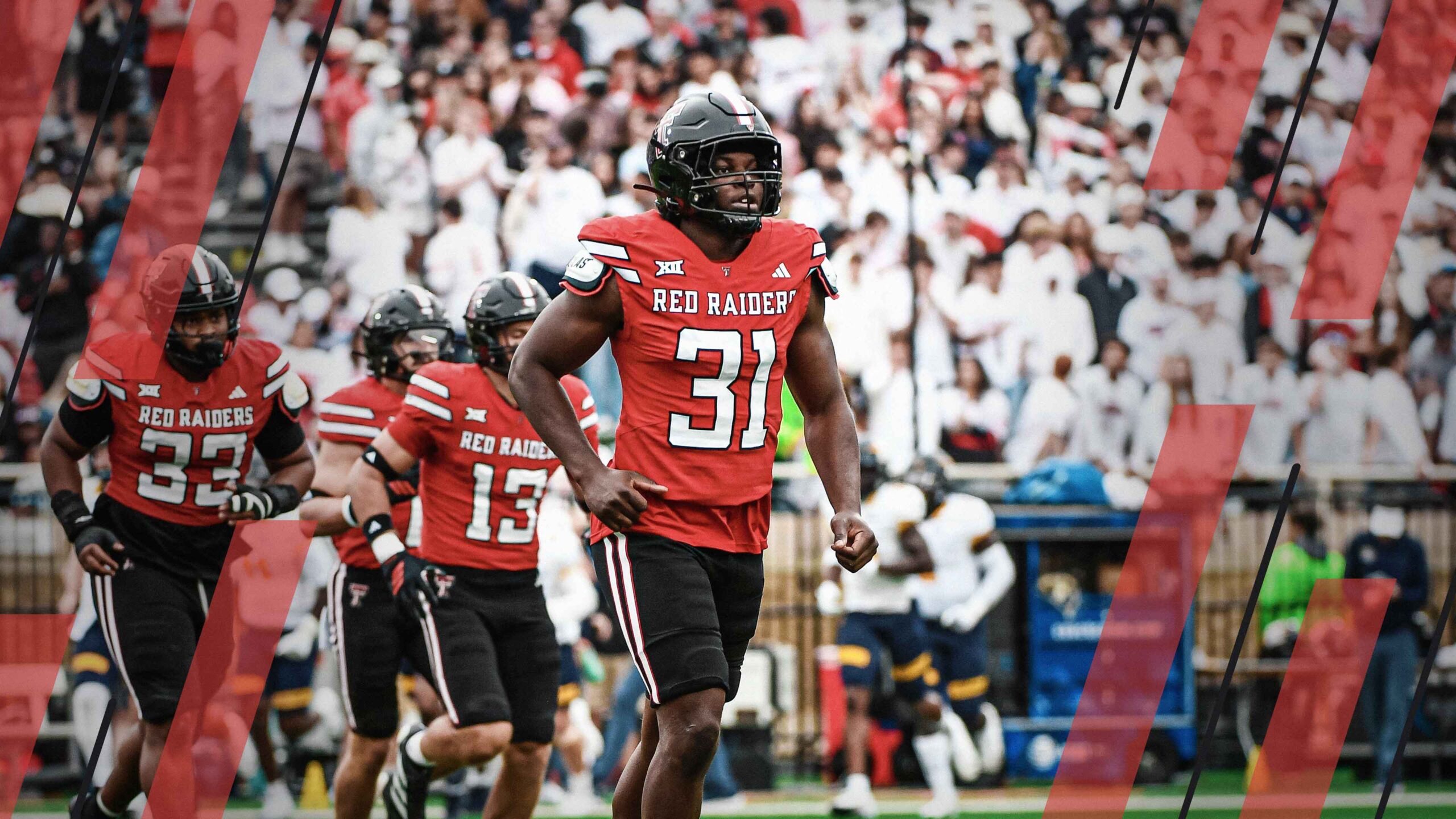
- Rueben Bain Jr. and David Bailey lead the way: Very little separates the top two edge defenders in this year’s class, backing up their claims as potential top-10 picks come April.
- Red flags around Keldric Faulk’s prospect profile: Another potential athletic prospect with average pass rush metrics will be a likely project at the next level.
- Unlock your edge with PFF+: Access Premium Stats, dominate fantasy with in-season tools and projections and make smarter bets with the new PFF Player Prop Tool. Get 25% off your PFF+ annual subscription with code PFFFANTASYPODCAST25.
Estimated Reading Time: 14 minutes
NFL draft season is in full swing, which naturally comes with a plethora of ways to evaluate potential talent coming out of college. This article series is no different, as we’ll add a fantasy football spin to the evaluation process to identify which incoming prospects have a shot to become fantasy-relevant early on in their NFL careers.
Starting with the edge position for IDP fantasy football, I have created a prospect model that takes into account the most important factors and metrics for a player to realize relevant IDP success in the NFL. Like with any position, no one metric will tell us whether a college prospect will be good or not in the NFL, but the purpose of this model is to combine the metrics and factors that data has proven to be most relevant, providing weight to those that are more important than others.
For the edge position, in no particular order, we’re looking at PFF pass-rush grades, pass-rush win rate, pressure rate, run-defense grades, draft capital, athleticism and level of competition faced. There is some weight to one-year numbers, though the most stable metrics with the most weight applied when it comes to underlying metrics are career numbers. Underlying metrics were also found to be much more reliable than overall production when accounting for all prospects. While production often comes with strong underlying metrics, one can exist without the other, and the underlying metrics have a better success rate than overall production alone.
Note: This is the pre-NFL combine version of the article and will be updated with athletic testing scores and any shifts in expected draft capital next month.
Keys
- The prospect pool for this model consists of 320 past edge prospects dating back to 2016.
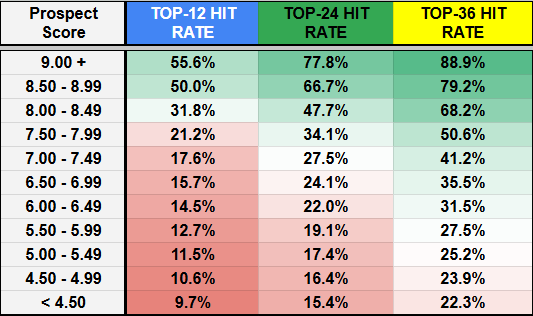
- 31 edges drafted since 2016 have become a top-12 IDP finisher for their position at least once (9.7%).
- Of those 31 top-12 finishers, 15 (48%) of them finished as top-12 finishers within their first three NFL seasons, though that number increases to 67% for those who score 8.50 or higher in the model.
- Also, among those 31 top-12 finishers, 14 of them (45%) have been repeat top-12 finishers, though that number increases to 50% for those who score 8.50 or higher in the model.
- 49 edges drafted since 2016 have become a top-24 IDP finisher for their position at least once (15.3%).
- 71 edges drafted since 2016 have become a top-36 IDP finisher for their position at least once (22.2%).
- This is an important context when understanding hit rates, as many more prospects will not become fantasy-relevant than most, given such a large pool of players.
- However, using this model, the higher the prospect score, the better the success rate will be for each prospect, as highlighted below.
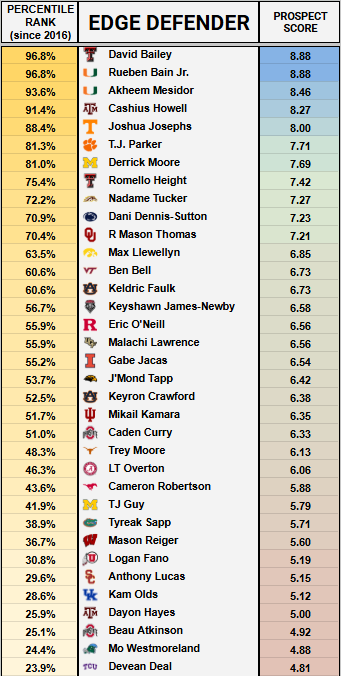
With all this in mind, it’s time to look at this year’s edge prospects to identify our future IDP contributors. It should also be noted that these scores should not necessarily be used so much as your rankings, as they should be more of a guide toward the quality of the player. Draft capital and landing spot can and will play a big part in actual rankings, though these scores can help us determine which players to trust or not when it comes time to pull the trigger on these players in our rookie drafts.
Rueben Bain Jr., Miami (FL)
- Consensus draft capital: 3rd overall
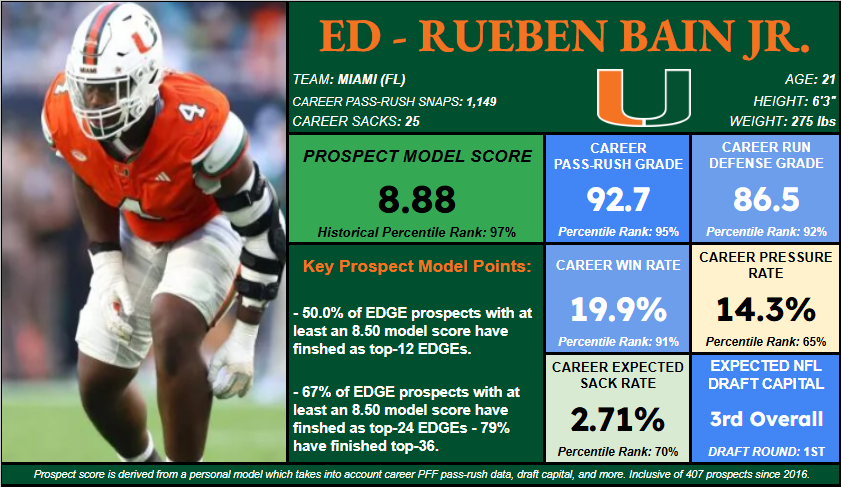
- Bain is coming off a massive 2025 season where he finished top 10 at his position in the Power-Four conferences in pass-rush grade (92.4) while leading the position in total pressures (83) and finishing second in win rate (23.5%).
- After a strong first two seasons in Miami, Bain delivered a career year in Year 3, which helped him crack the top five in consensus mock drafts right now, and his high-end prospect model score indicates that he deserves high capital.
- Bain finished his college career with 25 sacks in three seasons, and based on his high-end advanced metrics, there’s evidence that he could have landed more with a little luck.
- Bain’s 29.6 expected sack total is a 95th percentile mark among prospects since 2016, which is important context heading into draft season, since others landed more but don’t necessarily have the stable metrics to say they’ll keep that going at the next level.
- Bain’s high-end marks as a run defender are also important, and they help separate him from some of his peers, as his 86.5 run-defense grade is a 92nd percentile mark.
- This is important context for an 8.50 scorer or higher in the model, as there are only five other prospects who achieved a higher career run defense grade from that model score range.
- Nick Bosa, Will Anderson Jr., Aidan Hutchinson, Joey Bosa, and Mike Green all achieved this mark, and four of those five have all been top-12 IDP scorers in their careers, while Green is the lone exception after his rookie year.
- Depending on league scoring and positional need, there’s an argument for Bain as the IDP 1.01 in this year’s class, considering the likely hit rate and positional value.
David Bailey, Texas Tech
- Consensus draft capital: 7th overall
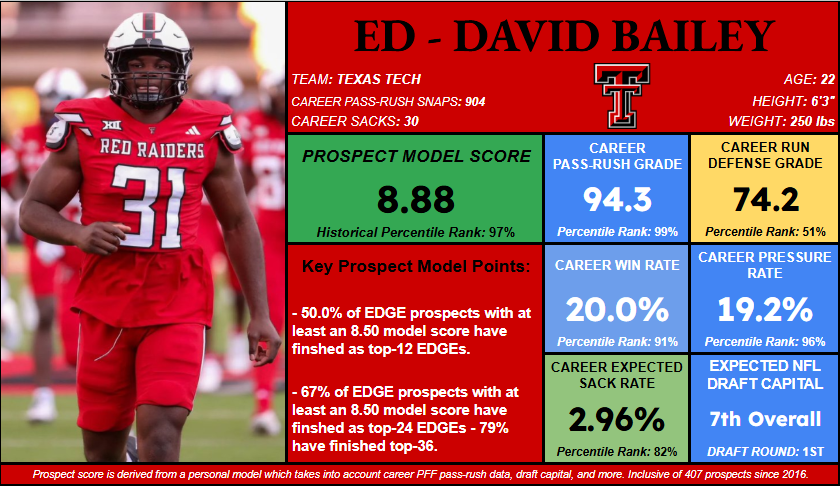
- Bailey is in a tight competition with Bain for the top spot at this position heading into the NFL draft, as both players have been mocked as potential top-10 picks and are tied in overall prospect model score.
- Bailey boasts similar high-end pass-rush metrics as Bain, even leading the Power-Four conferences in pass-rush grade in 2025 (93.8) and 2024 (93.2).
- Bailey’s first three seasons were spent at Stanford, where his overall playing time wasn’t nearly as high as it was this past season after transferring to Texas Tech, essentially doubling his total pass-rush opportunities from the previous year.
- Bailey was not only productive on those opportunities, but it also helped him showcase some of the best pass-rush metrics in recent years.
- Bailey's 94.3 career pass-rush grade trailed only Chase Young (95.4) and Myles Garrett (94.4) among past Power-Four conference-exclusive prospects since 2016.
- While he doesn’t necessarily have the run-defense marks to compare to Bain, his pressure rate (19.2%) and quick pressure rate (14.0%) are also top 95th percentile marks and significantly better than Bain, who scores between the 65th and 70th percentile in those regards.
- With Bain and Bailey both potential top-10 picks who don't show any real red flags, both should be in the conversation for rookie IDP 1.01, and whichever you choose, the other shouldn’t be far behind.
Keldric Faulk, Auburn
- Consensus draft capital: 15th overall
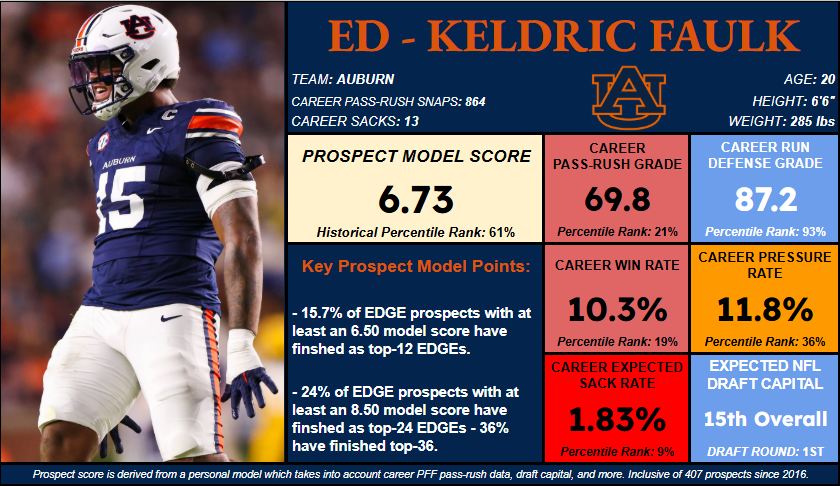
- Faulk appears to be this year’s class’ version of the big, highly athletic edge defender that NFL teams are going to fall in love with his potential.
- Every year, there seems to be a player like this who cracks the first round purely off size and athleticism, despite not boasting proven pass-rush metrics, but the potential is seemingly there.
- In 2025, it was Shemar Stewart and Mykel Williams, 2024 didn’t really have a player like this, though 2023 had Tyree Wilson, 2022 had Travon Walker, 2021 had Payton Turner, etc.
- These players either take longer to develop into players worthy of the draft capital spent on them, or they don’t hit at all, so it’s become clear that the first round is not the range worth making those gambles, yet not every NFL team is going to learn that lesson.
- This year, Faulk appears locked into the first round, and while he may deliver at the next level, it’s much more unlikely that he’ll do so right away, if at all.
- Faulk’s career pass-rush grade ranking among the bottom 25th percentile is a clear concern for his IDP potential, as there have only been seven past prospects drafted Day 2 or earlier since 2016 with a career pass-rush grade below 70.0, including Noah Spence, Landon Jackson, Lorenzo Carter, Tanoh Kpassagnon, Chad Thomas, Oluwafemi Oladejo, and Travon Walker.
- Only Walker has ever cracked the top-24 IDP scorers in his career from that group, and there’s a clear argument to be made that he’s done so purely off of playing time alone, as the team that spent the first overall pick on him had no choice but to force that value out.
- Auburn will likely need similar circumstances to deliver for IDP at the next level, especially in the early stages of his career as we wait for his potential development.
Cashius Howell, Texas A&M
- Consensus draft capital: 21st overall
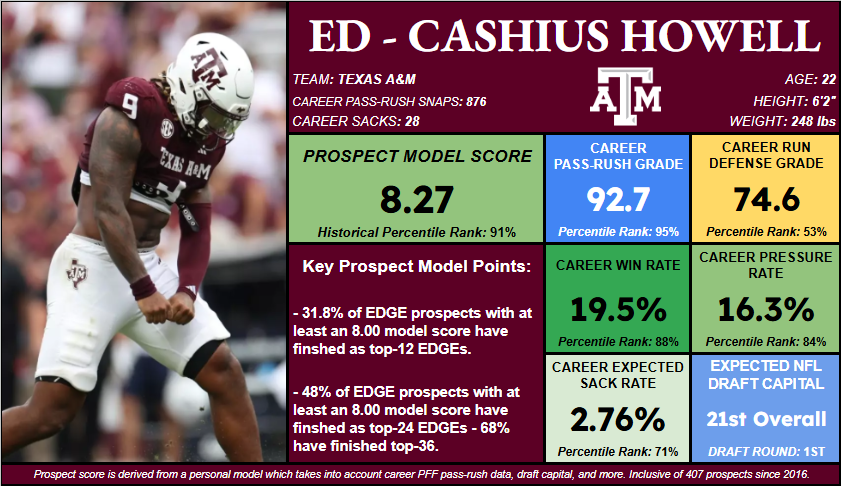
- Howell is a strong potential first-round pick for the NFL draft based on consistent pass-rush prowess throughout his collegiate career.
- Howell delivered three consecutive seasons with at least a 90.3 pass-rush grade, including his final year at Bowling Green (2023) and the past two seasons after transferring to Texas A&M, cracking the top 12 at his position in that regard in the Power-Four conferences the past two years.
- Howell was incredibly unlucky in the sack column in 2024 with just four sacks, though all of his key underlying metrics pointed to a player due for positive regression, and he delivered on that in 2025, likely helping him solidify his standing as a potential first-round pick.
- Howell doesn’t score as highly in terms of run defense, though his pass-rush prowess will get him drafted highly and potentially get him on the field for high-value snaps early in his NFL career, even if he’s not an immediate weekly IDP asset.
- Howell comes with a decent enough hit rate to be worthy of drafting in IDP rookie drafts this year, even if not until the third or fourth round, depending on scoring.
T.J. Parker, Clemson
- Consensus draft capital: 31st overall
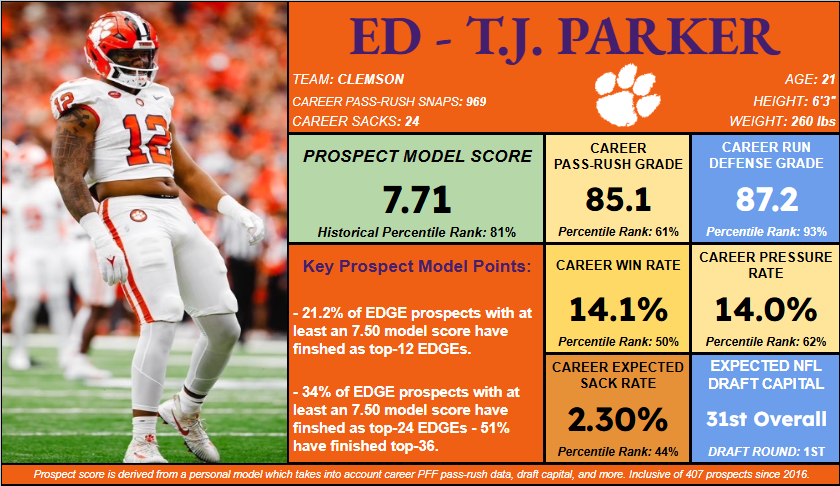
- Parker is currently the fifth of six potential first-round edge defenders in this class, though unless he tests off the charts at the NFL combine, he’s one I wouldn’t mind seeing dropping to the second round.
- While his underlying pass-rush metrics aren’t nearly as concerning as the previously mentioned Faulk, he’s not quite on the level of what we typically see from first-round edge prospects.
- The average career pass-rush grade for past first-round edge prospects since 2016 is 85.1, and the most successful IDPs often are much higher than that while a lot of the misses come in below that mark.
- Unfortunately, Parker currently falls in the latter category as a player with below-average metrics compared to past first-round picks, putting him in a bucket with 22 of 55 edge defenders to score below that 85.1 average career pass-rush grade.
- Of those 22, only three (13.6%) – Travon Walker, Haason Reddick, Greg Rousseau – have cracked the top-12 IDP performers at the position, and 14 (64%) have not cracked the top-36.
- Parker can still be a usable IDP asset, regardless of whether he lands in the first or second round of the NFL Draft, though IDP managers should keep in mind that his likelihood of being a locked-in weekly starter is lower than most, putting him in the range of fourth or fifth rounds of rookie drafts.


 © 2026 PFF - all rights reserved.