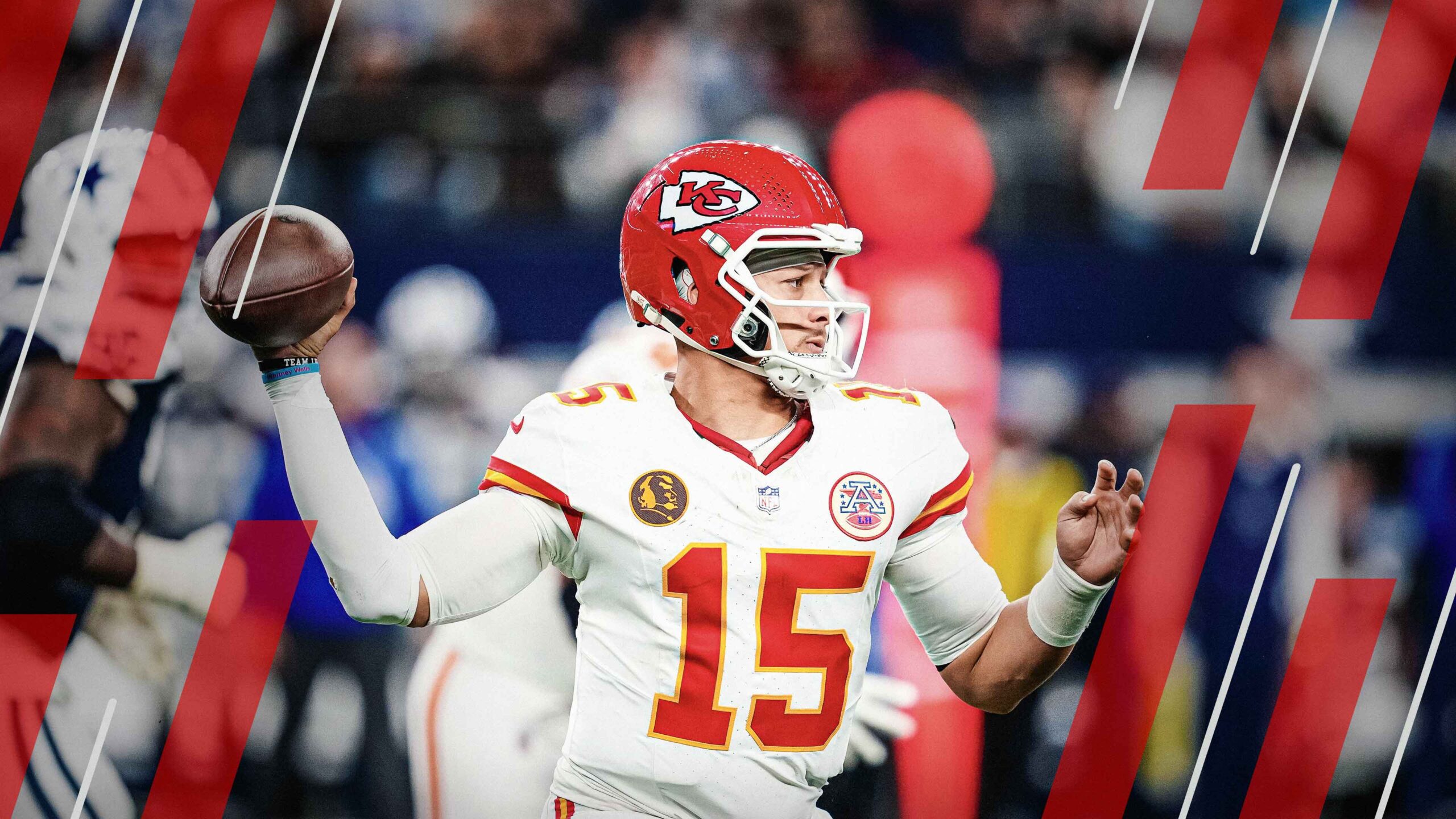
- Patrick Mahomes' torn ACL raises questions for fantasy managers: What should be expected of him once he returns? We dive into 10 serious quarterback injuries to find out.
- Quarterbacks tend to slightly decline post-injury: The season after returning, our 10-player sample averaged 25 touchdowns, 12 interceptions, 21 big-time throws and 17 turnover-worthy plays — all slightly lower marks than the year before (or the year of) the player’s season-ending injury.
- 2026 NFL Draft season is here: Try the best-in-class PFF Mock Draft Simulator and learn about 2026's top prospects while trading and drafting for your favorite NFL team.
Estimated Reading Time: 8 minutes
It goes without saying that one of the biggest stories of the 2026 offseason is the status of Kansas City Chiefs quarterback Patrick Mahomes. The ninth-year signal caller tore his ACL during a Week 15 loss to the Los Angeles Chargers and faces a lengthy road to recovery.
Aside from the injury all but putting an end to Kansas City’s chances at making a postseason surge, it sent fantasy football managers (especially those playing dynasty) into a frenzy. What do you do with a consensus top-five fantasy quarterback, in the prime of his career, coming off a serious injury?
Mahomes was having, by his own lofty standards, a relatively average season. Among quarterbacks with at least 350 dropbacks, he ranked 14th in PFF passing grade (70.7). And yet, he was the QB2 overall entering Week 15 in standard-scoring dynasty formats.
Mahomes' injury poses an interesting fantasy question: What can we expect from him when he eventually returns?
The same can also be asked of Indianapolis Colts quarterback Daniel Jones (68.7 PFF passing grade), who tore his Achilles during a Week 14 loss to the Jacksonville Jaguars. Jones was the QB7 entering that game, and he faces a similarly grueling rehab process ahead of the 2026 season.
For this exercise, we’ll pick 10 signal-callers who have suffered serious, season-ending injuries since 2015 — when PFF began tracking fantasy data.
Those are, in no particular order: Joe Burrow, Aaron Rodgers, Daniel Jones, Kirk Cousins, Ben Roethlisberger, Jimmy Garoppolo, Carson Wentz, Ryan Tannehill, Andrew Luck and Tom Brady.
One exception had to be made, as charting the seasons on either side of Brady’s 2008 ACL tear is required learning.
It’s a wide range of quarterbacks, from MVPs to manageable QB2 starters, all of whom have had stellar fantasy seasons in one regard or another. Averaging the above 10 signal-callers out should create a usable baseline of expectation for Mahomes in 2026 or 2027 — should he suffer any complications — and others.
Here are the statistics from those 10 quarterbacks before injury:
| Player | Year | PFF Passing Grade | Pass TDs | Rush TDs | INTs | Big-Time Throws | Turnover-Worthy Plays | QB Finish |
| Brady | 2007 | 94.8 | 50 | 2 | 8 | 38 | 9 | — |
| Luck | 2016 | 90.3 | 31 | 2 | 13 | 30 | 15 | QB4 |
| Tannehill | 2016 (13 games) | 73.4 | 19 | 1 | 12 | 25 | 16 | QB26 |
| Wentz | 2017 (13 games) | 84.7 | 33 | 0 | 7 | 29 | 17 | QB7 |
| Garoppolo | 2018 (3 games) | 60.5 | 5 | 0 | 3 | 4 | 5 | — |
| Roethlisberger | 2018 | 75.2 | 34 | 3 | 16 | 43 | 27 | QB3 |
| Burrow | 2020 (10 games) | 74.3 | 13 | 3 | 5 | 15 | 15 | QB14 in 10 games |
| Rodgers | 2022 | 75.9 | 26 | 1 | 12 | 33 | 18 | QB13 |
| Jones | 2023 (6 games) | 54.4 | 2 | 1 | 6 | 4 | 9 | QB29 in 6 games |
| Cousins | 2023 (8 games) | 85.1 | 18 | 0 | 5 | 10 | 8 | QB6 in 8 games |
When averaging the above out, we see the following: 23 passing touchdowns, one rushing touchdown, nine interceptions, 23 big-time throws and 14 turnover-worthy plays.
Those averages are very similar to Green Bay Packers quarterback Jordan Love’s 2025 campaign: 23 passing touchdowns, six interceptions, 27 big-time throws and 14 turnover-worthy plays. Love finished as the QB16 in standard-scoring PPR formats in 2025, so it’s reasonable to assess that the average from those 10 players would be a strong QB2 candidate. However, we must account for Garoppolo and his three games played.
Garoppolo suffered his injury after just three games in 2018, and since the former San Francisco 49ers quarterback only started five games in 2017, there is no healthy baseline to quantify him.
It’s easy to assume that any player who misses a season due to a serious injury will come back and be far less productive. After all, their body needs to return to a football routine, and it could take time to settle in. When you watch a player after a serious injury, it can seem as though they’re a step slower.
But from a fantasy perspective, we’re concerned with whether they’re still tossing up numbers. Points are points, regardless of how they come. The extra stuff is good guidance for if you’re riding with them long term or just using them as a QB2 bridge (or desperate QB1 play).
Take Aaron Rodgers, for example. His age and lost 2023 season were two huge question marks entering 2024. The last time we had fully seen him was in a disjointed 2022 campaign.
But even while dealing with a worse offensive line as a member of the New York Jets, who logged a 68.9 PFF pass-blocking grade in 2024 (17th) compared to the Packers' 77.6 mark in 2022 (third), and a near-identical PFF receiving grade for his skill position players, Rodgers still performed almost equally from a statistical point of view.
His time to throw was similar (2.67 seconds in 2022 compared to 2.65 seconds in 2024), his adjusted completion percentage was separated by just 2.1 percentage points in 2022 (75.8%) and 2024 (73.7%) and even his average yards per attempt numbers were just 0.1 yards off (6.8 in 2022 and 6.7 in 2024). His average depth of target in 2024 did drop by 1.2 yards, though.
And this was reflected in Rodgers' fantasy finishes. He went from the QB13 in 2022 (255.2 total points) to the QB15 in 2024 (267.6 total points) while scoring more total points. All of this is to say he was basically fine as a QB2 even though so much had changed around him in the intervening two years.
But that isn’t always the case. Kirk Cousins was dealing in 2023 with the Minnesota Vikings before an Achilles injury shut him down after eight games. At that time, he owned the second-best PFF overall grade of his career (86.1), had logged a career-high 80.5% adjusted competition rate and had tossed 18 touchdowns, projecting him to throw a career-high 38 over 17 games.
He was not the same player in 2024 with the Atlanta Falcons, nor was he in 2025. In 2024, Cousins threw for 18 scores across 14 contests — a far cry from the passer who tossed the same amount of touchdowns in almost half the games.
His 10 big-time throws in 2023 were the 15th most among 31 qualifying quarterbacks from Weeks 1 to 8. A year later, he logged just 13 such throws in 14 games, 24th out of 26 qualifiers. Add into the mix that his number of turnover-worthy plays tripled (from eight to 24) and his turnover-worthy play rate doubled (from 2.3% to 4.6%), and you have a problem at quarterback on your fantasy roster.
But how did the rest shake out? Here are the numbers for those same signal-callers coming off their season-ending injuries:
| Player | Year | PFF Passing Grade | Pass TDs | Rush TDs | INTs | Big-Time Throws | Turnover-Worthy Plays | QB Finish |
| Brady | 2009 | 82.5 | 28 | 1 | 13 | 30 | 11 | — |
| Luck | 2018 | 88.8 | 39 | 0 | 15 | 35 | 22 | QB5 |
| Tannehill | 2018 (11 games) | 42.4 | 17 | 0 | 9 | 8 | 23 | QB30 |
| Wentz | 2018 (11 games) | 78.5 | 21 | 0 | 7 | 18 | 16 | QB23 |
| Garoppolo | 2019 | 75.7 | 27 | 0 | 13 | 13 | 19 | QB14 |
| Roethlisberger | 2020 | 68.2 | 33 | 0 | 10 | 26 | 18 | QB14 |
| Burrow | 2021 | 91.2 | 34 | 2 | 14 | 35 | 15 | QB8 |
| Rodgers | 2024 | 76.1 | 28 | 0 | 11 | 26 | 12 | QB15 |
| Jones | 2024 (10 games) | 67.5 | 8 | 2 | 7 | 7 | 9 | QB17 in 10 games |
| Cousins | 2024 (14 games) | 72.3 | 18 | 0 | 16 | 13 | 24 | QB21 |
Averaging all this out results in 25 touchdowns, 12 interceptions, 21 big-time throws and 17 turnover-worthy plays — all slightly lower marks than the season before (or the season of) the player’s season-ending injury.
Coincidentally, that average is very close to what Mahomes put together in 2025: 22 touchdowns, 11 interceptions, 23 big-time throws and 20 turnover-worthy plays.

The bottom line is this: Trading for injured quarterbacks in dynasty, or waiting for them to fall in redraft formats, is a standard strategy for fantasy managers looking to find value.
But know that you’re also buying a dip in production with the risk that the player doesn’t even start all 17 games, depending on how late in the season the injury occurred.
Buyer beware, you will almost certainly have to wait until the player is two years removed from any serious injury to get a fresh assessment of their talents.


 © 2026 PFF - all rights reserved.