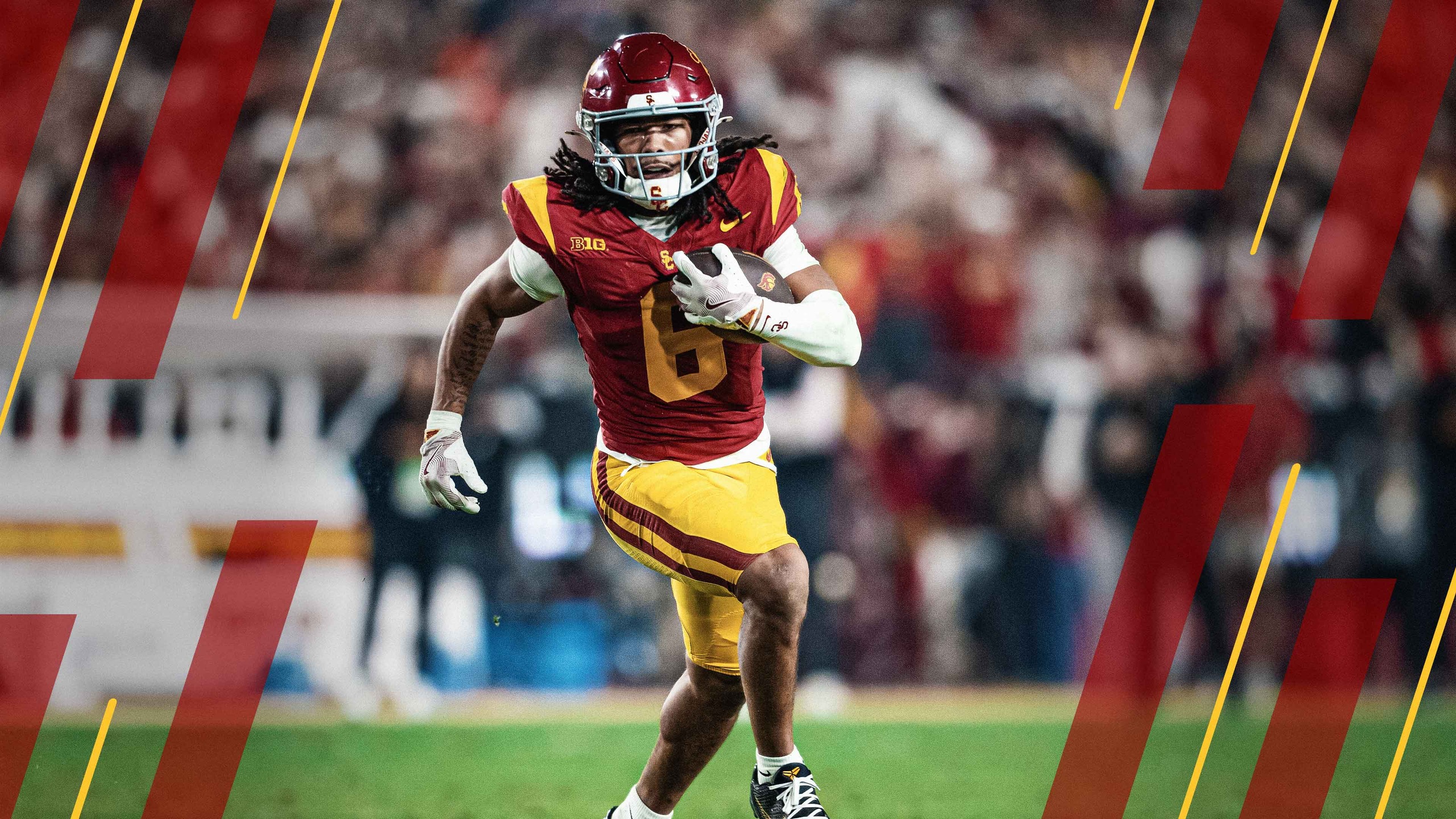
- Makai Lemon and Jordyn Tyson thrive: Lemon and Tyson stand out once again as more context is added to their career college production.
- Indiana boasts two top performers: Elijah Sarratt and Omar Cooper Jr. overcome each other’s target competition to deliver high-end production.
- Unlock your edge with PFF+: Access Premium Stats, dominate fantasy with in-season tools and projections and make smarter bets with the new PFF Player Prop Tool. Get 25% off your PFF+ annual subscription with code PFFFANTASYPODCAST25.
Estimated reading time: 9 minutes
One of the most common statistics used in evaluating wide receiver draft prospects is yards per route run. YPRR is a stable metric from college to the NFL and year-to-year in the NFL. However, like any evaluation tool, it isn’t perfect at identifying future star NFL players.
The idea with personnel-adjusted YPRR is to dive even deeper into the data and provide more context into a player’s production — specifically, which ones were put in more or less favorable situations based on how many other wide receivers were on the field with them on any given play.
We performed this same analysis for the 2025 and 2024 classes, and while it might be too early to conclude whether the players are NFL standouts, there was quite a bit to take out of that exercise, which included historical hit rates going back to 2019. This year’s version will look to do something similar: identify which players performed well above expectations and which ones have red flags.
Typically, the fewer wide receivers on the field, the easier it is to rack up yardage for the wide receivers who are out there. And the more wide receivers on the field, the more difficult it is to be efficient, as highlighted in the chart below.
Power Four WR groupings from 2023-2025
| Number of WRs on the Field | Average WR Yards per Route Run |
| 1 | 1.98 |
| 2 | 1.97 |
| 3 | 1.49 |
| 4 | 1.38 |
| 5 | 0.86 |
Key
- YPRR: Yards per route run is the number of receiving yards a player accrued over their college career divided by the number of routes they ran.
- Expected YPRR: Derived from a formula that breaks down how many routes each wide receiver ran from the listed personnel groupings (one-WR sets, two-WR sets, three-WR sets, four-WR sets, five-WR sets) to calculate what their YPRR figure should be based on the average production from the position.
- Deviation: The total number of actual yards per route run over (or under) the player's expected yards per route run total.
- Percentile Rank: The percentage of wide receiver prospects since 2019 that each player ranks higher than in the respective category.
- Teams with a light yellow highlight: Wide receiver played at least one season in a Power Four conference. Highlighted to remove some of the noise from competition-level concerns.
- Players with a bright yellow highlight: Player is a projected top-100 pick in the consensus mock draft database. These are the players that we will focus on most.
With the stage set, let’s dive into the 2026 NFL Draft wide receiver class, starting with those who produced the most yards per route run over expectations based on their various personnel involvements in college.
Top performers in YPRR over expected | 2026 NFL Draft class
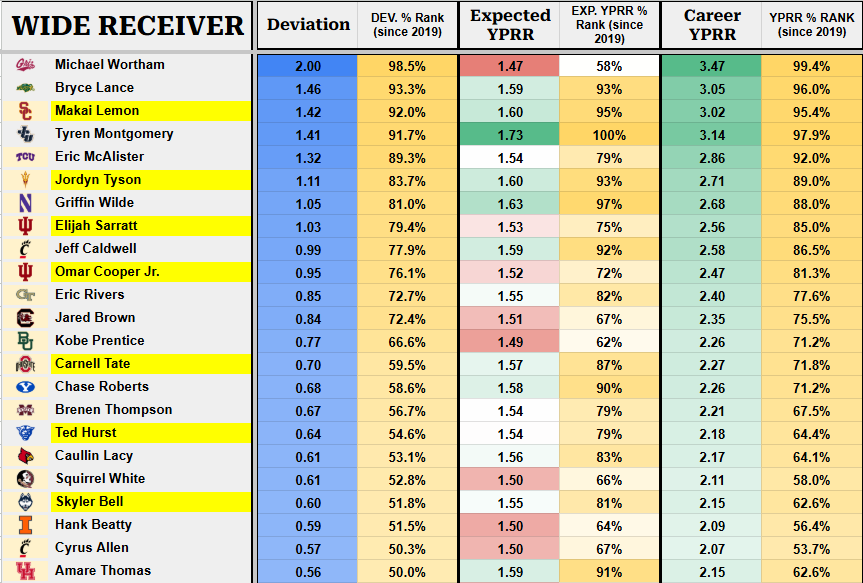
Projected top-100 players of note:
- Makai Lemon, USC:
- It should be no surprise that Lemon leads the way in terms of delivering yards per route run over expectations, as he also leads all Power-Four wide receivers in this class in career yards per route (3.02).
- Lemon was among the most effective with his playing time in this class, posting over 1,100 receiving yards from three-receiver sets – over 500 more receiving yards than expected in that regard.
- As a potential top-15 pick in this year’s draft, there are nothing but positive signs in Lemon’s on-field performance coming out of college, which is a big reason why he deserves first-round capital.
- Jordyn Tyson, Arizona State:
- Tyson has been in and out of the projected top-10 picks in this year’s class, and while he doesn’t surpass Lemon – who is now being mocked ahead of him – in terms of his underlying metrics, he still projects as a top receiver prospect.
- It’s worth noting that Tyson was often put in very favorable situations to be more efficient, ranking in the 93rd percentile in expected yards per route run.
- Tyson ran just two routes from sets of four or more wide receivers on the field in his career, which, as noted at the top, can make life much easier for a wide receiver.
- One surprising data point to highlight for why Tyson wasn’t even higher on this list is that he significantly underperformed in two-receiver sets by a little more than 60 yards below expectations.
- Tyson’s 1.64 yards per route run in two-receiver sets was well below average for this class, while his 3.03 yards per route run in three-receiver sets was the best mark among Power Four receivers in this class.
- Elijah Sarratt, Indiana:
- Sarratt has some of the most career receiving production in this year’s class, delivering 3,652 receiving yards over his four-year career, though his efficiency would indicate he’s not just a compiler as a result of being a four-year starter.
- Sarratt, like most prospects, delivered the large majority of his production from three-wide receiver sets, though his efficiency from those routes across four seasons allowed him to deliver over one thousand receiving yards above expected for his career in those situations.
- Omar Cooper Jr., Indiana:
- Cooper emerged as Indiana’s top receiver this past season, leading the team in targets (91), receptions (69) and receiving yards (937).
- Cooper’s efficiency as a starter allowed for over 500 receiving yards above expected in three-receiver sets and over 150 receiving yards above expected in two-receiver sets.
- Cooper delivering well over expected in these situations, while mostly competing with another high-end target-earner like Elijah Sarratt in the offense, is an important context to put him in the conversation for one of the top players at his position in this class.
- Carnell Tate, Ohio State
- Tate is the projected top receiver in this class and for the most part, performs enough to help maintain that standing.
- It shouldn’t necessarily be a lock that Tate is the WR1 for this class with Tyson and Lemon outperforming him in several metrics, including this one and actual yards per route run.
- That being said, Tate dealt with significant target competition at Ohio State, which helps put his production into perspective — as Jeremiah Smith, the past two years, as well as Emeka Egbuka in 2024, did not make it easy for Tate to be overly efficient.
- Even with the target competition, Tate still performed over expectations in four-wide receiver sets and three-receiver sets for about 400 additional receiving yards in both situations combined.
Average to below-average performers in YPRR over expected | 2026 NFL Draft class
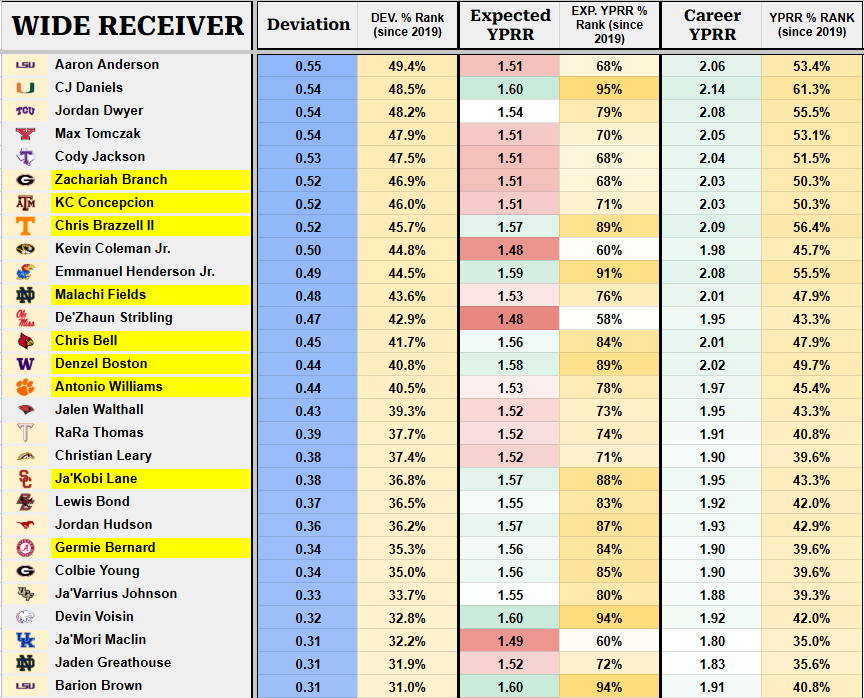
Projected top-100 players of note:
- Denzel Boston, Washington:
- Boston is one of two projected first-round wide receivers to fall into this mid-range performance area, which was the case with his actual career yards per route run total as well.
- Interestingly, Boston has no receiving production in four-, five-, or one-receiver sets in his college career, running just 13 total routes in those situations combined.
- As a result, two- and three-receiver sets created an above-average expectation for Boston to deliver solid production, indicated by his 89th percentile mark in expected yards per route run.
- Unfortunately, even with slightly more favorable situations, Boston’s 41st percentile mark isn’t as strong as we’d like to see from a potential first-round pick, though he may deliver at the next level.
- Unfortunately, the odds are against him as just 3.8% of wide receivers since 2019 to score in the 50th percentile or lower have finished as top-12 wide receivers so far.
- Only 6.4% from that bucket have finished as top-24 or top-36 wide receivers since 2019.
- KC Concepcion, Texas A&M:
- Concepcion is also a fringe first-round wide receiver who didn’t quite deliver in terms of actual career yards per route run (2.03), ranking just 50th percentile in that regard since 2019.
- However, it’s worth noting that Concepcion’s situations were among the least ideal among the first-round wide receivers.
- Concepcion ran more routes (267) from four-wide receiver sets than any of the other projected first-rounders and, to his credit, he outperformed average production in those situations, delivering 232 more receiving yards than expected.
- Concepcion delivered slightly above expected in three- and two-receiver sets, though his performance in the tougher four-receiver sets is likely the more encouraging data point for those looking at potential positives in his profile.
- Unfortunately, the more discouraging data point is that Concepcion still falls in that bottom 50th percentile of performers with the same low 6.4% hit rate of top-36 fantasy success, as was the case with Boston.
Poor performers in YPRR over expected | 2026 NFL Draft class
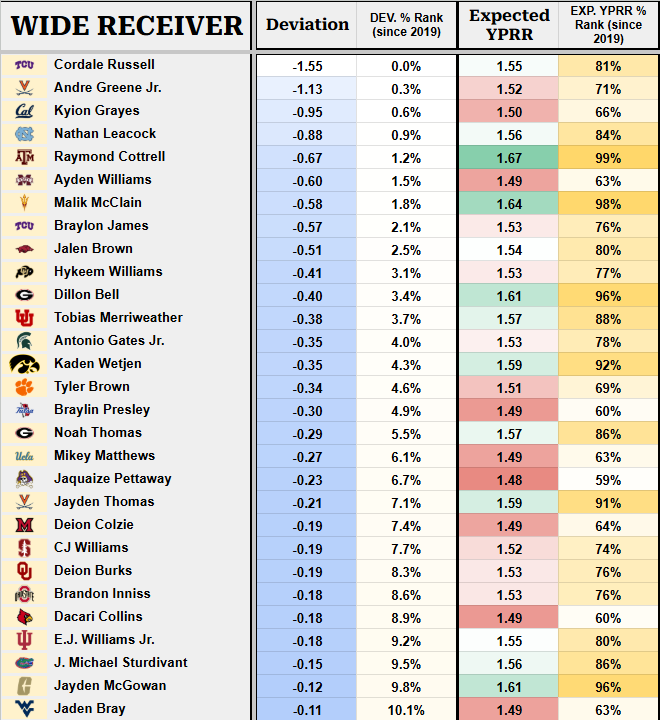
Players of note:
- For the first time in two years, there are no currently projected top-100 wide receivers in the bottom 20th percentile in this metric.
- In 2024, Adonai Mitchell, Keon Coleman and Xavier Legette were the names of concern with this metric.
- In 2025, Savion Williams was highlighted here, as was Isaiah Bond – who at the time was a projected top-100 pick via consensus mock drafts but ended up going undrafted.
- Deion Burks, Oklahoma
- This year, the closest receiver to the top-100 is Burks, who underdelivered in most situations, especially in three-receiver sets, where he came in nearly 200 receiving yards short of his expected totals.
- Even in two-receiver sets, Burks only delivered about eight receiving yards above expectations on 125 routes in those situations for his career.

 © 2026 PFF - all rights reserved.