- Jadarian Price has competition: Price’s lack of receiving production, his size and the eventual return of Zach Charbonnet are all limiting factors for the first-round rookie.
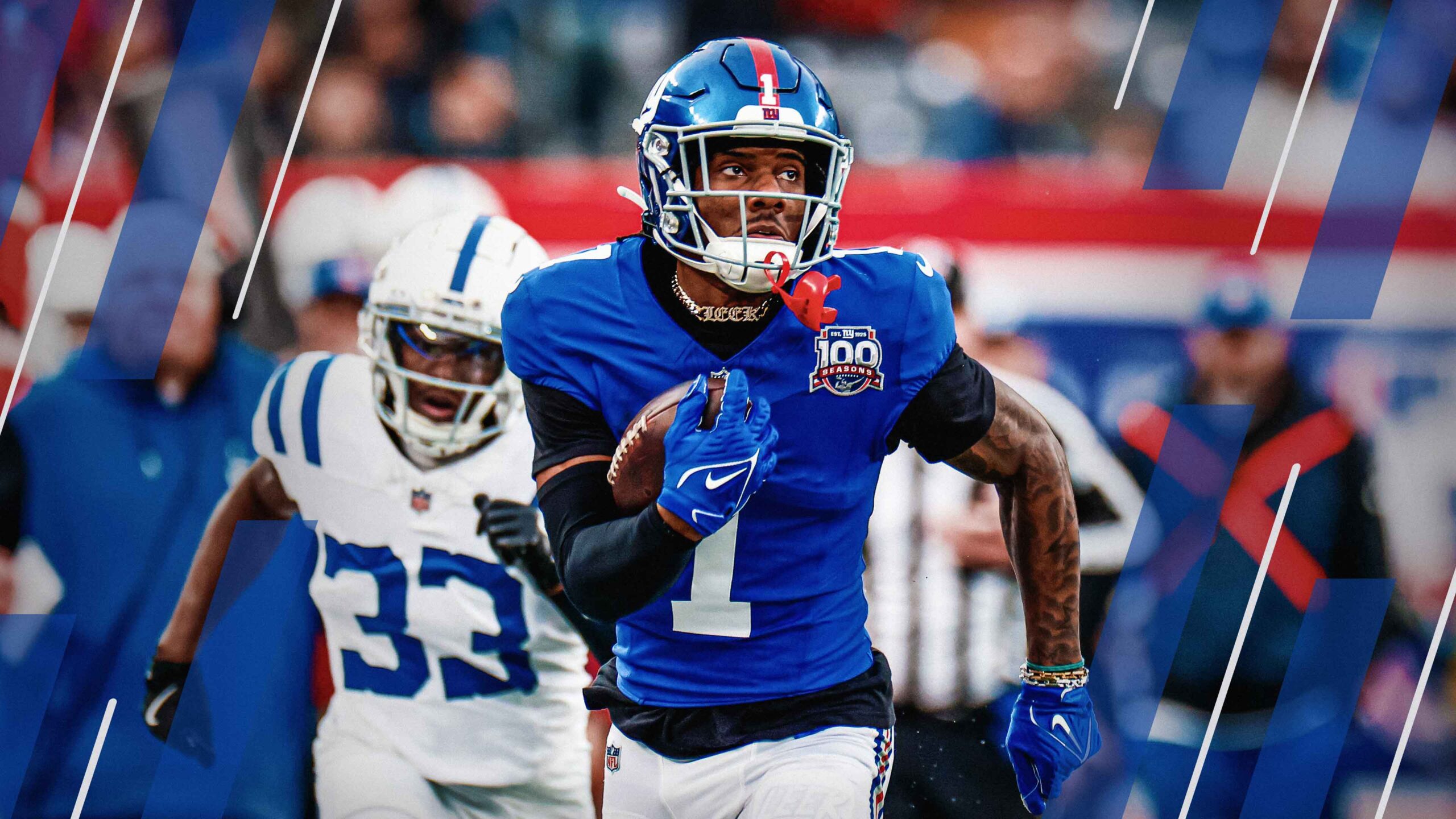
- Malik Nabers‘ recovery remains a concern: It is unclear whether the New York Giants‘ star wide receiver (ACL) will be ready for Week 1, and the team's recent additions at the position only add to the uncertainty.
- Dallas Goedert’s likely touchdown regression: Goedert reached career lows in several metrics last season, with touchdowns saving his fantasy value. Touchdown regression will take Goedert out of the starting-fantasy-tight-end conversation.

Fantasy football drafts are often driven by what players have done rather than what they are likely to do next. As a result, players can become overvalued when managers assume recent production will continue unchanged despite shifts in quarterback play, target competition or age-related decline. A player could also have more competition for touches than most fantasy managers realize.
The players featured in this article are being drafted as though they will replicate their recent production or have an exceptionally large role. However, there are legitimate reasons to expect a decline in fantasy output.
RB Jadarian Price, Seattle Seahawks
Price emerged as the second-best running back in the class despite serving as a backup last season. He has the least collegiate experience among the top-10 running backs in the class, but his 6.0 yards per carry ranked second among the top 20 backs, behind only Jeremiyah Love, and he tied for the best mark in yards after contact per carry at 4.3.
Where Price really stands out is his ability to create big plays. He posted the class' best rate of runs graded 1.5 or better, as well as the highest rate of runs graded 1.0 or better. His inexperience as a receiver is a red flag, with just 15 receptions over the last three seasons and a 9% target rate that ranks by far the lowest among the top 20 running backs. However, PFF's pre-draft analysis noted that his strength and willingness in pass protection could still help him develop into a three-down back.
Most big boards projected Price as a second-round player, but he went higher than expected, landing with Seattle at the end of the first round. The Seahawks were arguably the team most in need of a running back after losing Kenneth Walker III in free agency and Zach Charbonnet to an ACL injury.
The Seahawks employed an unusual backfield split last season, with Kenneth Walker III handling most of the early-down work. At the same time, Zach Charbonnet served as both the primary receiving back and goal-line option. That arrangement made it difficult to trust either player in fantasy despite Seattle's productive offense. Given his limited receiving background, Price could be deployed in a role similar to Walker's. Even with Charbonnet sidelined, a veteran addition such as Emanuel Wilson could absorb much of the receiving and goal-line work.
Price should still be drafted ahead of most running backs in committee situations because of his upside and offensive environment, but he carries the same risks associated with any timeshare. His redraft ADP will likely be shaped by offseason developments surrounding his role, the usage of the other Seahawks backs and Charbonnet's recovery timeline.
Charbonnet received light work in OTAs, a month earlier than expected, suggesting he might be ready to play sooner than anticipated. It’s early, but Price has been hit-or-miss as a receiver without pads. George Holani has been working with the first team throughout OTAs, and while Price is expected to pass Holani on the depth chart at some point, Holani could make this a three-man backfield before Charbonnet returns. While Price’s upside remains, the risk has been increasing.
WR Malik Nabers, New York Giants
Nabers was the sixth overall pick of the 2024 NFL Draft and immediately began living up to the hype, finishing with 100-plus yards in two of his first four games and three touchdowns during that stretch before missing two games due to injury. From Weeks 7 to 18, he averaged 16.5 PPR points per game, 12th best among wide receivers.
He ranked around the 90th percentile in most situations, was targeted on 29.7% of his routes, first among 72 wide receivers who ran at least 355 routes last season, and averaged a league-leading 11 targets per game. That elite volume and strong play added up to the seventh-most fantasy points per game last season. His high target rate gave him a reliable floor, scoring at least 8.0 PPR points in every game he played, though it also meant few truly explosive outings. After returning from injury, he had just one game with more than 85 receiving yards.
Nabers was healthy for only three games in 2025, all with Russell Wilson at quarterback, averaging 17.7 PPR points per game in those outings. His 86.4 PFF receiving grade over the past two seasons is by far the best among wide receivers in the past two draft classes, with Ladd McConkey‘s 80.2 mark ranking second. Ideally, he will take another step forward with Jaxson Dart at quarterback in 2026.
There is meaningful uncertainty around the Giants' offense. John Harbaugh takes over as head coach with Matt Nagy as offensive coordinator, and Cam Skattebo‘s health at running back remains a concern. New York added Darnell Mooney, Calvin Austin III and Malachi Fields at wide receiver and Isaiah Likely at tight end. None of those additions should significantly cut into Nabers' target rate, but it may not reach the highs of his rookie season.
The bigger concern is his health. Nabers is still working his way back from a torn ACL, and there is only hope he will be ready for Week 1. Even if he does return, there is a real chance he is not fully himself, and most wide receivers see a significant drop in production the season after returning from a torn ACL.
Those concerns were amplified when the Giants signed Odell Beckham Jr., JuJu Smith-Schuster and Braxton Berrios on the same day. None of them can replace what Nabers does at his best, but the fact that New York felt the need to add three more receivers after already bolstering the position earlier in the offseason suggests the team has real concerns about his availability.
Nabers' ADP sits among the top 10 wide receivers on most sites, and he could still reach that ceiling, but the risk of a significant underperformance is too high to justify a top-10 selection with confidence.
TE Dallas Goedert, Philadelphia Eagles
Goedert has a long history of reliability in fantasy football. He finished as TE10 in his second NFL season and has finished top 12 in either fantasy points or fantasy points per game in every subsequent season. For most of his career, he accomplished this through volume, which gave him a high floor and a low ceiling. From 2019 to 2024, Goedert posted the sixth-most receiving yards among tight ends but only the 12th-most touchdowns. He also posted the seventh-best PFF receiving grade by a tight end during this span, at 87.8.
Goedert was 30 years old during the 2025 season, and by several measures, it was the worst of his career. His 69.7 receiving grade was a career low, and his 39.4 receiving yards per game was the lowest mark since his rookie season. His 9.8 yards per reception and 4.1 yards after the catch per reception were career lows, as was his 0% contested catch rate. Most notably, he stopped making as many big plays. He earned a +1 grade or better on at least 1.5% of his routes in each of his first four career seasons. That rate fell to the 1.1-1.3% range from 2022 to 2024, and to 0.5% last season.
He was able to counteract this from a fantasy perspective with a career-high 11 receiving touchdowns, more than doubling his previous high of five. Eight of those touchdowns came when the Eagles were within 6 yards of scoring, tied for the most by a tight end in a season over the last 20 years. Jimmy Graham matched that mark in 2017. No tight end has finished a season with seven such touchdowns, and only six have reached six. Five of Goedert's touchdowns came on shovel passes and wide screens, and no other tight end in the last 20 years has more than two touchdowns from that combination of routes in a season. All of this makes it highly likely that Goedert's touchdown total regresses.
The Eagles drafted Eli Stowers in the second round to be their tight end of the future. While it's unlikely Stowers overtakes Goedert in 2026, he could cut into Goedert's playing time more than recent Eagles backups have.
To remain a weekly fantasy starter, Goedert will need to bounce back in his quality of play and have his new offensive coordinator, Sean Mannion, scheme up touchdowns the way Kevin Patullo did. Some combination of continued regression with age, a decrease in snaps in favor of Stowers, and a return to his usual touchdown totals would be enough to make Goedert a bye-week fill-in only.


 © 2026 PFF - all rights reserved.