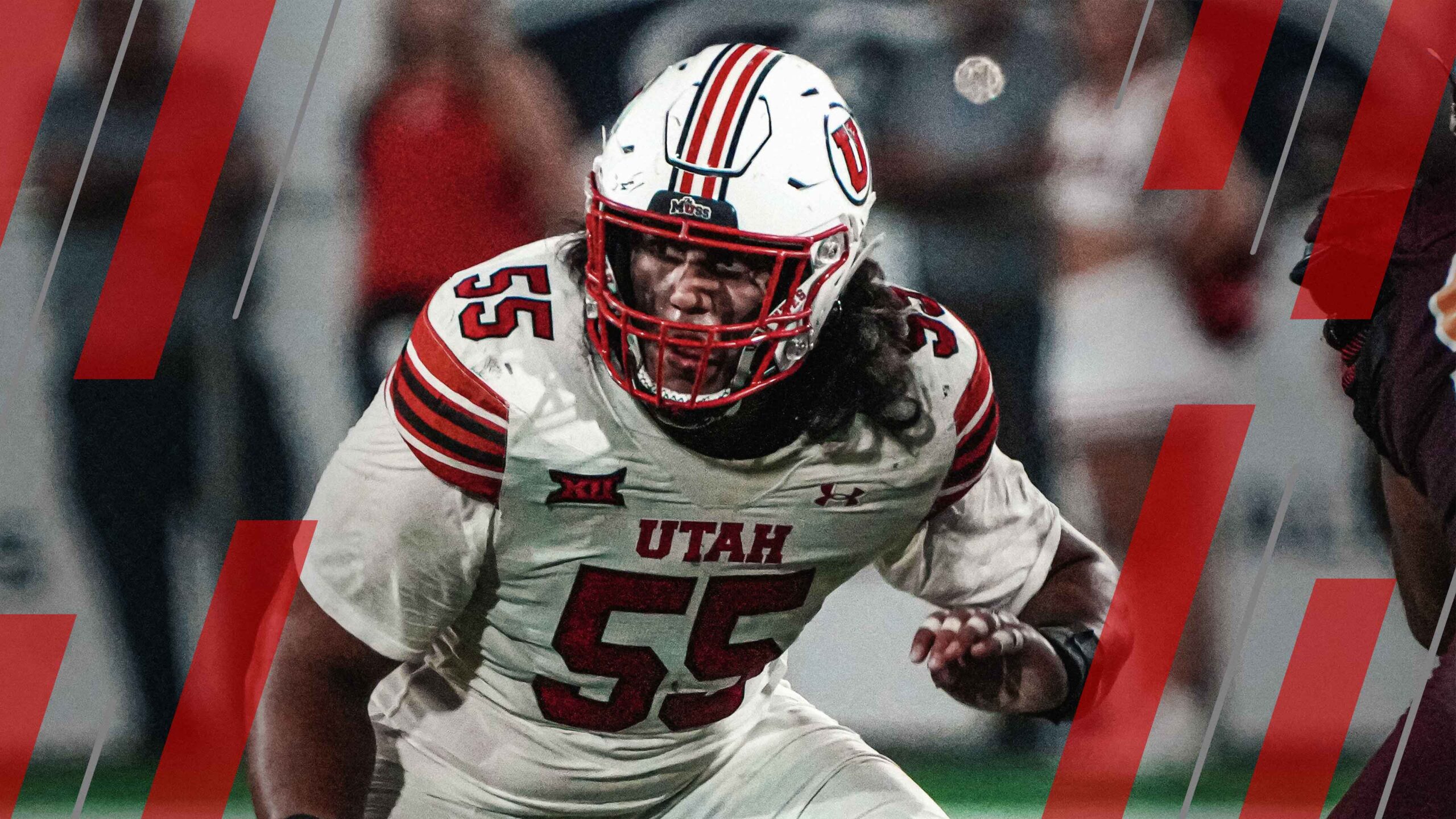
- Focusing on the needs of the offense: To effectively run his offense in 2026, Mike LaFleur will need an above-average run-blocking right tackle — particularly one who thrives in outside zone concepts.
- No shortage of options: The top three offensive tackle prospects on the predictive big board — Utah’s Spencer Fano, Miami’s Francis Mauigoa and Alabama’s Kadyn Proctor — all fit the bill for Arizona at right tackle.
- 2026 NFL Draft season is here: Try the best-in-class PFF Mock Draft Simulator and learn about 2026's top prospects while trading and drafting for your favorite NFL team.
The Arizona Cardinals enter 2026 with the premium picks needed to reshape their roster in 2026, holding three selections inside the top 65: No. 3 overall, No. 34 and No. 65.
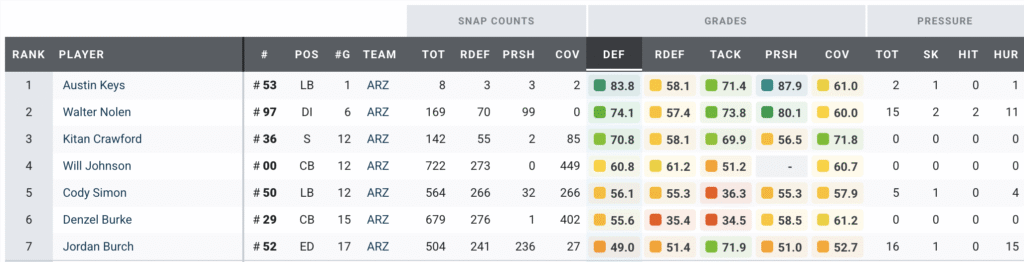
Since taking over, general manager Monti Ossenfort has understandably prioritized the defensive side of the ball, using six of his eight top-50 picks there. In 2025, Arizona doubled down on that approach, spending its first five selections — and six of seven overall — on defense by picking interior defender Walter Nolen, cornerback Will Johnson, edge defender Jordan Burch, linebacker Cody Simon, cornerback Denzel Burke and safety Kitan Crawford.
While that investment didn’t immediately translate into wins, it yielded encouraging early returns. All six defensive rookies played meaningful roles in 2025, combining for 28 starts, 2,780 defensive snaps and another 813 snaps on special teams.
Nolen and Johnson, in particular, flashed star-level potential when healthy, and five of the six defenders recorded at least one 90.0-plus PFF game grade.
Ossenfort’s 2025 draft class should only see its impact grow with increased playing time over the next two seasons, forming the foundation of Arizona’s defense moving forward.
Cardinals' 2025 draft class on defense
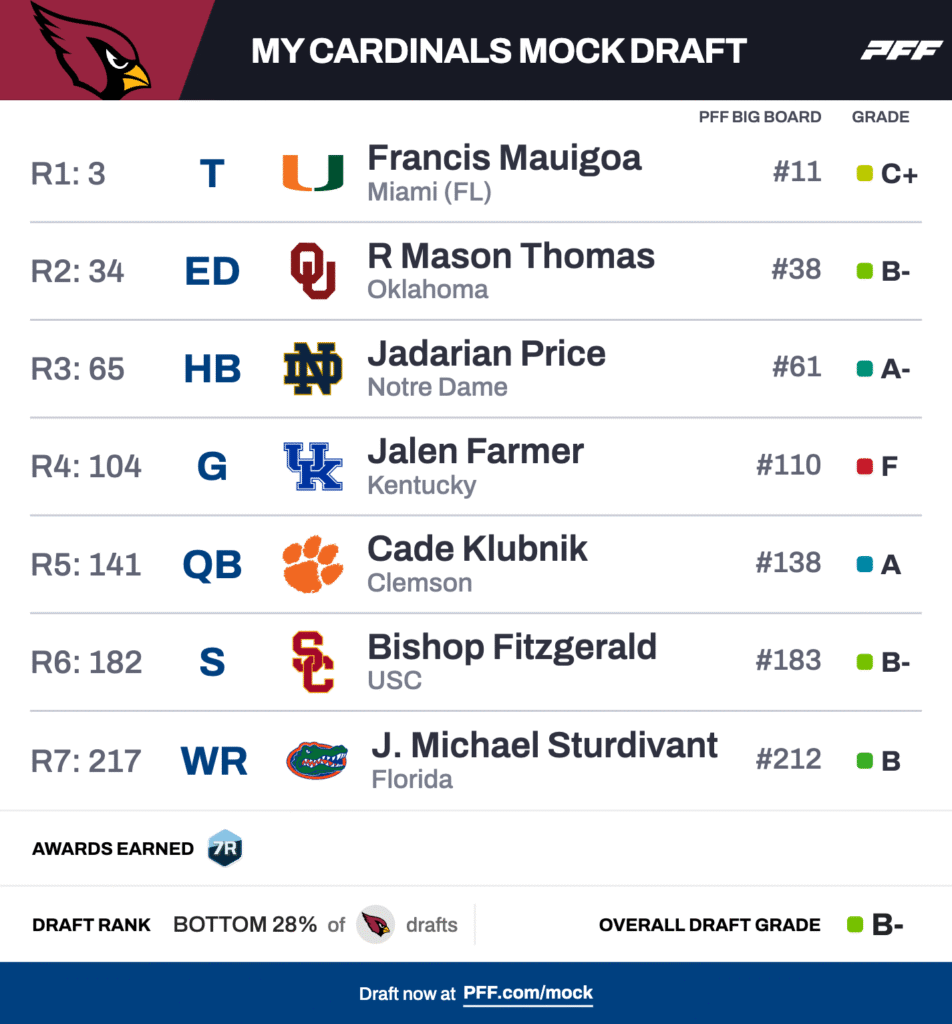
The Cardinals could opt for a best-player-available approach with the No. 3 overall pick, and that player may very well come from the defensive side of the ball. Selecting Miami edge defender Rueben Bain Jr. and pairing him with Walter Nolen would create a disruptive front that offensive coordinators would have to game-plan around weekly. Texas Tech’s David Bailey would provide another productive young edge presence. Ohio State safety Caleb Downs is one of the highest-ranked players on the predictive big board, though safety is arguably one of the deeper positions on Arizona’s roster. Meanwhile, Ohio State linebacker Arvell Reese offers athleticism and versatility in the front seven, but his pass-rush impact remains more projection than proven production at this stage.
From a roster-building standpoint, however, it would not be surprising to see the pendulum swing back toward offense in the 2026 NFL Draft after such a heavy defensive investment in 2025.
Allocating one of those premium picks to support new head coach Mike LaFleur’s offensive vision may ultimately represent the most strategic use of Arizona’s draft capital — and the clearest way to accelerate the team’s overall development.
What Mike LaFleur Wants to Do on Offense
In 2021, Mike LaFleur joined Robert Saleh’s staff with the New York Jets, serving as offensive coordinator and primary playcaller for the 2021 and 2022 seasons. Evaluating the concepts he leaned on during that two-year stretch provides the clearest projection of what his offense could look like in 2026, as he did not call plays during his most recent stop under Sean McVay in Los Angeles.
LaFleur has often credited Kyle Shanahan with giving him the foundational blueprint for his offensive philosophy. Like his mentor, LaFleur built his run game around the outside zone. During his time calling plays in New York, outside zone accounted for roughly 35% of all run calls, with inside zone serving as the complementary staple.
There is, however, a significant stylistic gap between LaFleur’s preferred structure and what Arizona has been doing offensively. From a personnel standpoint, the Cardinals have leaned toward more power-oriented, people-moving offensive linemen rather than the laterally agile, mobile blockers required to execute outside zone at a high level.
That philosophical difference showed up in the numbers. Over the past two seasons, Arizona ranked near the bottom of the league in outside-zone usage. In 2025, the Cardinals ran outside zone on just 10% of their rushing attempts, the lowest rate in the NFL.
If Arizona is going to pivot toward LaFleur’s historically outside-zone-heavy system, the roster will need to reflect that shift. As currently constructed, the offensive line was not built for that approach, which explains why the Cardinals rarely called it.
Adding linemen who can consistently reach, climb and operate in space will be essential if LaFleur is going to implement his vision successfully.

The Pieces LaFleur Will Need to Implement His Scheme in Year 1
The Cardinals are unlikely to find a franchise-altering quarterback with the No. 3 overall pick in the 2026 NFL Draft. They already have young building blocks at left tackle, wide receiver and tight end. From a roster-construction standpoint, investing in a right tackle feels like the most logical next step.
Paris Johnson Jr. is a talented long-term fixture at left tackle, but the right tackle spot still lacks stability. Rather than continuing to rely on short-term free-agent patches, Arizona would be better served by drafting and developing a cornerstone at the position. Using the No. 3 pick on a right tackle would go further than any other move toward helping Mike LaFleur build and execute his offense — both immediately in 2026 and in the years beyond.
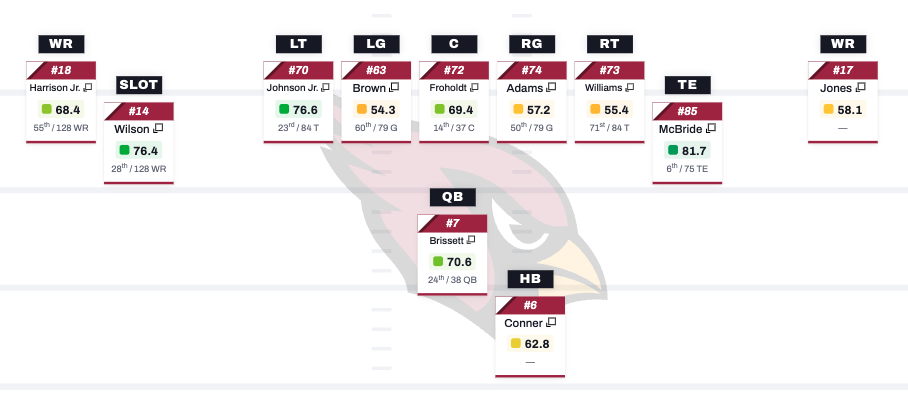
A strong right tackle doesn’t just help the run game. It improves the overall offensive ecosystem. If the Cardinals target a quarterback in the first round of the 2027 draft, that player would enter a far more favorable situation behind an upgraded offensive line.
Spending No. 3 on a defensive player in 2026 may add talent, but it would do little to improve the infrastructure that supports long-term offensive success. Building a reliable offensive line gives LaFleur the best possible runway to implement his scheme.
The numbers illustrate the current disconnect. Of the Cardinals’ offensive linemen who logged more than 700 snaps in 2025, not one graded above 60.0 on outside-zone runs. Johnson is the exception in terms of projection. In 2024, he earned a 75.7 run-blocking grade on outside zone and an 87.8 grade on inside zone, demonstrating he can execute the concepts LaFleur prefers. He is the clear foundational piece up front.
Right now, the largest gap between Arizona’s schematic aspirations and its personnel reality exists along the offensive line. To effectively run his offense in 2026, LaFleur will need an above-average run-blocking right tackle — particularly one capable of executing outside zone at a high level.
If the Cardinals want to align their roster with their new coach’s vision, the draft’s most impactful investment would be along the offensive line.
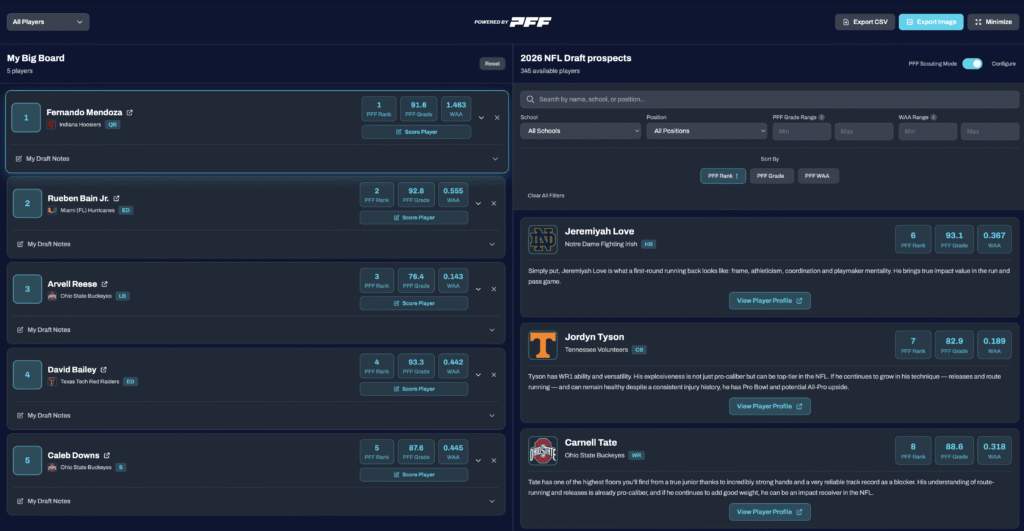
Which 2026 NFL Draft offensive tackle prospects could the Cardinals target at No. 3?
The top three offensive tackles on the PFF Big Board — Utah’s Spencer Fano, Miami’s Francis Mauigoa and Alabama’s Kadyn Proctor — would all make sense as long-term solutions at right tackle for Arizona.
Spencer Fano, Utah
Fano began his collegiate career at left tackle but has started at right tackle for the past two seasons. At 6-foot-6 and 308 pounds, he brings the foot quickness and spatial awareness necessary to thrive in an outside-zone-heavy system.
While his outside-zone grade dipped to 58.1 in 2025, Fano earned an elite 90.6 grade on outside zone runs in 2024 and owns a strong 79.4 career PFF run-blocking grade on the concept. He also posted an 84.9 grade on inside zone in 2025 — the second-most frequently called run concept in Mike LaFleur’s offense.
Fano has been steady in pass protection, recording an 82.7 PFF pass-blocking grade on true pass sets in 2025. Of the top three tackle prospects, Fano has been the most consistent run blocker across his career and carries the strongest overall résumé in the zone concepts LaFleur is likely to emphasize.
Francis Mauigoa, Miami
Mauigoa was a three-year starter at right tackle and brings a different profile. At 6-foot-6 and 335 pounds, he is heavier and more powerful than Fano, though not quite as fluid in space.
His career run-blocking grades reflect that stylistic difference. Mauigoa has graded better on downhill concepts, such as inside zone and duo, than on lateral concepts like outside zone, where he owns a 66.5 career grade.
Where Mauigoa separates himself is in pass protection. His 85.9 PFF pass-blocking grade on true pass sets tops both Fano and Proctor. His size, strength and anchor ability would also be particularly valuable in a division that features powerful edge defenders like the Rams’ Jared Verse, whose bull rush presents a recurring challenge twice per season.
Kadyn Proctor, Alabama
Proctor arguably carries the highest ceiling of the three. At 6-foot-7 and 366 pounds, he combines rare size with elite strength. According to The Athletic’s Bruce Feldman’s “Freaks List,” Proctor benches 535 pounds and squats 815 pounds — numbers that match his imposing on-field presence.
A three-year starter at left tackle at Alabama, Proctor improved each season, culminating in an 86.1 overall grade, an 84.2 pass-blocking grade and an 81.1 run-blocking grade in 2025. His career outside-zone grade sits at 77.9, and he earned an impressive 83.9 mark on the concept in 2025.
Unlike Fano and Mauigoa — both natural right tackles — Proctor presents a projection question. If Arizona drafts him, does he transition to right tackle after three years on the left side? Or would the Cardinals consider moving Paris Johnson Jr. back to right tackle, where he began his career, to keep Proctor at his natural position?
The final word
Each option presents a viable path. The decision ultimately comes down to whether Arizona prioritizes immediate schematic fit (Fano), pass-protection stability and power (Mauigoa), or long-term upside and physical dominance (Proctor).
For a deeper dive into how each of these prospects stacks up — and to build your own rankings — check out Scouting Mode in the PFF Big Board Builder, where you can grade players on the specific traits that matter most to you and create a fully customized draft board.


 © 2026 PFF - all rights reserved.