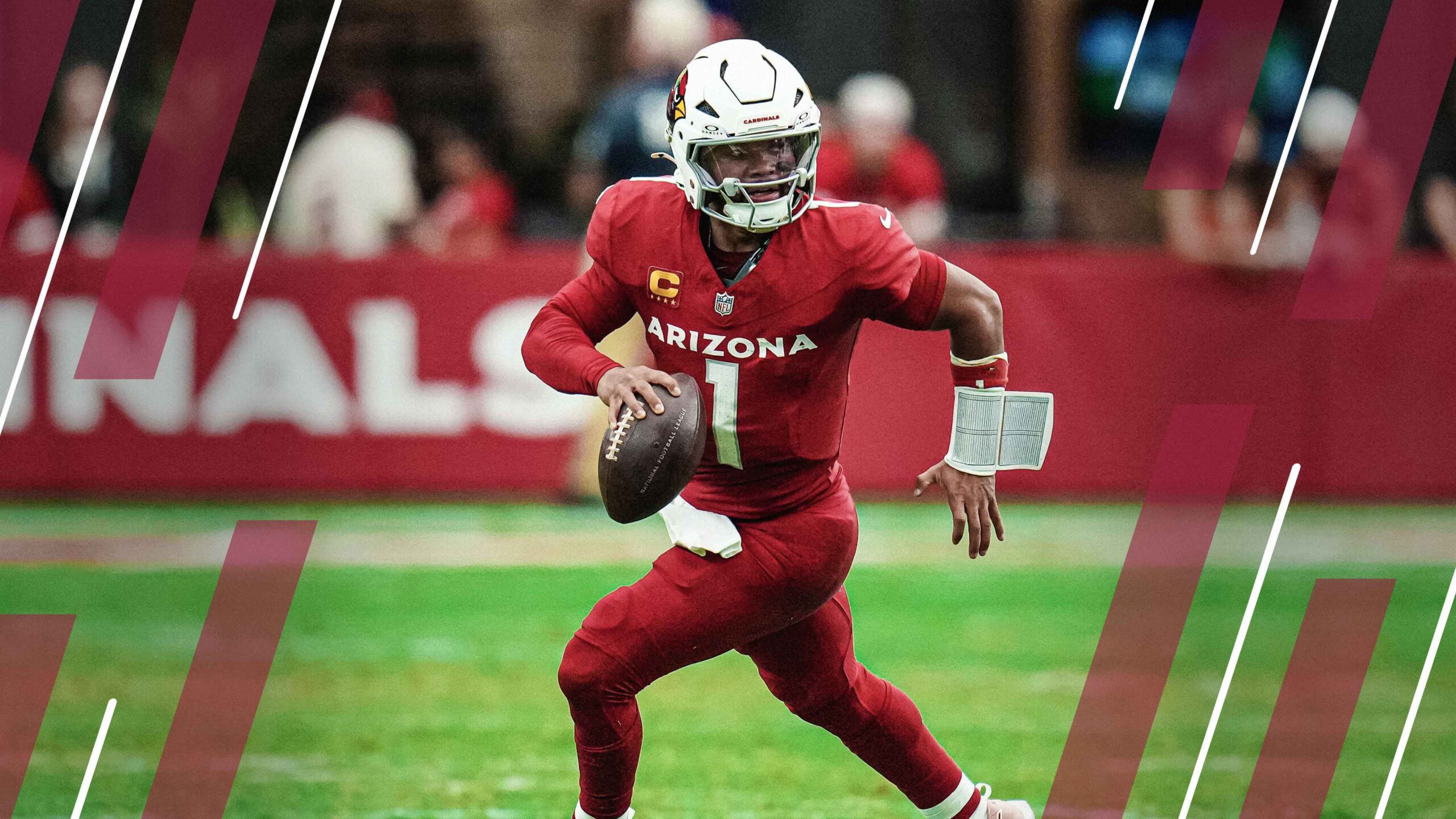
- Kyler Murray secures the starting quarterback nod: In a tight three-way debate alongside Kurt Warner and Carson Palmer, Murray claimed the starting position by leveraging his dual-threat rushing upside and superior career snap volume in Arizona.
- J.J. Watt secures a roster spot despite brief tenure: Highlighting the extreme gap in interior pass-rush efficiency across franchise history, Watt forced his way onto the team on the strength of a premier, class-leading 78.4 PFF pass-rushing grade over just two seasons.
- Larry Fitzgerald serves as the definitive offensive anchor: Fitzgerald stood out as one of the easiest consensus selections on the entire board, serving as the primary high-grade perimeter link between all three generation-defining quarterbacks.

As part of PFF's celebration of 20 years of NFL data, we're building an All-Star team for every franchise, highlighting the best players at each position from the PFF era. This installment turns to the Arizona Cardinals.
PFF's database dates back to the 2006 NFL season, providing a unique lens for evaluating and comparing players across eras. More details on the methodology used to construct these teams are available at the bottom of the page.
Offense
- QB: Kyler Murray (2019-2025)
- HB: James Conner (2021-2025)
- WR: Larry Fitzgerald (2006-2020)
- WR: DeAndre Hopkins (2020-2022)
- Slot WR: Anquan Boldin (2006-2009)
- TE: Trey McBride (2022-2025)
- TE: Maxx Williams (2019-2022)
- LT: Jared Veldheer (2014-2017)
- LG: Mike Iupati (2015-2018)
- C: Hjalte Froholdt (2023-2025)
- RG: Will Hernandez (2022-2025)
- RT: D.J. Humphries (2016-2023)
Unlike most teams, the Cardinals did not have a clear-cut choice at quarterback. Kyler Murray, Carson Palmer and Kurt Warner each played more than 3,000 snaps for Arizona, while no other quarterback exceeded 1,200. Palmer and Warner earned higher passing grades, but Murray's rushing ability helped him post the highest overall grade of the three. His longevity also played a role, as he logged nearly 1,000 more dropbacks than either Palmer or Warner.
Eight of the other offensive players on this roster were once Murray's teammates, even though Arizona's best offenses arguably came in 2008 and 2015. Those seasons coincided with some of the best years of Hall of Fame wide receiver Larry Fitzgerald's career. Fitzgerald was one of the easiest selections on the roster and the common link between all three quarterbacks.
The tackle positions presented the most difficult roster decision. D.J. Humphries and Jared Veldheer were clearly the top two tackles of the era, but both spent most of their time at left tackle and also logged snaps on the right side. Notably, they shared the field for 470 snaps in 2016, with Veldheer at left tackle and Humphries elsewhere on the line, and for 204 snaps in 2017, with Humphries at left tackle and Veldheer at right tackle.
Over their careers in Arizona, Veldheer earned the higher grades at left tackle, while Humphries graded better at right tackle. That ultimately determined their placements on this roster.
Defense
- DI: Calais Campbell (2008-2016, 2025)
- DI: J.J. Watt (2021-2022)
- NT: Dan Williams (2010-2014)
- ED: Chandler Jones (2016-2021)
- ED: Markus Golden (2015-2022)
- LB: Daryl Washington (2010-2013)
- LB: Karlos Dansby (2006-2009, 2013, 2017)
- CB: Patrick Peterson (2011-2020)
- CB: Dominique Rodgers-Cromartie (2008-2010)
- Slot CB: Tyrann Mathieu (2013-2017)
- S: Budda Baker (2017-2025)
- S: Adrian Wilson (2006-2012)
While the Cardinals' offense is largely represented by players from the past decade, the defense draws more heavily from an earlier era. Several selections were straightforward, particularly in the secondary with Patrick Peterson, Tyrann Mathieu and Budda Baker. Up front, Calais Campbell anchored the defense, while Chandler Jones was the clear choice at edge defender.
One of the more surprising selections on this roster is J.J. Watt, whose Cardinals tenure lasted only two seasons. Arizona had 29 interior defenders play at least 500 defensive snaps during the PFF era, yet only eight earned a PFF defensive grade above 65.0. Watt's 78.4 PFF pass-rush grade ranks comfortably atop that group, with Campbell as the only close challenger.
While Watt never reached the heights he achieved in Houston and lacked the longevity of many other Cardinals defenders, his peak performance in Arizona was strong enough to overcome those shortcomings and earn him a spot on the roster.

Methodology
Selections were based on normalized PFF grades adjusted by season. To balance peak performance and longevity, only a player's five best seasons with a franchise from 2006-25 were considered. Any season with an overall PFF grade below 60.0 was excluded, ensuring that strong years helped a player's case while weaker seasons were not held against him. Postseason play was included, though all seasons were capped at a 16-game equivalent to maintain consistency across eras. At each position, the player with the highest score under this methodology earned the spot.
Each team consists of 12 offensive and 12 defensive players. Because 11 personnel and nickel defense were the league's most common alignments over the past two decades, those personnel groupings served as the foundation for every roster. Teams received either a second tight end or a fullback, depending on whether they used more 12- or 21-personnel. Defensively, teams received either a third interior defender or a third linebacker depending on whether they primarily operated from a 3-4 or 4-3 front.
Players who logged significant snaps at multiple positions during their tenure with a franchise were eligible at either spot. In most cases, those players were assigned to the position where they provided the greatest value, though their versatility occasionally influenced the final roster construction.
Unlike some All-Pro teams that group offensive linemen by position type, these rosters were built according to where players actually lined up. If a team's two best tackles both played exclusively on the left side, only the top left tackle was selected. One of the three wide receivers and one of the five defensive backs was also required to have significant slot experience. In a 4-3 defense, one linebacker needed experience at the Sam linebacker position, while in a 3-4 defense, one defensive tackle needed experience at nose tackle.
When multiple players are listed at the same position, the first name represents the top selection. Players designated as slot wide receiver, slot cornerback, nose tackle or Sam linebacker were selected specifically for those roles rather than as the third-best player within their broader position group.


 © 2026 PFF - all rights reserved.