
- Fields and the Jets didn’t just survive Cincinnati in Week 8: The fifth-year quarterback completed 21 of his 32 passes for 245 yards, a touchdown and no interceptions while leading New York to 0.39 expected points added (EPA) per pass play, an 89th-percentile single-game mark this season.
- Room and space to work: Fields was pressured on just six of his 37 dropbacks — the lowest pressure rate of his Jets tenure — and he capitalized. From a clean pocket, he went 18-of-26 for 217 yards and 11 first downs, earning a 65.6 passing grade.
- Dig into the numbers: Click here for PFF's full statistical recap of Jets vs. Bengals.

Justin Fields’ NFL journey has never lacked turbulence, but this week might have been his biggest test yet.
Just days after New York Jets owner Woody Johnson publicly blasted the passing offense and head coach Aaron Glenn pulled him in favor of Tyrod Taylor, Fields looked destined to spend Week 8 watching from the bench — until Taylor’s knee injury reopened the door.
Then, in a 39–38 win over the Bengals, Fields delivered a statement performance.
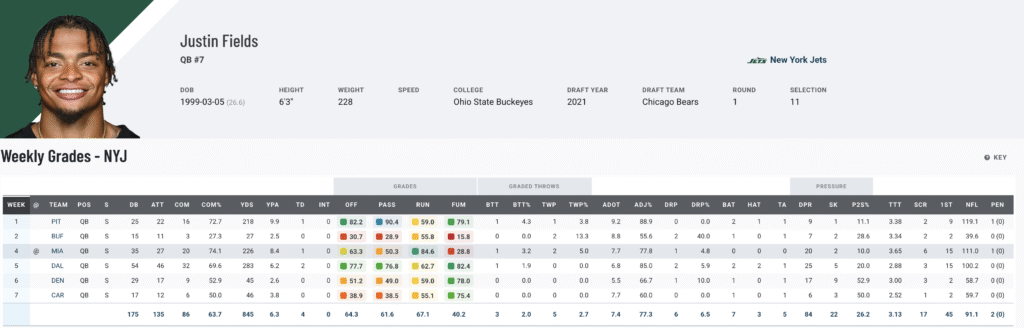
By the end of Week 7, it wouldn’t have been unfair to say some criticism was justified. New York’s passing offense ranked 30th in EPA per play (-0.141), 28th in yards per attempt (6.0) and dead last in explosive pass rate at 6.4% — a full 2.6 percentage points worse than any other team.
Fields’ individual production mirrored that inefficiency: a 64.3 PFF grade, just four touchdown passes and a bottom-tier 2.0% big-time throw rate, 35th among 38 qualifiers.
He wasn’t reckless — his 2.7% turnover-worthy play rate sat right alongside Matthew Stafford (2.5%) and Daniel Jones (2.8%) — but his low-risk, low-reward approach was strangling an offense already short on rhythm. New York’s 7.4-yard average depth of target ranked 30th, and only 6.7% of Fields’ passes traveled 20-plus yards downfield.
That’s what made Week 8 such a revelation.
Fields and the Jets didn’t just survive in Cincinnati — they attacked. The fifth-year quarterback completed 21 of his 32 passes for 245 yards, a touchdown and no interceptions while leading New York to 0.39 expected points added per pass play, an 89th-percentile single-game mark this season.
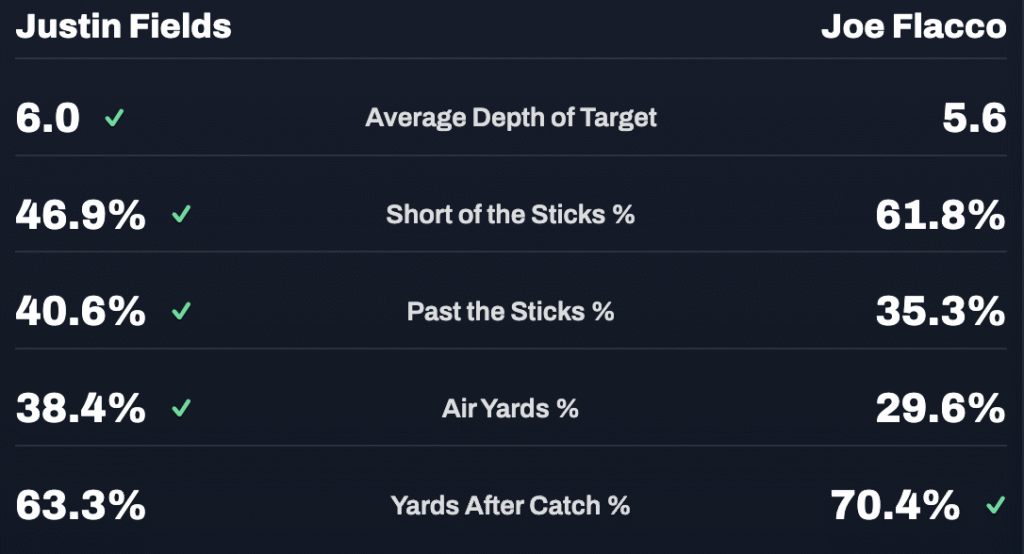
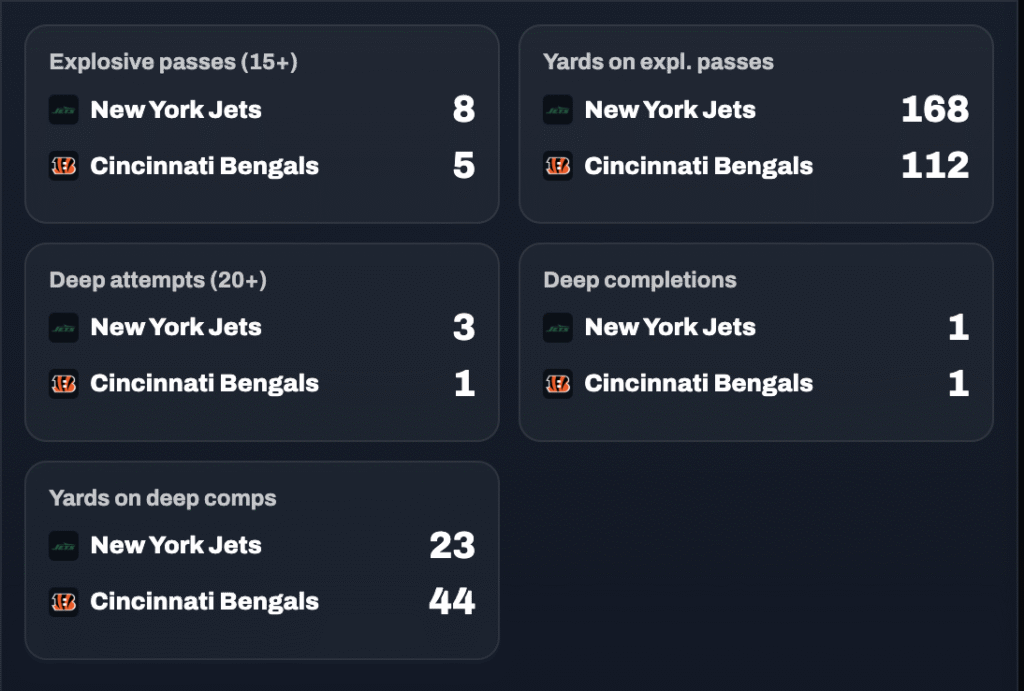
He generated 13 passing first downs, hit eight explosive completions of 15 or more yards, and pushed the ball beyond the sticks on 40.6% of his throws — his most aggressive outing of the season.
He attempted three deep passes of 20 or more yards, only the second time all year he has hit that number.
Crucially, he wasn’t sacked once. And that might have been the most important number of all.
Fields was pressured on just six of his 37 dropbacks — the lowest pressure rate of his Jets tenure — and he capitalized. From a clean pocket, he went 18-of-26 for 217 yards and 11 first downs, earning a 65.6 passing grade. When pressure did arrive, he delivered: 3-of-6 for 27 yards, a touchdown, and an 87.4 grade.
It was the first time all season that New York’s offensive line looked like a cohesive, premium unit. On first review, none of the five starters allowed a pressure: Olumuyiwa Fashanu (85.1), Armand Membou (82.3), Joe Tippmann (86.8), Josh Myers (83.9) and John Simpson (81.3) all earned pass-blocking grades north of 80.0.
Justin Fields: Career numbers from a clean pocket vs. under pressure
| Clean pocket | Under pressure | |
| 86.2 | PFF Passing grade | 29.8 |
| 69.6% | Comp. % | 45.9% |
| 76.9% | Adj. Comp. % | 63.6% |
| 7.8 | Average target depth | 11.7 |
| 7.6 | Yards per attempt | 5.6 |
| 4.5% | Big-time throw rate | 4.5% |
| 2.0% | Turnover-worthy play rate | 5.3% |
| 95.0 | Passer rating | 65.6 |
For Fields, that kind of protection is everything. Over his career, he owns an 86.2 passing grade from a clean pocket with 40 big-time throws to just 19 turnover-worthy plays. Under pressure, that grade plummets to 29.8, with a nearly inverted ratio (22 big-time throws to 43 turnover-worthy plays).
After a week of public criticism and doubt, Fields answered in the best way possible. Whether it proves to be a turning point remains to be seen, but for one week, he met adversity with exactly the kind of performance his team needed.

 © 2026 PFF - all rights reserved.