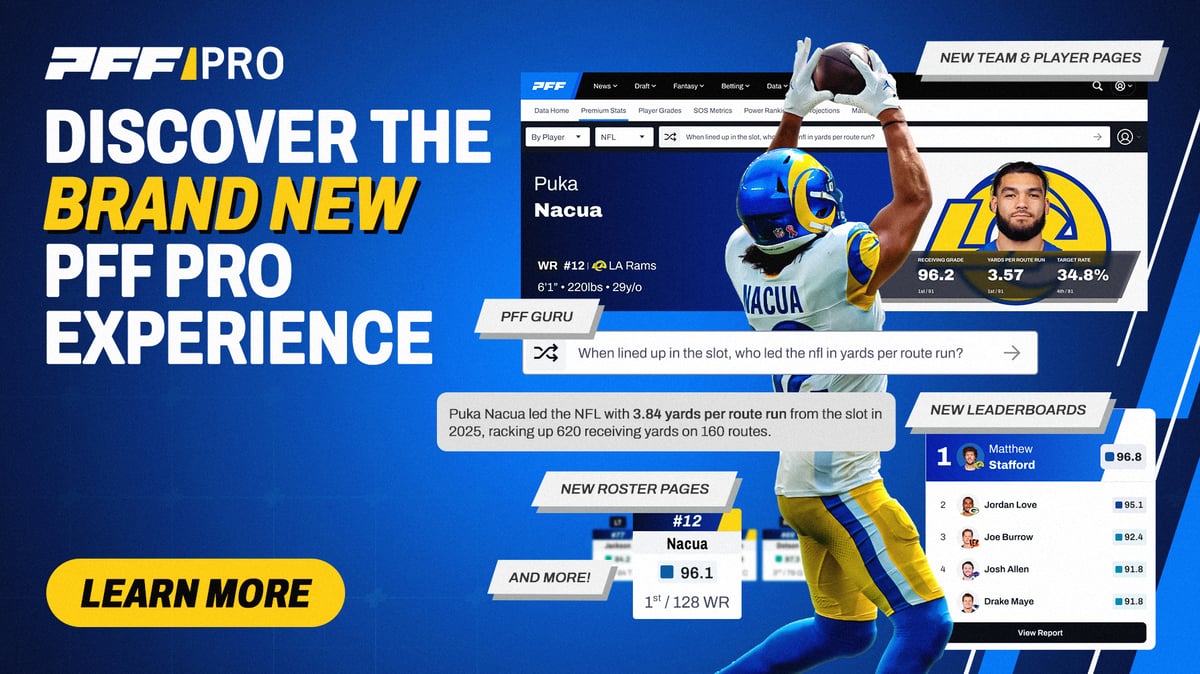
PFF+ is getting a long-awaited upgrade.
From smarter ways to search for PFF data to redesigned stats pages and new fantasy and roster-building tools, the next generation of PFF products makes it easier to find, understand and use the information that matters most to you, our loyal subscribers.

New for 2026: PFF AI Guru
Finding the right number in PFF’s database no longer has to start with navigating to the right page and selecting the correct filter.
PFF AI Guru lets users ask any football question and receive answers directly from the PFF database. Want to know which rookies earned the highest PFF grades? Or how Lamar Jackson compares to Josh Allen? Which edge defender earned the NFL’s highest pass-rush grade? Who produced the highest passing grade on throws of 20-plus yards? Just ask.
New for 2026: Premium Stats Pro
We have rebuilt Premium Stats, making PFF data easier to find, compare and use. Premium Stats Pro introduces more than 50 new data points, redesigned team and player pages, improved filtering and navigation, cleaner CSV exports and new tools for turning PFF data into custom visualizations.
Team Pages
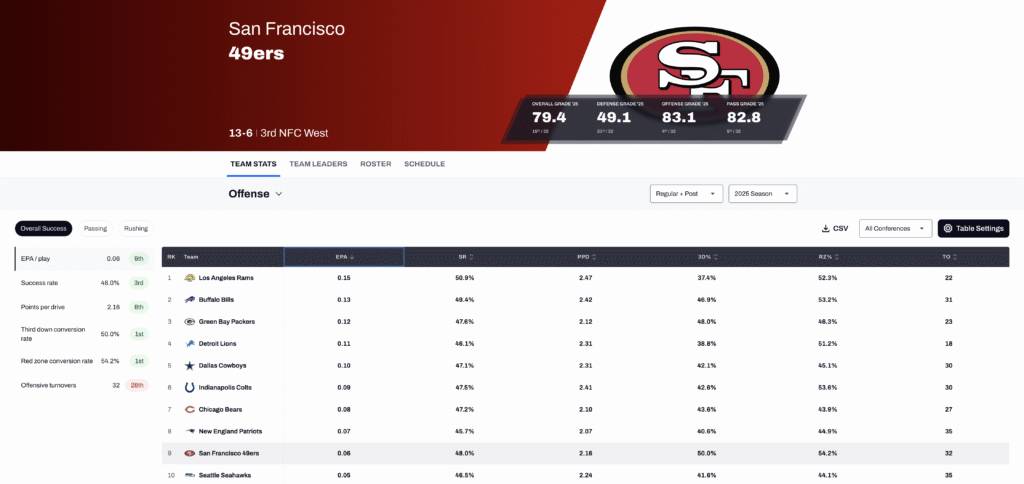
PFF’s team pages are getting a significant upgrade, bringing the numbers that explain how a team wins and loses into one place. EPA per play, success rate, points per drive, third-down conversion rate, red-zone efficiency and more now sit alongside PFF grades, with offense, defense, passing and rushing views that go well beyond the box score.
Every stat also comes with a league rank and a full 32-team leaderboard, making it easy to see how each team stacks up against the rest of the NFL.
Team Management
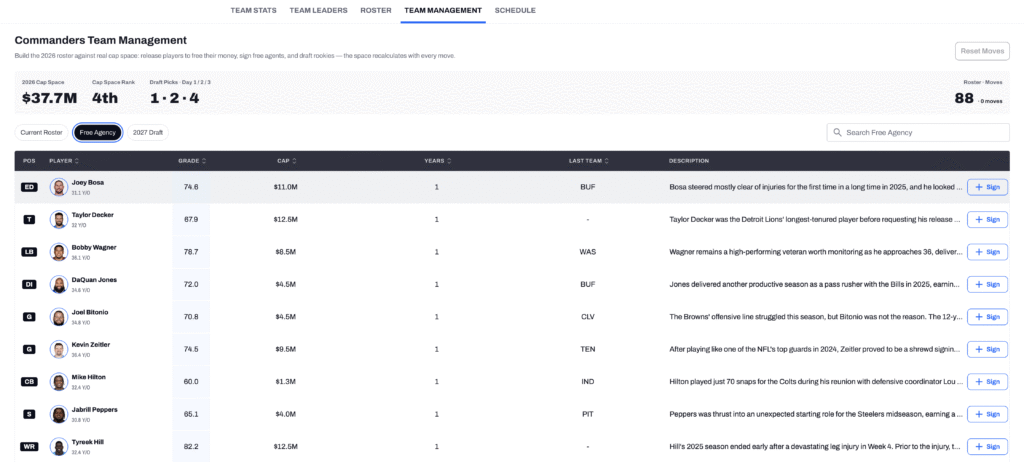
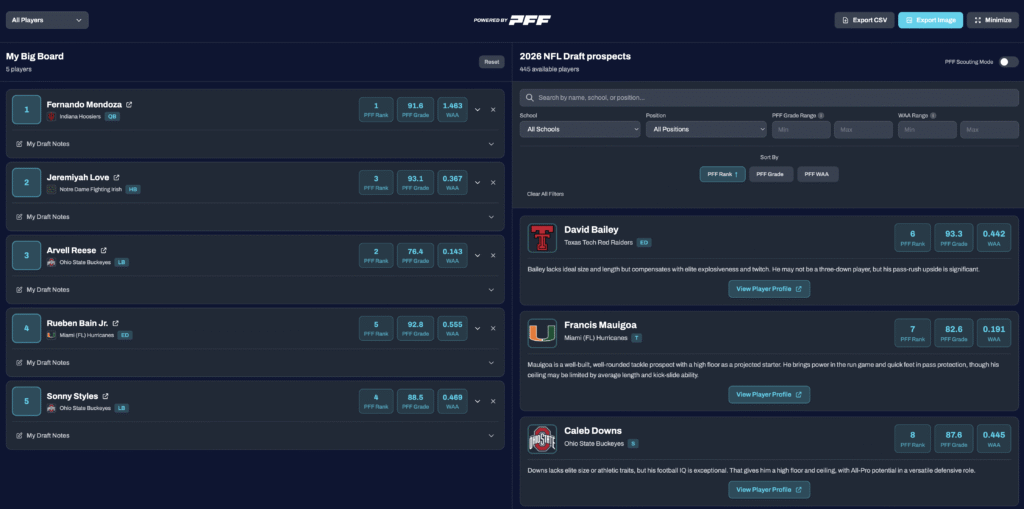
PFF’s new Team Management tool puts users in control of an NFL roster, with real contract information and PFF grades providing the foundation for every decision. Users can release players and immediately see the resulting cap savings and dead money, while the team’s projected cap space updates with every move.
From there, users can reshape the roster through free agency and the NFL draft. Available free agents come with PFF grades, projected contract values and scouting notes, while draft prospects include projected draft position and rookie cap figures. Each addition is reflected in the team’s cap situation, allowing users to build out an offseason plan and see how the numbers work in real time.
Player Pages
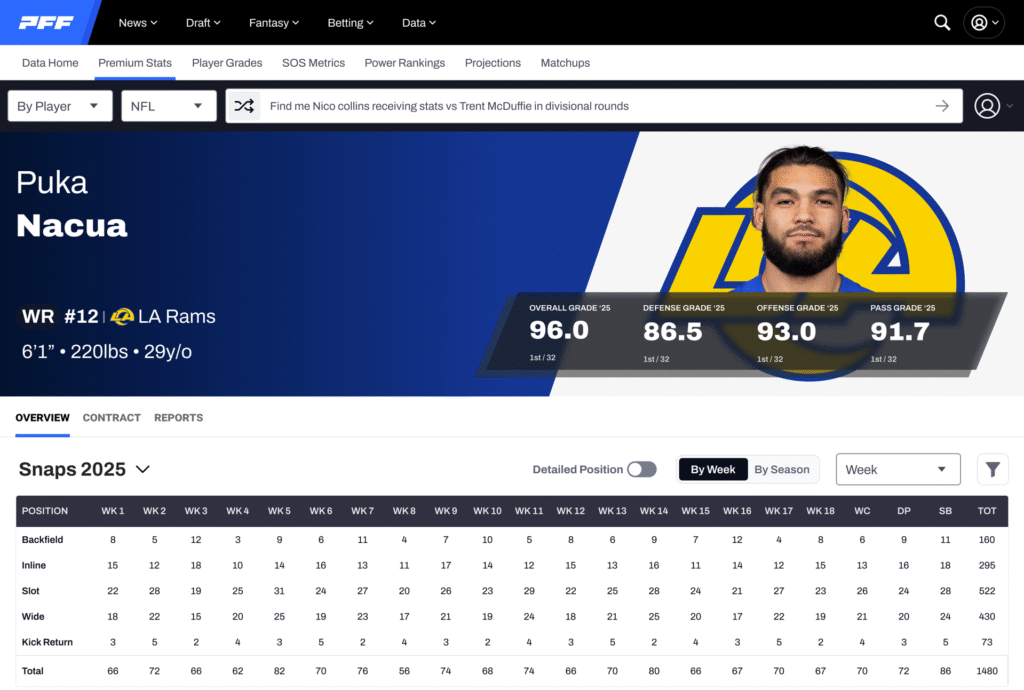
PFF’s player pages have been rebuilt to put more of a player’s story in one place. The upgraded experience brings together season stats, snap counts, PFF grades and recent-game performance in a cleaner, easier-to-navigate profile, with reports that allow users to dig deeper into how and where a player is performing.
The biggest addition is a new contract view, which puts a player’s deal alongside his on-field performance. Users can see contract value, length, average annual salary and guaranteed money, as well as year-by-year cap hits, a contract timeline and comparisons with other top deals at the position.
Position Reports
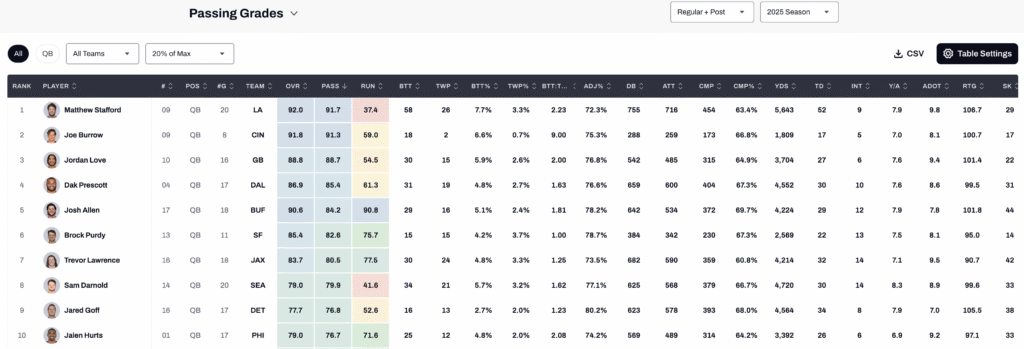
Position reports have also been redesigned around leaderboards, giving users a quick look at the NFL’s best performers across different facets of play before allowing them to jump into the data users have come to expect from PFF.
From there, the experience becomes fully customizable. Reports can be filtered by team, season and snap threshold, while table settings allow users to choose the data points they want to see, sort the results and export the finished report directly to CSV.
New: Game View
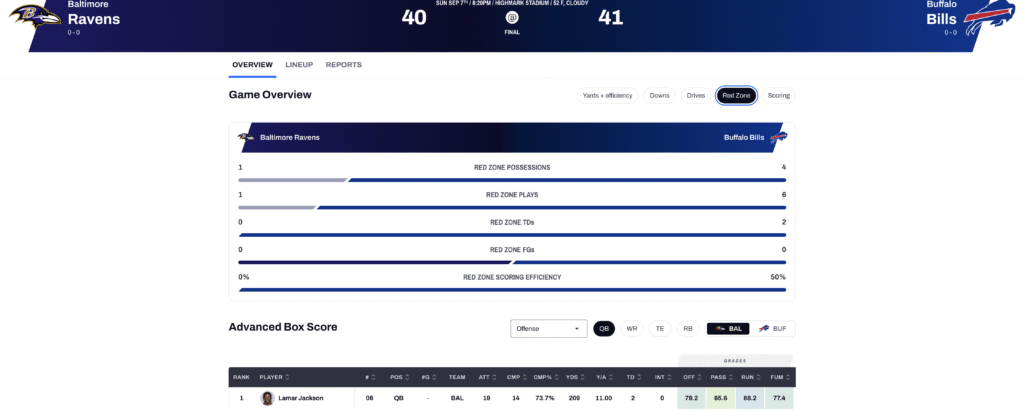
PFF’s new Game Pages go well beyond the traditional box score, bringing the grades and advanced data from every game into one place. Users can compare teams across yards and efficiency, downs, drives, red-zone performance and scoring, before digging into an advanced box score that pairs traditional statistics with PFF grades and metrics such as big-time throws, turnover-worthy plays, time to throw and average depth of target.
New for 2026: Waiver Wire Tool
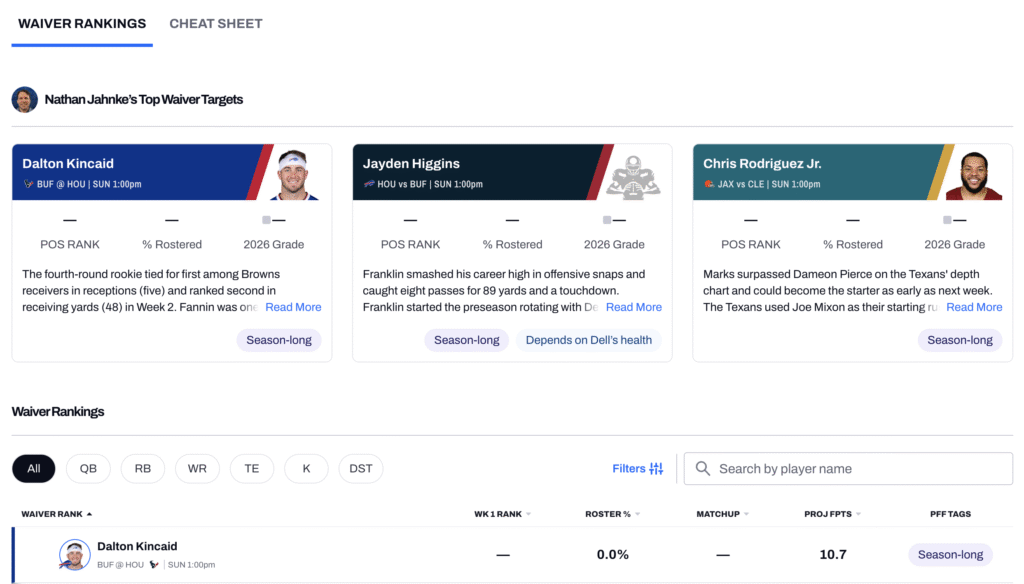
PFF’s Waiver Wire Targets are built to make one of the most important decisions of the fantasy week a little easier. Every Monday, lead fantasy analyst Nathan Jahnke provides roughly 30 waiver targets, with three top options leading the way and written analysis explaining the case for every player on the list.
Each recommendation includes the information needed to quickly evaluate the player, including matchup rating, projected fantasy points and PFF grade, along with tags highlighting players with favorable matchups, season-long value, breakout potential and more.
And once a fantasy league is synced, the list becomes specific to that league. Players who are already rostered are removed, while additional filters allow users to narrow the available options by position, matchup, team and other criteria.
Live Draft Assistant: Manual Drafting
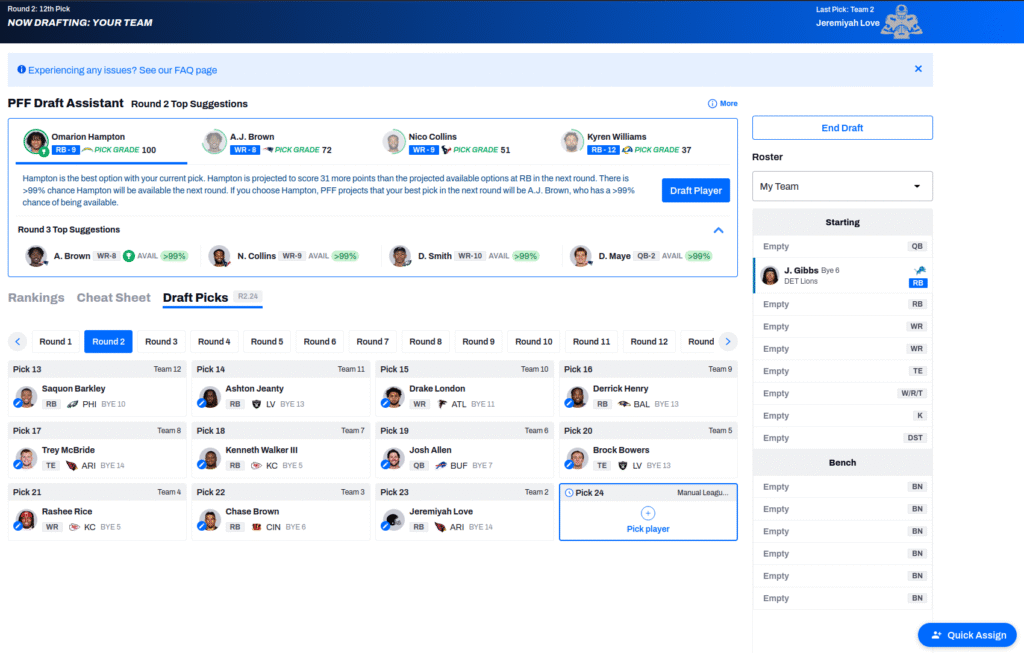
Not every fantasy league can be synced, but that no longer means managers have to draft without PFF’s tools. A new manual drafting mode brings the same pick grades, projections, player availability and draft board from PFF’s Live Draft Assistant to leagues that can’t be connected directly.
Managers can enter each selection as the draft unfolds, edit picks when needed and adjust the draft order, with support across desktop and mobile. Manually drafted leagues also live alongside synced leagues in the same league picker, making it easier to move between drafts without changing the experience.
PFF API Access: The data at your fingertips
The numbers that all 32 NFL teams rely on are now available directly to you — every grade, every advanced stat, every charted detail behind them, delivered straight into whatever you're building. Wire the PFF API into your projection model, your prop engine, your league's custom rankings, your dynasty trade calculator, your dashboard or your scouting tool. Or skip the integration entirely and use the CLI: query from your terminal, pipe it into a script, drop it into a spreadsheet, set it on a schedule so your data refreshes itself while you sleep.
No more exporting, cleaning, pasting, and rebuilding the same thing next Tuesday. Pull it once and build on it forever.


 © 2026 PFF - all rights reserved.