- Unlock your edge with PFF+: Access Premium Stats, dominate fantasy with in-season tools and projections and make smarter bets with the new PFF Player Prop Tool. Get 25% off your PFF+ annual subscription with code PFFFANTASYPODCAST25.
Estimated Reading Time: 4 minutes

Fantasy and DFS enthusiasts, bettors and analysts often rely on a wide array of statistics and models to gain a competitive edge. These range from basic box score stats to advanced metrics available in PFF's Premium Stats 2.0 and models like Josh Hermsmeyer‘s Buy Low model and WOPR (Weighted Opportunity Rating).
There is always room for new insights and analyses to help bettors and fantasy managers refine their strategies. That’s why I developed a new metric that offers several advantages over WOPR. Click here for an in-depth explanation of the model, my process and its advantages.
Week 7 Recap
- Chris Olave: Top-five WR finish – 26.8 PPR Points
- A.J. Brown: Top-five WR finish – 28.1 PPR Points
- Jerry Jeudy: WR 69 – 3.7 PPR Points
- Jameson Williams: 0 PPR Points
- Jakobi Meyers: Did Not Play
The model performed exceptionally in Week 7, with two outstanding performances from Chris Olave and A.J. Brown.
Potential Breakouts: Week 8
PWOPR is significantly more stable than FPpG and serves as a stronger indicator of future performance. To help identify potential breakout candidates, the residual is calculated by subtracting a player’s predicted FPpG from their actual FPpG. Players with a strong PWOPR and a residual of -3.0 or lower are included on this list. Players remain on the list until one of the following conditions is met:
- They fulfill their PWOPR potential with a big game
- Their PWOPR decreases to match their expected FPpG
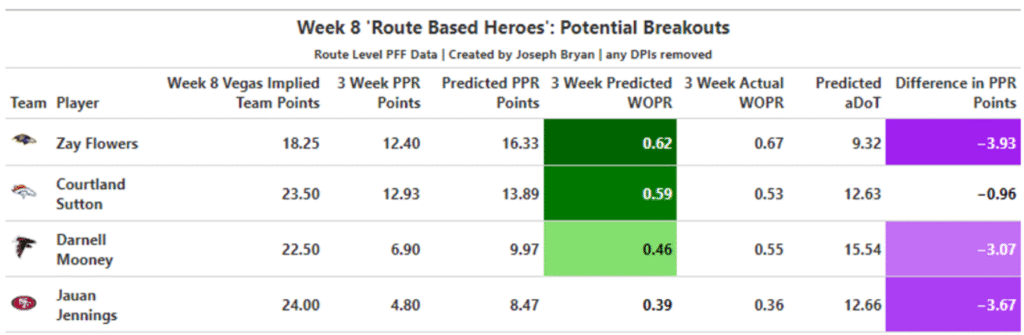
WR Zay Flowers, Baltimore Ravens vs. the Chicago Bears: Notably, the Bears have the best PFF grade versus receivers this season and have been exceptionally well-graded since Week 3. Since Week 3, Chicago boasts a 78.7 grade against wideouts, with the next-closest team the Falcons with a 61.1 mark. Having allowed the fourth-fewest single-coverage opportunities, second-fewest targets and second-fewest yards to opposing receivers, this could be a challenging matchup.
The good news for Flowers is that the Bears play fairly high rates of Cover 3 and Cover 1, where Flowers has excelled over the last two seasons. He’s earned an elite 90.7 PFF grade and 28.4% THREAT in those situations.
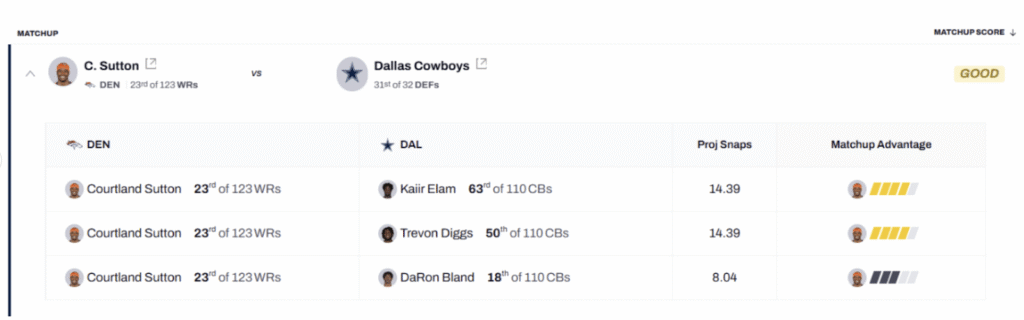
WR Courtland Sutton, Denver Broncos vs. the Dallas Cowboys: If there ever were a defense to facilitate a breakout receiver performance, Dallas would be that defense. The Cowboys hold the fourth-worst PFF coverage grade against receivers, allow the highest rate of open targets to opposing wide receivers (62.4%) and yield the fourth-highest passer rating when wideouts are targeted. Furthermore, Dallas allows the fifth-highest EPA per play and the 11th-highest success rate to receivers.
Combine those points with Dallas’s average team PFF pass-rush grade facing the Broncos’ No. 1-ranked team PFF pass-blocking grade, and all signs point to a potential Sutton breakout game.
WR Darnell Mooney, Atlanta Falcons vs. the Miami Dolphins: The Dolphins possess the third-worst team PFF coverage grade and the second-worst team PFF pass-rush grade this season. Combine these with the third-highest blitz rate and 11th-worst quick pressure rate, and you end up with a defense that has surrendered the highest EPA per play in the NFL.
The toughest fact about this matchup for Mooney or any receiving threat is more about how NFL offenses are choosing to attack this Dolphins defense. Miami has defended the fourth-most rushing plays and the sixth-fewest passing plays. The Falcons should be able to execute any offensive game plan they desire and be very efficient. If Mooney is integral in their game plan, we can expect a big game from him.
WR Jauan Jennings, San Francisco 49ers vs. the Houston Texans: Jennings has been dealing with three separate injuries this season, which has hindered him from being on the field — let alone being an elite contributor to this offense. Assuming Jennings is able to come back and attain the WR1 role in this Kyle Shanahan offense, look forward to some big games in his future.
This week, he matches up against a fairly stingy Houston defense, which ranks 10th in team PFF coverage grade — but 16th against specifically receivers. The Texans play the 10th-most Cover 3 and the third-most Cover 4, where Jennings sees a solid 75.7 PFF grade and 23.6% THREAT.

 © 2026 PFF - all rights reserved.