
- Unlock your edge with PFF+: Access Premium Stats, dominate fantasy with in-season tools and projections and make smarter bets with the new PFF Player Prop Tool. Get 25% off your PFF+ annual subscription with code PFFFANTASYPODCAST25.
Estimated Reading Time: 4 minutes

Fantasy and DFS enthusiasts, bettors and analysts often rely on a wide array of statistics and models to gain a competitive edge. These range from basic box score stats to advanced metrics available in PFF's Premium Stats 2.0 and models like Josh Hermsmeyer‘s Buy Low model and WOPR (Weighted Opportunity Rating).
There is always room for new insights and analyses to help bettors and fantasy managers refine their strategies. That’s why I developed a new metric that offers several advantages over WOPR. Click here for an in-depth explanation of the model, my process and its advantages.
Week 6 Recap
- Chris Olave: WR16 – 15.8 PPR points – Did better than his average
- Jerry Jeudy: WR34 – 9.3 PPR points – Did better than his average
- Jameson Williams: WR12 – 18.6 PPR points – Did better than his average
- Wan’Dale Robinson: WR9 – 20.4 PPR points – Did better than his average
- Cooper Kupp: WR23 – 12.0 PPR points – Did better than his average
Potential Breakouts: Week 7
PWOPR is significantly more stable than FPpG and serves as a stronger indicator of future performance. To help identify potential breakout candidates, the residual is calculated by subtracting a player’s predicted FPpG from their actual FPpG. Players with a strong PWOPR and a residual of -3.0 or lower are included on this list. Players remain on the list until one of the following conditions is met:
- They fulfill their PWOPR potential with a big game
- Their PWOPR decreases to match their expected FPpG
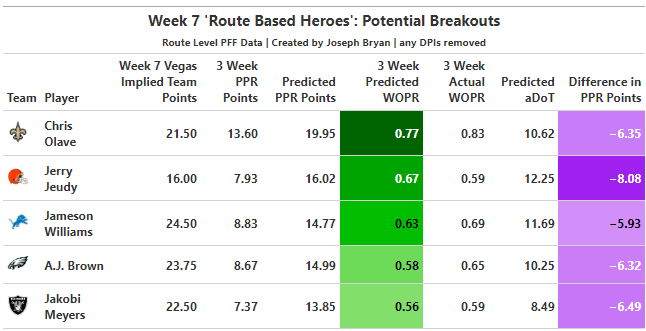
Chris Olave had the best PWOPR for any receiver of the season in Week 6 (0.99) and owns the second-most targets this season. Only 69% of Olave’s targets have been considered catchable, which ranks in the bottom 25% of all wide receivers. Given his PWOPR, we would expect him to be scoring roughly 20 PPR points a game.
Olave matches up against the Bears this week, who have the 17th-ranked team PFF coverage grade and 28th-ranked team PFF pass-rush grade. Over the previous four weeks, the Bears have played the 10th-highest rate of man coverage while also fielding the 10th-lowest PFF grade in man coverage. Olave’s PFF grade versus man is fairly average at 62.6, but he sees a tremendous 38.2% THREAT. This is a premier spot for Olave to earn even more targets and have a great game.
Positive regression models like the one created for this article often feature wide receivers on struggling passing offenses. This is a function of the team’s lesser ability to score, and sometimes the quarterback’s ability to accurately get the ball to the receiver. Jerry Jeudy recorded only five receptions on 13 targets (eight of which were considered catchable). He had the 13th-highest PWOPR for Week 6 and the second-highest number of predicted air yards (133).
The Browns match up against the Dolphins in Week 7, who have registered the third-worst team PFF coverage grade and given up the second most EPA per pass. This is a solid matchup for Jeudy, and if his catchable-target percentage increases, he should have some big games ahead of him.
Jameson Williams appeared on the list last week and had himself a solid game, but it was still not enough to match his PWOPR expectation over the last three weeks. The Lions play the Buccaneers, who have an average PFF grade for coverage and slightly-above-average grade for pass rush. Tampa blitzes at the sixth-highest rate in the NFL, fueling the ninth-highest rate of quick pressure and the highest rate of unblocked pressure. Williams’ THREAT does not change much when Jared Goff experiences pressure or the blitz. When the Buccaneers blitz, Williams could very well take advantage with his remarkably high average depth of target (15.9).
The original idea for the Predicted Targets Model, which this breakout model is derived from, stemmed from the Eagles playing the Vikings in 2023. In this new version of the matchup, the Vikings own the eighth-best team PFF coverage grade and 19th-ranked team PFF pass rush grade. A.J. Brown historically thrives when given single-coverage situations. The Vikings have allowed the second-least number of single coverage situations to develop this season. Pair this with the fact the Vikings possess the 10th-worst team PFF run-defense grade, and Brown may not receive many opportunities this week.
Jakobi Meyers and the Raiders have an incredibly tough matchup this week against the red-hot Kansas City Chiefs. The Chiefs wield the third-best team PFF coverage grade and fifth-best team coverage grade against wide receivers. In a game where the Raiders will likely be playing catch up (11.5-point underdogs), Meyers still might be able to bounce back by sheer volume, even if the matchup isn’t stellar.

 © 2026 PFF - all rights reserved.