
- Lamar Jackson‘s collapsing rushing volume is a red flag: Jackson's carry total has declined every year, falling to just 5.2 per game in 2025. A coaching overhaul and an aging offensive core also cloud the rushing outlook that drives his fantasy ceiling.
- Joe Burrow‘s ceiling depends on his defense staying bad: Burrow leans on volume from negative game scripts, so an improved Cincinnati Bengals defense could cap his upside, and his injury history remains a real risk.
- Jaxson Dart comes with too much injury risk to trust early: Dart's rookie fantasy line leaned on rushing over efficient passing. Last year, he suffered one confirmed concussion and several other concussion evaluations, so the risk of missed games is high at his cost.

The top fantasy quarterbacks have been relatively consistent from year to year, but almost every team has a quarterback capable of finishing in the top 10. Most starters have reached that mark at some point over the past few seasons, while younger quarterbacks still have plenty of room to improve. That leaves a relatively small gap between QB6 and QB22, making it difficult to justify drafting a quarterback early in that range when similar production is often available several rounds later.
The three quarterbacks below are not players we expect to struggle. Each has a realistic path to success, but each also carries enough risk to make the price difficult to justify, especially when similarly valued options are available a few rounds later. That combination — legitimate concerns and a deep pool of alternatives — is what lands them here.
The average draft position listed is a consensus of ESPN, Sleeper and Yahoo! ADP data for 12-team redraft leagues.
Lamar Jackson, Baltimore Ravens (ADP: 3.07)
Jackson is the highest-risk, highest-reward quarterback in the top five. He is the only quarterback to ever average 25 fantasy points per game in multiple seasons — having done so in both 2019 and 2024 — and he has won the NFL MVP twice while nearly claiming a third in 2024.
The concern is his declining rushing volume. Jackson averaged double-digit carries per game from 2019 through 2021 before falling to 9.3 in both 2022 and 2023, 8.2 in 2024 and just 5.2 in 2025. Some rebound is reasonable to expect, but a return to his peak rushing workload is not.
His passing efficiency has remained strong, as he has averaged more than 8.0 yards per attempt in each of the past three seasons. However, his sack rate climbed to a career high in 2025, contributing to a decline in passing volume compared to the previous two seasons.
The Ravens also overhauled their coaching staff, hiring Jesse Minter as head coach and Declan Doyle as offensive coordinator. Doyle spent 2025 with the Chicago Bears but did not call plays under head coach Ben Johnson, making 2026 the first season he will run his own offense. At 29, he is one of the youngest and least experienced play-callers to inherit an elite quarterback, and some growing pains are to be expected.
Baltimore also lost several notable offensive players in free agency, including center Tyler Linderbaum, tight ends Isaiah Likely and Charlie Kolar, wide receiver DeAndre Hopkins and fullback Patrick Ricard. The offense now leans on Derrick Henry, Mark Andrews and Ronnie Stanley, all of whom are on the wrong side of 30. Baltimore also used seven draft picks on offensive players, and how quickly those rookies contribute will have a meaningful impact on Jackson's floor and ceiling in 2026. Even with his league-winning upside, the uncertainty surrounding his rushing workload, new coaching staff and supporting cast makes his top-five price difficult to justify when similar upside is available several rounds later.
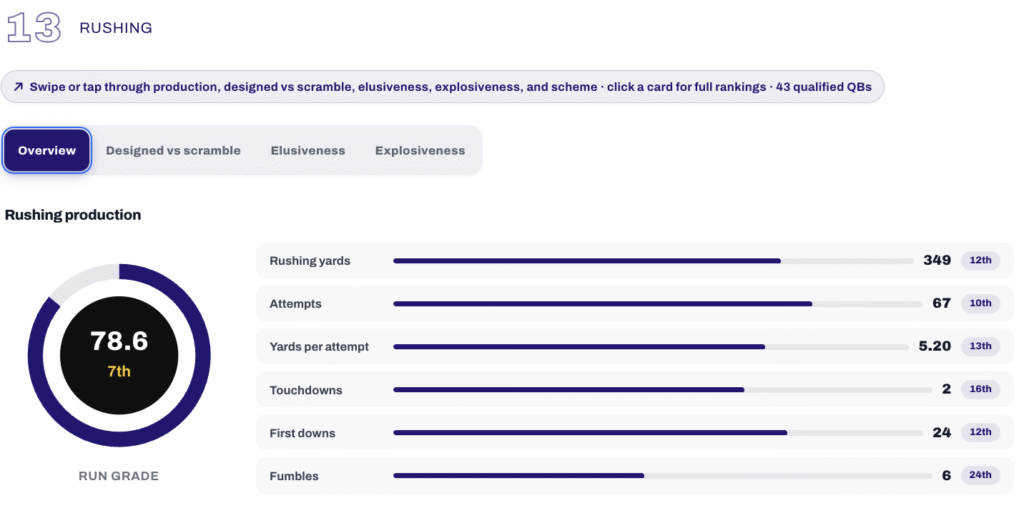
Joe Burrow, Cincinnati Bengals (ADP: 5.01)
Burrow opened the 2025 season slowly, drawing the Cleveland Browns in Week 1 and then suffering an injury in Week 2. From his return in Week 13 through Week 18, he ranked third among quarterbacks in fantasy points per game. He finished as the QB3 in 2024.
Unlike most quarterbacks drafted near the top of fantasy leagues, Burrow does not rely on rushing production. He is the exception because he has been one of the highest-graded passers in the NFL in recent seasons, operates in one of the league's most pass-heavy offenses and throws to elite wide receivers in Ja'Marr Chase and Tee Higgins.
Continuity also works in his favor, as Cincinnati is retaining its coaching staff and Burrow, Chase, and Higgins are all signed long-term. Twenty of the 22 players who logged at least 25 offensive snaps last season remain on the roster. The only departures are backup tight end Noah Fant and third-string quarterback Jake Browning, with Erick All Jr. returning from injury and veteran Josh Johnson filling those roles.
Health remains the primary concern. Burrow has missed at least six games in three of his six NFL seasons and has already won Comeback Player of the Year twice. His injuries have affected different areas of his body, including a knee, wrist and toe, which suggests misfortune rather than a recurring structural issue.
The secondary concern is whether an improved defense reduces his passing volume. The Bengals have ranked among the worst defenses in terms of points allowed in each of the past two seasons, forcing them into negative game scripts and a pass-heavy approach. Cincinnati addressed that by trading for defensive tackle Dexter Lawrence and signing safety Bryan Cook and defensive end Boye Mafe in free agency. If the defense improves significantly, the Bengals should spend more time protecting fourth-quarter leads with the running game, which would likely reduce Burrow's passing volume and cap his fantasy ceiling. His floor is as safe as any quarterback's, but potential volume regression and his injury history make it difficult to justify his cost when similar production is available several rounds later.
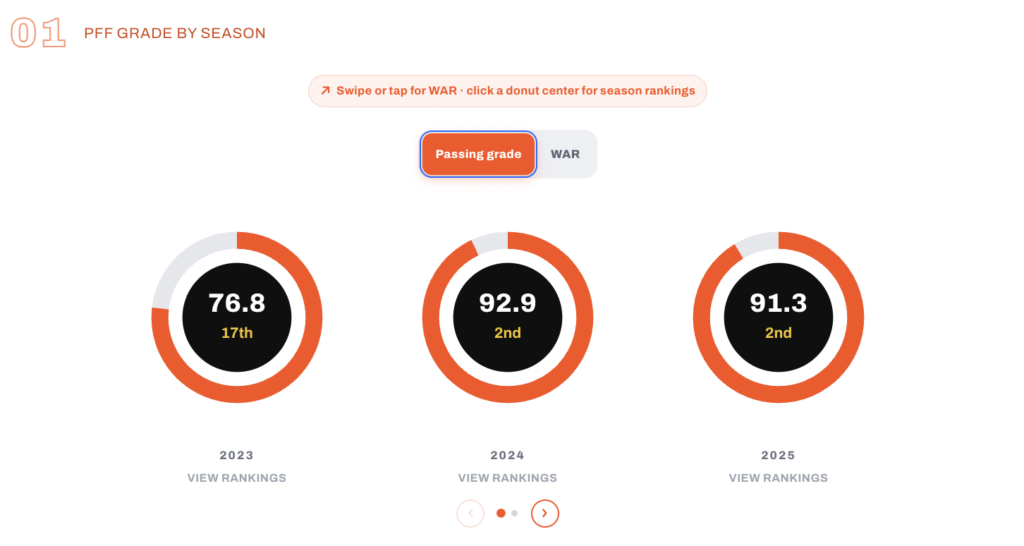
Jaxson Dart, New York Giants (ADP: 6.07)
Dart was highly impressive as a rookie from a fantasy perspective, averaging 20.5 fantasy points per start, seventh among quarterbacks. His rushing ability drove much of that production, as his 86 rushing attempts ranked fourth at the position and resulted in nine rushing touchdowns. As a passer, however, he averaged just 6.7 yards per attempt and threw 15 touchdown passes.
There are several reasons to expect improvement from Dart and the Giants' passing game this season. By the end of last year, his top receiving options were Darius Slayton, Isaiah Hodgins, Gunner Olszewski and tight end Daniel Bellinger. This season, Malik Nabers is expected to be healthy, while the Giants added Darnell Mooney, Calvin Austin III and Malachi Fields at wide receiver and Isaiah Likely at tight end. Running back Cam Skattebo and tight end Theo Johnson should also be healthy to begin the season, and New York used the 10th overall pick on offensive lineman Francis Mauigoa to further bolster the offense.
The biggest question is Nabers' health. If he is not ready for Week 1 or is limited during the season, Dart's chances of joining the top tier of fantasy quarterbacks become much slimmer.
Injury concerns are the primary reason Dart is not ranked higher. He missed two games because of a concussion and underwent concussion evaluations several other times. While he could adjust his playing style to reduce the number of head impacts, additional concussions would increase the risk of missed time. Ranking him outside the top tier reflects that risk.

 © 2026 PFF - all rights reserved.