- Caleb Downs stands out as one of the best safety prospects: Downs’ elite scores in many key metrics put him in high company as one of the most promising IDP assets in recent years.
- Emmanuel McNeil-Warren and Dillon Thieneman battle for the second top spot: Both safeties have a claim for that next spot after Downs and should be considered promising future IDPs in their own right.
- Unlock your edge with PFF+: Access Premium Stats, dominate fantasy with in-season tools and projections and make smarter bets with the new PFF Player Prop Tool. Get 25% off your PFF+ annual subscription with code PFFFANTASYPODCAST25.
Estimated Reading Time: 12 minutes
NFL draft season is in full swing, which naturally comes with a plethora of ways to evaluate potential talent coming out of college with the potential to translate to the next level. This article series is no different, as we’ll add a fantasy football spin to the evaluation process to identify which incoming prospects have a shot to become fantasy-relevant early on in their NFL careers.
The next position group that this model series will cover is the safeties, which is often one of the more volatile positions for IDP, as there is so much dependence on usage and big plays and that tends to vary year-to-year for most players. This model has dug into the data to sort out what matters and doesn’t for NFL safety prospects and how effectively these things translate to IDP. As was the case with all the other positions covered, there is not one singular metric that will tell us who will have success and who won’t, and the combination of key metrics tends to have much better predictive success.
For the safety position, in no particular order, we’re looking at overall PFF grade, coverage grade, run-defense grade, play-on-pass rate, draft capital and level of competition, among a few others. Underlying metrics were found to be much more reliable than overall production when accounting for all prospects. While production often comes with strong underlying metrics, one can exist without the other, and the underlying metrics have a better success rate than overall production alone.
This is the pre-NFL combine version of the article and will be updated with athletic testing scores and any shifts in expected draft capital next month.
Keys
- The prospect pool for this model consists of 384 past safety prospects dating back to 2016.
- Thirty-one safeties drafted since 2018 have become a top-12 IDP finisher for their position at least once (8.1%).
- Among those 31 top-12 finishers, 18 (58%) finished as top-12 finishers within their first three NFL seasons.
- Also of those 31 top-12 finishers, 12 (39%) have been repeat top-12 finishers.
- Fifty safeties drafted since 2018 have become a top-24 IDP finisher for their position at least once (13.0%).
- Sixty-six safeties drafted since 2018 have become a top-36 IDP finisher for their position at least once (17.2%).
- This is an important context when understanding hit rates, as many more prospects will not become fantasy-relevant than most, given such a large pool of players.
- However, using this model, the higher the prospect score, the better the success rate will be for each prospect, as highlighted below.
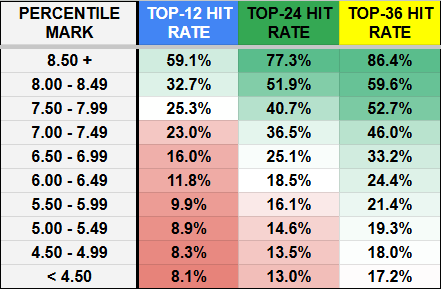
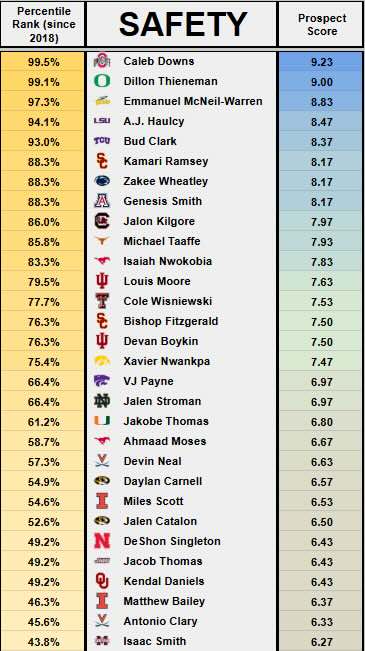
With all this in mind, it’s time to look at this year’s safety prospects to identify our future IDP contributors. It should also be noted that these scores should not necessarily be used so much as your rankings, as they should guide you toward the quality of the player. Draft capital and landing spot can and will play a big part in actual rankings, though these scores can help us determine which players to trust or not when it comes time to pull the trigger on these players in our rookie drafts.
Caleb Downs, Ohio State
- Consensus draft capital: 8th overall
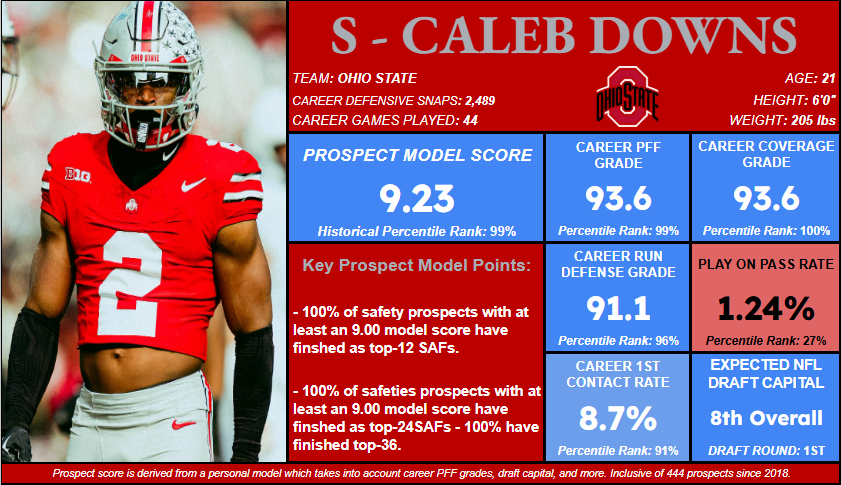
- Downs is far and away the top safety prospect in this class and often considered a true “blue chip” prospect, and his model score backs that up.
- Downs only scores lower than Derwin James (9.50) and Minkah Fitzpatrick (9.33) in this historical model dating back to 2018, creating significant excitement about his IDP potential once he gets drafted into the NFL.
- All of Downs’ PFF career grades rank among the elite across the board as a three-year starter at both Alabama and Ohio State.
- Making Downs a more enticing IDP prospect is that he has the versatility to line up anywhere on the field and be effective, spending 35% of his snaps in the box and 23% in the slot throughout his career.
- As a result of his versatility, he’s been an efficient tackler in his college career, earning an 11.0% tackle rate (84th percentile) on an 8.7% first contact rate (91st percentile).
- The expectation is that Downs will be an immediate starter at the next level, and it wouldn’t be a surprise to see him getting the same versatile usage that made him a star in college.
- Considering the expected draft capital, model score and IDP potential, a second-round rookie draft pick isn’t out of the question, depending on league scoring and team need.
Emmanuel McNeil-Warren, Toledo
- Consensus draft capital: 34th overall
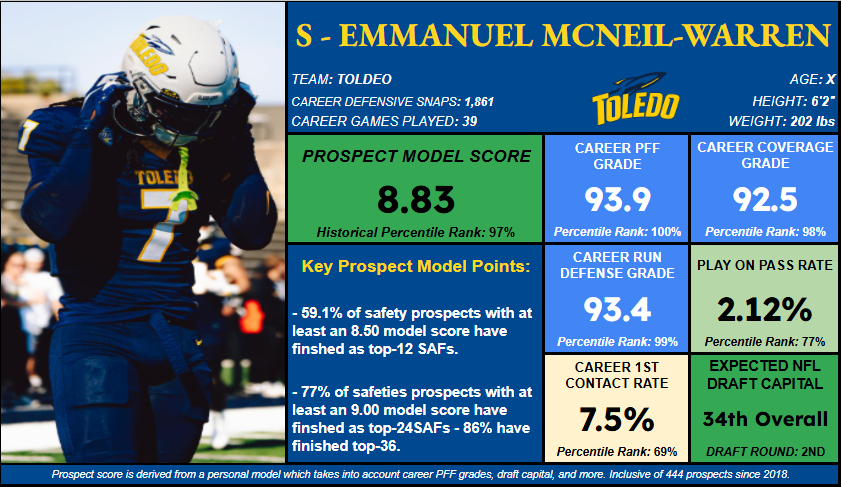
- McNeil-Warren kicks off a run of safeties expected to go on Day 2, in what is a stacked class.
- This 2026 class’ top five expected safeties score the highest average score (8.50) since the 2022 class (8.75), which had three first-rounders, and four of the five players have already finished as top-12 IDP options at their position.
- McNeil-Warren scores very well across the board, especially in terms of his career PFF grades. The only thing moving him out of the 9.00 range is that he played in the Group of Six and not the Power-Four conferences, as the level of competition is accounted for in the model.
- That being said, a 97th percentile score is an elite mark to hit for any safety prospect, as all past safety prospects to score 8.80 or higher have finished as at least a top-36 IDP option and 78% finished top-12.
- Making McNeil-Warren even more enticing for IDP is his experience playing in the box, where he’s spent 52% of his career college snaps – the highest mark among any safety prospect who has actually been drafted into the league since 2018.
- McNeil-Warren compares very similarly to last year’s Nick Emmanwori as an early second-round pick who spent a lot of time in the box and earned high marks while doing so.
- If McNeil-Warren can show nearly as much promise as Emmanwori showed as a rookie, he’ll be worth a high third-round pick in rookie IDP drafts this offseason.
Dillon Thieneman, Oregon
- Consensus draft capital: 39th overall
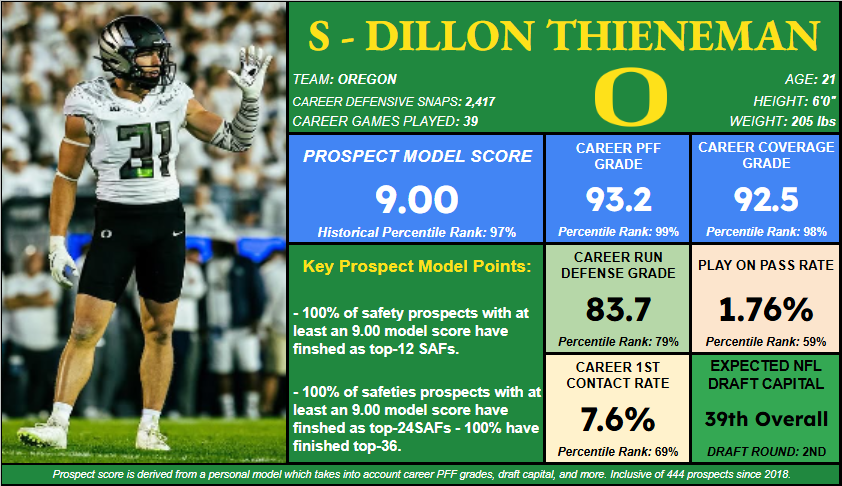
- Thieneman is another high-end IDP prospect expected to go in the second round of the NFL draft, scoring an elite 9.00 – the second prospect in this class to reach that mark and only the fifth total since 2018.
- Thieneman also comes with decent experience as a three-year starter during his time at Purdue and Oregon in his final college season, earning strong PFF grades during that stretch.
- While Thieneman was used more as a deep safety at Purdue, this past year at Oregon, he spent the majority of his snaps (53%) in the box, creating hope that he can do so at the next level as well.
- Thieneman is also one of the better tacklers in this year’s class with a 97th percentile 13.2% tackle rate.
- Considering that he has spent more than half of his career snaps from a deep alignment, that tackle rate is more impressive, though it should be noted that tackle rate isn’t a stable metric from college to the NFL.
- If Thieneman is going to hit for IDP, it’ll be a result of opportunity and usage at the next level, which he’ll likely earn because of his strong play that we’ve already seen in his college career.
- Thieneman’s rookie IDP draft value, like McNeil-Warren, can begin in the third round depending on league size/scoring, though fourth round is the more reasonable price to pay for a rookie safety.
A.J. Haulcy, LSU
- Consensus draft capital: 59th overall
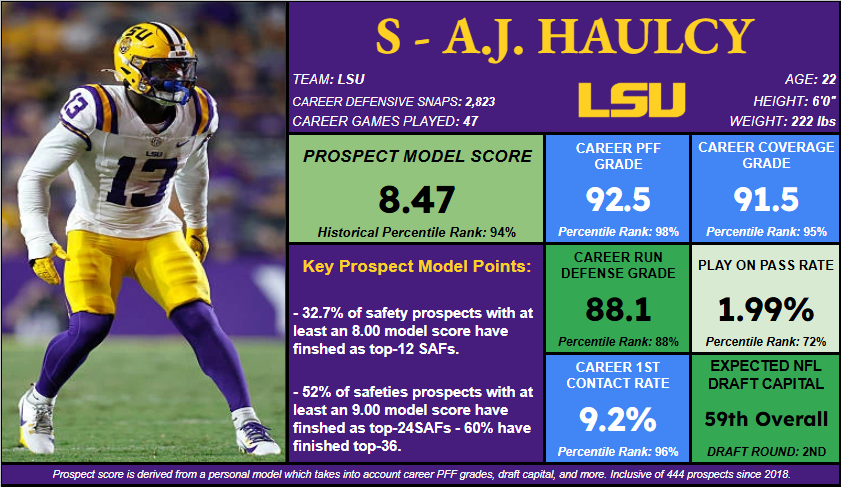
- Haulcy is a four-year starter in his NFL career, playing at New Mexico, Houston, and finally at LSU. He delivered consistently strong grades across the board.
- Haulcy delivered a career year this past season at LSU with an 86.6 overall grade and 88.6 coverage grade, both of which were top-15 marks for his position in the entire FBS in 2025.
- As a result of his consistently strong performances in college, Haulcy is expected to be drafted on Day 2, which will have him on IDP radars. Depending on the landing spot, he could have a role in Year 1.
- Haulcy was also one of the more productive safety prospects in this year’s class, both as a tackler (12.9% tackle rate) and when it came to coverage with a 2% play-on-pass rate for his career, which includes 10 career interceptions.
- Considering the strong depth of this safety class, Haulcy and the rest of the safeties going later than the middle of the second round should all likely be late-round rookie draft picks.
Kamari Ramsey, USC
- Consensus draft capital: 74th overall
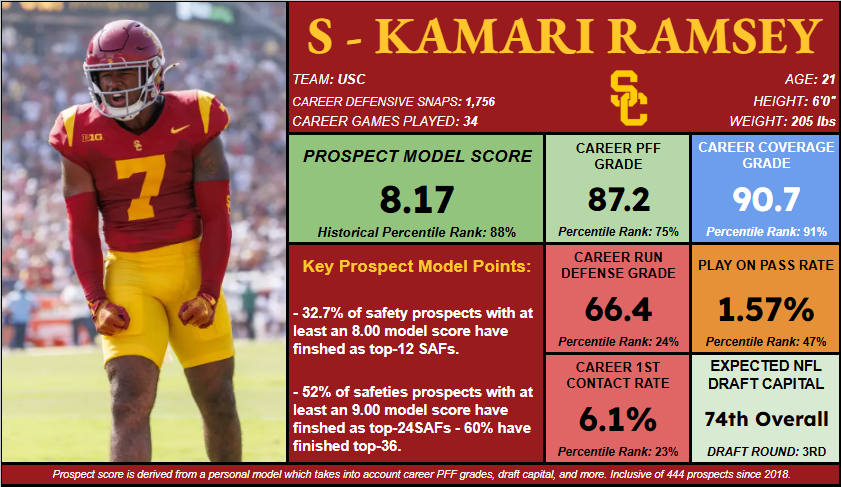
- Ramsey is currently projected for the third round along with about four other safeties at the moment, all of whom could end up being the best of the Round 3 bunch as they score similarly in the model.
- For now, Ramsey leads the way after his four-year career at both UCLA and USC, mostly playing deep or in the slot.
- Ramey’s typical safety rotation makes him relatively unremarkable from an IDP perspective relative to several others in this class, though, given his model score, he still has a decent shot to be IDP-relevant, especially as a potential Day-2 pick.
- Ramsey wasn’t overly efficient with his opportunities in college, ranking in the bottom 25th percentile in tackle rate (8.1%) and first-contact rate (6.1%), which could have more to do with his usage and not necessarily something that will perfectly translate to the next level, even with similar usage.
- However, we shouldn’t necessarily expect prime usage for Ramsey considering his role and experience coming out of college, which will likely hurt his IDP potential.
- IDP rookie drafters should be considering Ramsey a fifth-round pick at best for now, and at least worth grabbing as a UDFA post-rookie draft if he doesn’t go in those final rounds.

 © 2026 PFF - all rights reserved.