- Unlock your edge with PFF+: Access Premium Stats, dominate fantasy with in-season tools and projections and make smarter bets with the new PFF Player Prop Tool. Get 25% off your PFF+ annual subscription with code PFFFANTASYPODCAST25.
Estimated Reading Time: 7 minutes

Last year, I introduced a new framework for understanding wide receiver play, quarterback decision-making and offensive potential. This framework relies on an XGBOOST model and PFF’s impressive collection of route-level data. Using machine learning and this breadth of PFF data, we can create models with the goal of predicting where a target should go on a given play.
The resulting metrics, Share of Predicted Targets and Share of Predicted Air Yards, are both more stable than their “actual” counterparts. Later on, we will discuss the NFL leaders and some potential breakout players.
Building Intuition – What the Model Sees
The foundational theory is that each route on every play carries an inherent probability of being targeted. However, quarterbacks may overlook open receivers or misread the coverage, forcing throws elsewhere. When coaches and players review the film, these missed opportunities are identified — and adjustments often follow. That recognition can lead to a spike in targets for overlooked players in the following game.
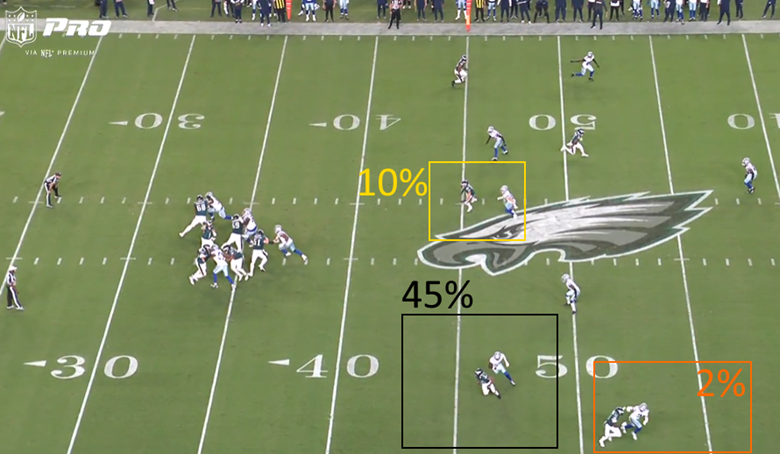
Here is an example from the very first game of the 2025 NFL season. On this play, Jalen Hurts immediately looks right, effectively removing Saquon Barkley and Jahan Dotson from target consideration. The ball is snapped, and Hurts promptly turns and stares down DeVonta Smith — who, by virtue of the separation he earns on this play, gains a 45% target probability. Hurts does end up targeting Smith on the play, as he was the best option on the field.
You can see that Brown did not earn any real separation while running a deep route. Deep routes without separation typically carry very low target probabilities. In this case, Brown only had a 2% chance.
If Smith hadn’t earned any separation or the Cowboys were in a different coverage shell, Dallas Goedert could have been an okay option at 10%. But on this play, it would have been a high-risk, low-reward proposition.
Improving the Model
I am going to focus on the improvements I have made to the model for this season. If you want to read about how I created the initial model, you can check out my first two articles, where I speak about the model creation and deriving some impressive metrics from it.
Announcers often point out “one-on-one” matchups, typically referring to man coverage but occasionally seen in zone concepts. These are best described as “single coverage situations,” where the structure of the defense isolates a receiver against a lone defender. Depending on a receiver’s archetype, these scenarios often present advantageous conditions for drawing a target.
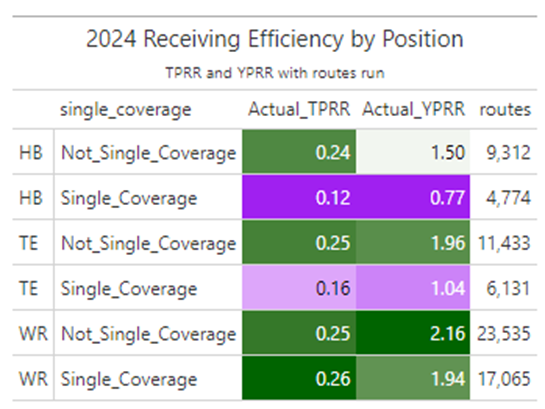
The table above highlights how halfbacks and tight ends experience a significant decline in both targets per route run (TPRR) and yards per route run (YPRR) when facing single-coverage situations. In contrast, wide receivers not only maintain their efficiency but often see a boost in TPRR under the same conditions.
Given this discrepancy, single-coverage situations were added as a variable to the underlying machine learning model to better account for position-specific dynamics in target distribution.
Next, we all know quarterbacks have special relationships with certain receivers. Matthew Stafford and Cooper Kupp would eat breakfast together. Tom Brady and Rob Gronkowski were inseparable. More times than we would probably like to admit, the quarterback has determined who is going to get the ball long before the ball is even snapped.
To address this, a three-week moving average of Weighted Opportunity Rating (WOPR) was added for each player. This metric captures not only how prominently a receiver is featured in the offense, but also whether the quarterback consistently favors that player. It offers insight into both offensive scheme tendencies and individual quarterback-receiver dynamics.
2025 Leaders: Share of Predicted Targets
- Share of Predicted Targets = Player Predicted Targets / Team Predicted Targets
- Share of Predicted Air Yards = Player Predicted Air Yards / Team Predicted Air Yards
- Predicted aDoT = Player Predicted Air Yards / Player Predicted Targets
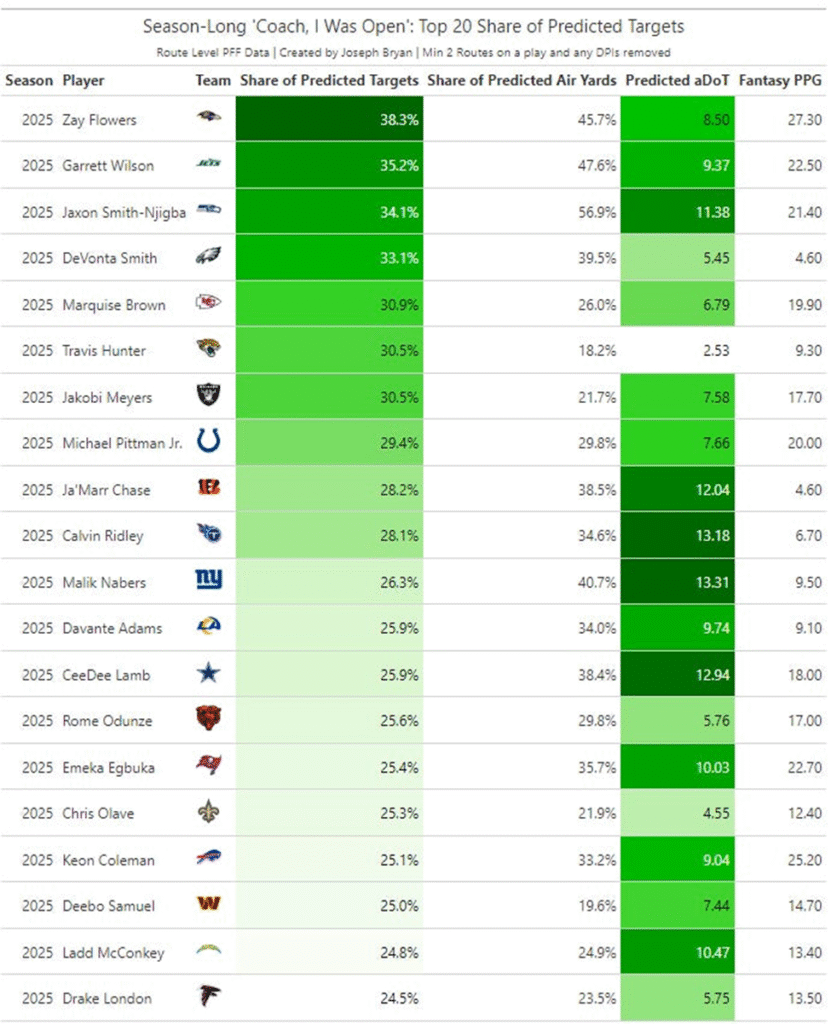
Zay Flowers combined a huge fantasy performance with the league’s best Share of Predicted Targets. If Flowers manages to maintain anywhere near this level of Predicted Target success, he will be in overall WR1 conversations by the end of the year.
DeVonta Smith is a great example of a future breakout relative to his fantasy points scored. Smith should have had an awesome Week 1 game but was hindered by general offensive passing woes. There is a world where he takes over as the Eagles’ WR1 if this route usage persists and A.J. Brown doesn’t feature more prominently.
Travis Hunter is such an exciting player, and it’s hard to tell if the Jaguars will continue to scheme up short-yardage targets for him. His predicted average depth of target of 2.53 was the lowest of any receiver with 15-plus routes. Despite running nine routes deeper than five yards, he rarely earned Predicted Targets. Still, Hunter finishing sixth in Share of Predicted Targets during a rookie debut is impressive.
Week 2 Potential Breakouts
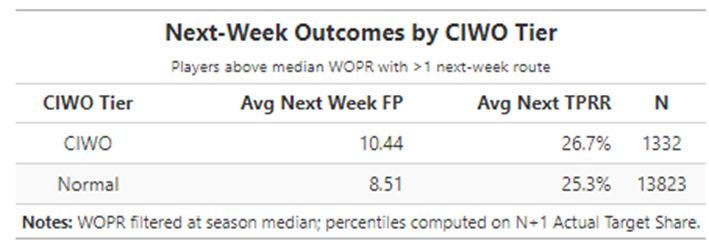
Here is a simple table to show the effectiveness of the CIWO classification. The classification is quite simple: A player finished with above an 80th-percentile Share of Predicted Targets (.17) while sitting below the 80th percentile in Actual Target Share (.17).
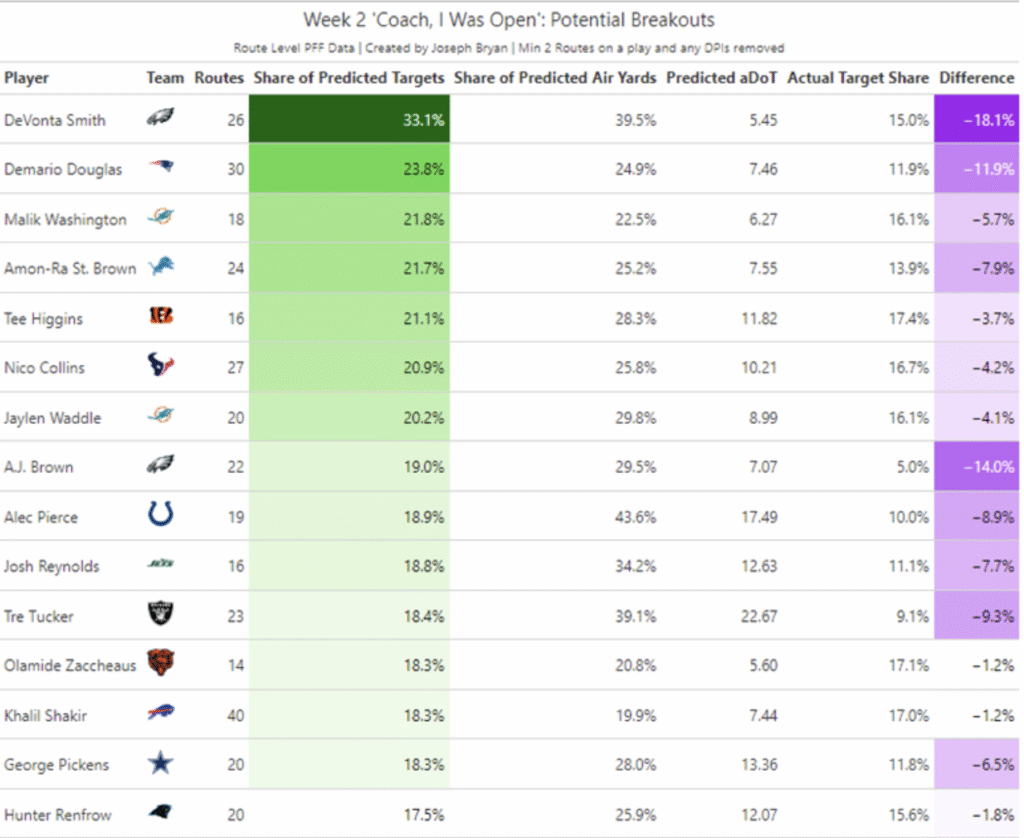
The goal of this table is to identify players who may see an increase in targets the following week. While it doesn’t aim to predict receiving yards or touchdowns directly, those outcomes typically require opportunity — and opportunity starts with targets.
This could be the most star-studded “Coach, I Was Open” list I have ever seen. The table featuring three mega-stars in Brown, Amon-Ra St. Brown and Nico Collins might be a record. Typically, there is just one or even zero.
After Week 1, much of the concern centered around A.J. Brown’s single target. While that’s noteworthy, the Predicted Targets model suggests DeVonta Smith may have been even more overlooked. Smith finished with the fourth-highest Share of Predicted Targets league-wide but managed just 4.6 PPR points. Positive regression seems likely for the Eagles’ passing offense — and Smith could be the focal point. Historically, when a star receiver appears on the CIWO breakout list, a big performance often follows.
Week 1 Review
Each week, I want to discuss one big play where the model predicted a target that could have changed the outcome of a game. The first play of the season I want to review is what ended up being an “optimal decision” by Patrick Mahomes. He threw this pass to Marquise Brown over the middle on second-and-11 with 4:36 left in the game for a gain of 12 yards.
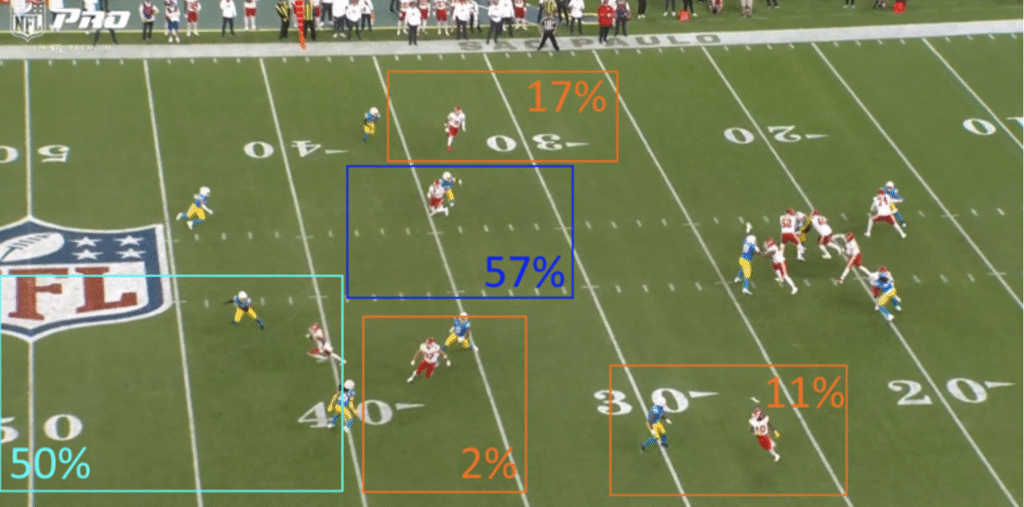
Had Mahomes waited half a second longer with what was very good protection on this play, he could have seen that Tyquan Thornton blew past his single-coverage situation. The Chiefs were down 9 at this point in the game and desperately needed a big play to manage the clock down the stretch.
The Chiefs settled for a field goal later in the drive, but had Mahomes been looking downfield on this play, there was a chance this could have been a 2-point game with 4 minutes left.

 © 2026 PFF - all rights reserved.