- Jordyn Tyson and Makai Lemon thrive throughout (again): Both receivers' data has consistently put them near the top of this class.
- Indiana offers up two potential strong options: Omar Cooper Jr. and Elijah Sarratt stand tall outside of the top-three consensus wide receivers in this class.
- Unlock your edge with PFF+: Access Premium Stats, dominate fantasy with in-season tools and projections and make smarter bets with the new PFF Player Prop Tool. Get 25% off your PFF+ annual subscription with code PFFFANTASYPODCAST25.
Estimated reading time: 12 minutes
The 2026 NFL Draft gets closer by the day, and there can never be enough data to pore over when it comes to evaluating prospects. After focusing on the running backs, this piece will focus on the top wide receiver prospects in this year’s draft and how they performed in key situations.
This piece will focus on a lot of metrics that are not readily available through PFF Premium Stats in order to give an exclusive, in-depth breakdown of production that can’t be found anywhere else.
- Only the top-40 performing wide receivers will be shown in each table for the specific categories (for space), though there are 104 total draft-eligible wide receivers included in this analysis.
- Yards per route run (YPRR) represents the amount of receiving yards per route run within each specific situation.
- The percentage of career receiving yards and touchdowns represents the amount of yardage and touchdowns that each wide receiver posted within each specific situation relative to the amount of total yardage and touchdowns for their career.
- Targets per route run is how many times a wide receiver was targeted on the routes run within each specific situation.
- Yards per target is the amount of receiving yards a wide receiver posted per the number of times they were targeted within each specific situation.
- 1DTD rate is the number of times a wide receiver caught a pass that went for a first down or touchdown per route run within each specific situation.
Overall career receiving numbers
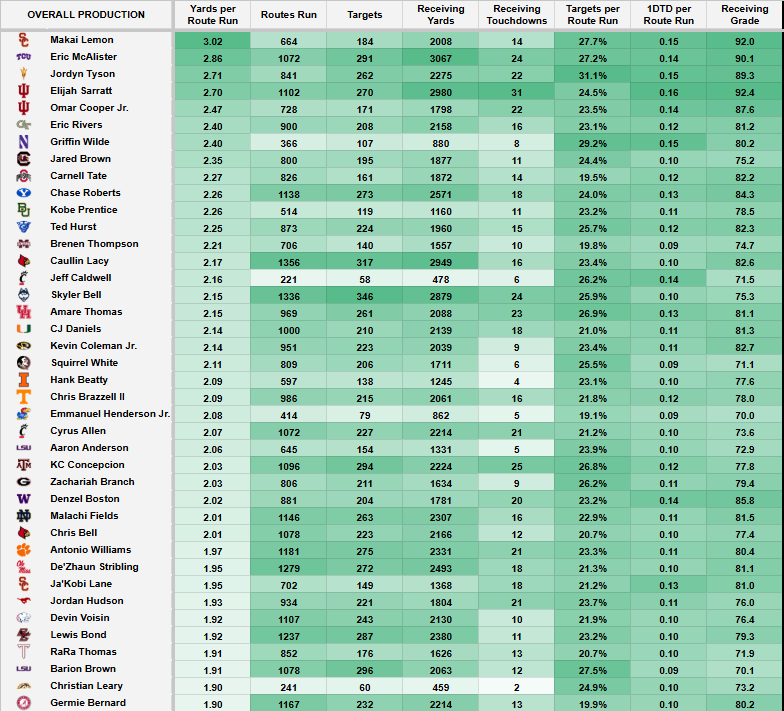
Starting with the basics, this is an overview of how each FBS wide receiver performed in the metrics that will be covered for their entire college career across all situations.
The top three consensus wide receivers in this class, Makai Lemon, Jordyn Tyson, and Carnell Tate, all crack the top 10 in this class in career yards per route. The other two potential first-round receivers, Denzel Boston and KC Concepcion, fail to crack the top 25 in that regard and, unfortunately, don’t thrive in most situations as we work through these categories.
Omar Cooper Jr. often fluctuates between a late first-round pick and early second round, though he owns a more encouraging career yards per route run mark than the other consensus late first-rounders in this class. Landing in an ideal situation as a late first-rounder could help Cooper potentially have more success at the next level as well.
Career numbers versus single coverage
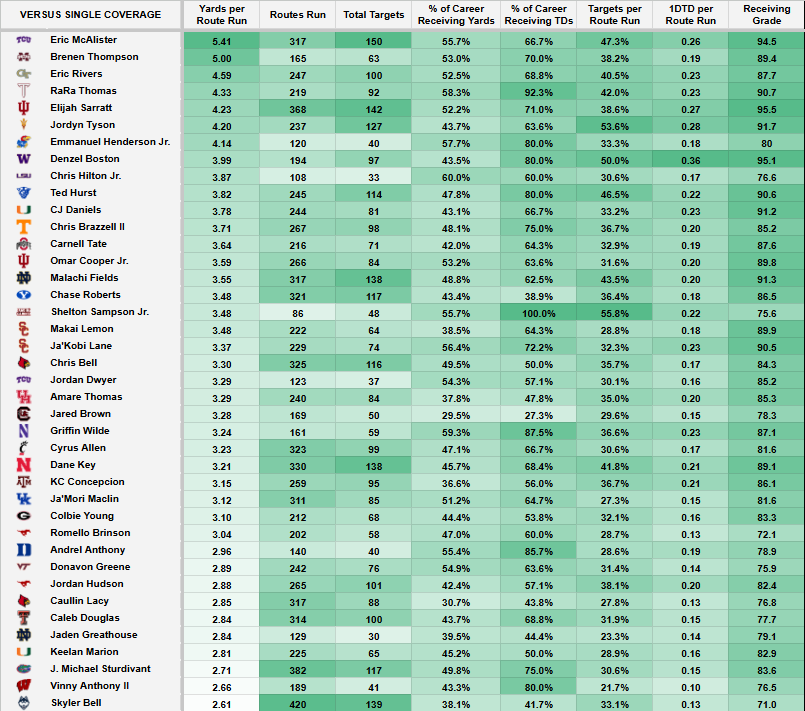
How wide receivers perform against single coverage simply highlights the player’s success rate going one-on-one against defensive backs in man coverage. This is especially important for outside wide receivers who face single coverage more often than those who align in the slot. It’s also worth noting that single coverage can happen within certain zone coverages, so it is not exclusive to just man coverages.
Both Eric McCallister and Brenen Thompson are projected early Day 3 picks and have thrived against single coverage, creating some encouragement about their sleeper potential at the next level. For McCallister, specifically, he also delivered as the most efficient wide receiver in this class against single coverage, doing so on the most total targets (150) of the class.
Elijah Sarratt is another one of the more effective receivers in this class, using yards per route run, and that translates to his performance against single coverage as well. Sarratt has been targeted a ton against single coverage, and he’s found elite success with 71% of his career touchdowns coming against single coverage as well.
Career numbers versus zone coverage
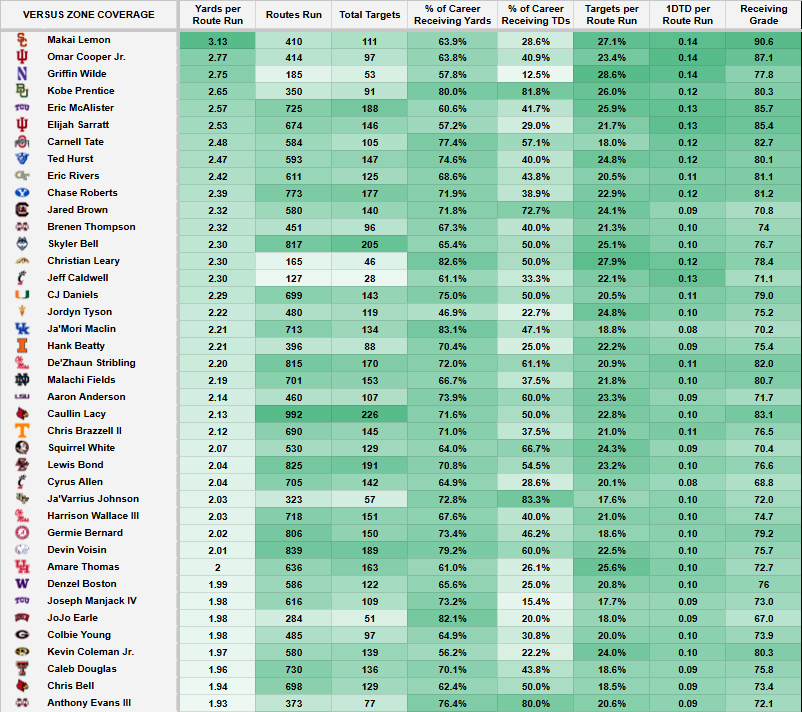
Zone coverage is the most common coverage scheme in college football as well as the NFL. Having a strong feel for zone coverage and knowing how to take advantage of the holes within those coverages is a translatable trait when projecting to the next level as well.
It’s no surprise that the most effective overall wide receiver in this class in terms of career yards per route run is also the top mark in that regard against zone coverage, considering how much more common zone coverages are compared to man coverage. There is a lot of crossover between the overall top performers and the zone coverage top performers, though some smaller sample receivers move the most. Carnell Tate improves his ranking with his zone coverage performance compared to his overall ranking, moving up to sixth here compared to ninth overall. Tate was a fine performer against single and man coverage, ranked 13th in yards per route run, so it’s not a significant difference that caused his overall production to be less than his zone production.
Career numbers versus press coverage
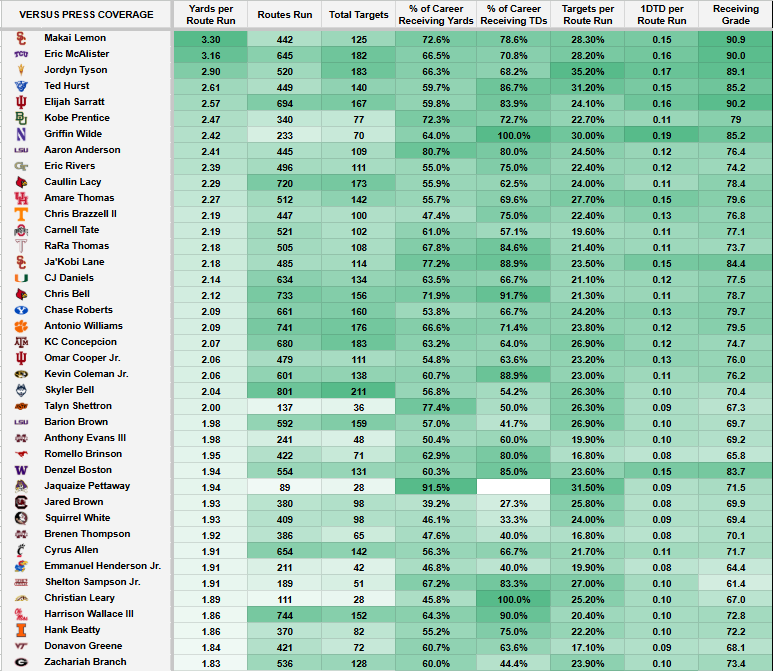
Press coverage involves a defender playing up on the line of scrimmage directly in front of the wide receiver, often with the intent to get hands on the receiver and create legal contact within the first five yards to jam up their release and throw them off their intended routes. This section highlights the receivers who have success against this tactic, as they can fight through the contact and still come up with targets, yardage and efficiency.
Lemon and Tyson, specifically, often show up as the clear stand-outs from a data perspective and typically create some separation from Tate, despite Tate often being mocked as the consensus WR1 for this class. Against press coverage, that doesn’t really change much, as Lemon and Tyson deliver elite scores facing contact at the line of scrimmage and still find ways to win their reps as they continuously add to their promising fantasy profiles heading into the NFL draft.
Career red-zone production
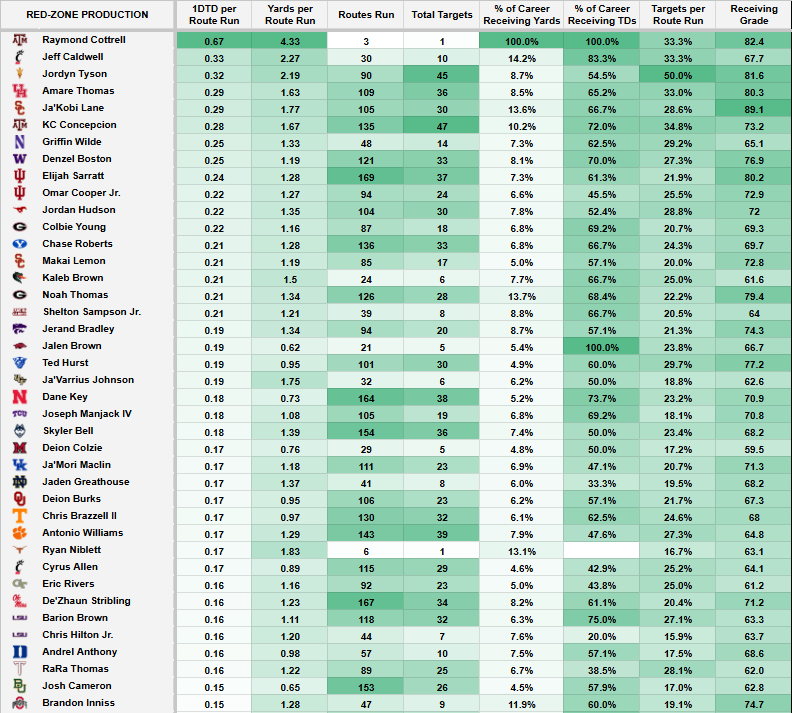
Red-zone usage and production are often associated with touchdowns, which translates to stronger fantasy performances. This category will be sorted by first-down-plus-touchdown rate as our main metric of success.
KC Concepcion is the most targeted receiver in this class when his team gets to the red zone, finishing with a high 47 targets over his college career that resulted in 18 of his 25 career receiving touchdowns. Concepcion is not a big wide receiver by any means, which speaks to his ability to win in that more condensed area of the field. It could ultimately help him translate to the next level, even if not an immediate WR1 on a roster. There’s room for him to take on more quality targets over quantity.
Career screen production
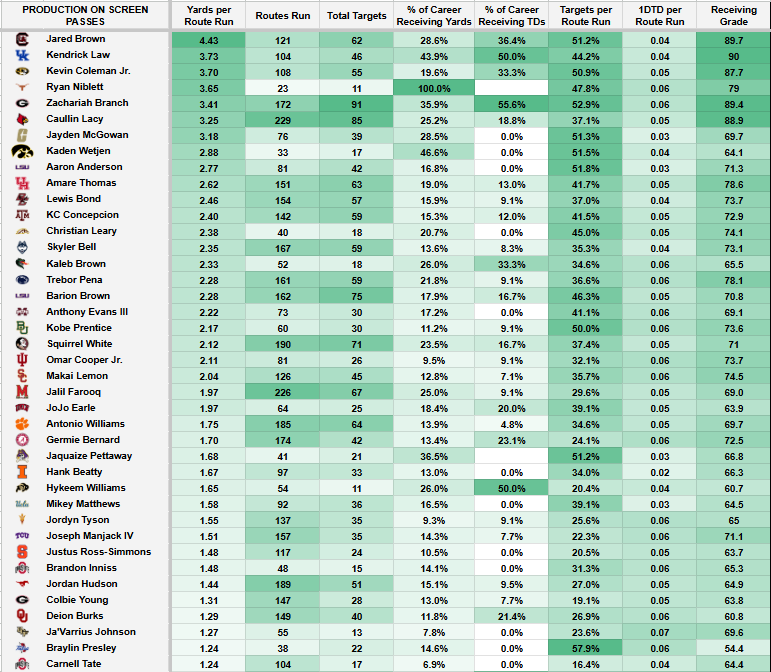
Understanding how much production receivers generate on screen plays and their usage in that regard helps contextualize their overall production in order to get a better understanding of what their true strengths tend to be.
Georgia’s Zachariah Branch is currently projected as a Round 2 pick in the NFL draft and has seen more screen passes (91) in his college career than any other player in this class. Screen passes have accounted for a high 36% (586 yards) of Branch’s career receiving yards (1634), which is a bit of a concern in that if an NFL team isn’t going to utilize him similarly, his non-screen capabilities leave more to be desired. Unfortunately, Branch comes in below average in most other categories covered in this piece, including outside of the top 25 in total yards per route run, versus single coverage and on deep passes.
Career deep ball production
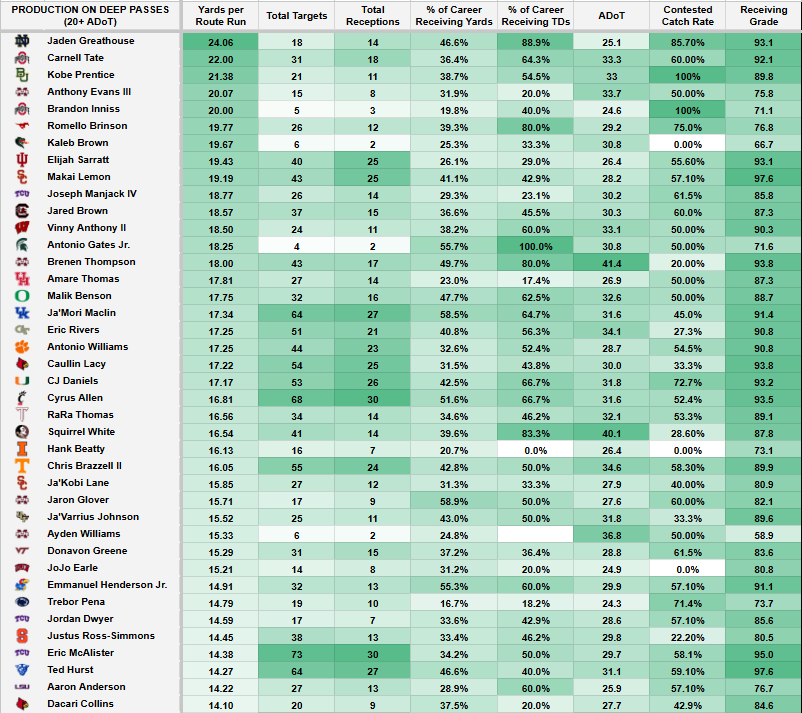
Highlighting each FBS wide receiver's usage on deep throws, as well as how often they’re used in that regard, is a good way to highlight a key strength that results in high-value plays both for fantasy and for their respective teams.
Carnell Tate has been incredibly effective on deep passes in his college career, leading to an elite 22.00 yards per route run mark on passes 20-plus yards downfield. This resulted in nine of his 14 career receiving touchdowns for his career, which equated to a touchdown on every other deep reception for Tate. As the consensus WR1 in this class, his ability to convert on such high-value passes is going to be a significant green flag in his favor.
Cincinnati’s Cyrus Allen is a potential top-200 pick in this year’s draft, as he's been utilized as a deep option on an incredibly high 68 targets for his career. However, he hasn’t been the most efficient on those targets, coming in just outside the top-20 in yards per route run. Over half of Allen’s career receiving production has come from deep passes, along with two-thirds of his total career touchdowns. Allen will likely enter the NFL as a specialist for an offense with a chance to increase his role over time, though he’ll unlikely be an immediate hit at the next level.
Career late-down production
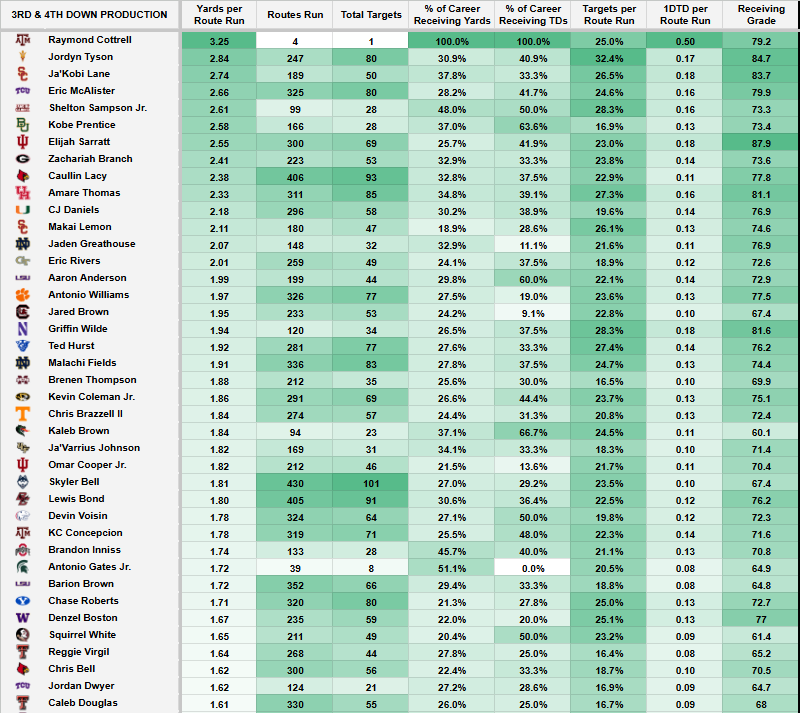
Lastly, we will focus on the receivers who delivered when their teams needed them most, on crucial late downs. Getting targets in these situations and coming up clutch to convert on third and/or fourth down can be a positive indicator of who the player’s team trusted the most in each situation and who stepped up to deliver.
Jordyn Tyson owns by far the highest target rate on third and fourth downs for his college career, and he’s consistently delivered in those situations, ranking second in yards per route run and receiving grade in those situations. Tyson’s “clutch rating” is arguably the best in this class and only adds to his claim to be the WR1 for this 2026 receiver group.


 © 2026 PFF - all rights reserved.