- Unlock your edge with PFF+: Access Premium Stats, dominate fantasy with in-season tools and projections and make smarter bets with the new PFF Player Prop Tool. Get 25% off your PFF+ annual subscription with code PFFFANTASYPODCAST25.
Estimated Reading Time: 5 minutes

Fantasy and DFS enthusiasts, bettors and analysts often rely on a wide array of statistics and models to gain a competitive edge. These range from basic box score stats to advanced metrics available in PFF's Premium Stats 2.0 and models like Josh Hermsmeyer‘s Buy Low model and WOPR (Weighted Opportunity Rating).
There is always room for new insights and analyses to help bettors and fantasy managers refine their strategies. That’s why I developed a new metric that offers several advantages over WOPR. Click here for an in-depth explanation of the model, my process and its advantages.
Quick Refresher
Using a Predicted Targets model, in conjunction with route-level PFF data, we can create two very stable and predictive metrics: Share of Predicted Targets and Share of Predicted Air Yards.
We can combine these and create a Predicted WOPR metric that is both more stable and predictive than Actual WOPR.
PWOPR = (1.5 * Share of Predicted Targets) + (.7 * Share of Predicted Air Yards)
Furthermore, we can compare this to the players’ Actual WOPR and Actual Fantasy Points to predict potential breakout players in upcoming weeks.
BREAKOUT CANDIDATES: WEEK 2
As a quick refresher on how regression-to-the-mean models work: a player’s fantasy points per game (FPpG) are projected based on their three-week PWOPR average (explained more here). For this week’s projections, only one week of 2025 data is available and is used accordingly.
PWOPR is significantly more stable than FPpG and serves as a stronger indicator of future performance. To help identify potential breakout candidates, the residual is calculated by subtracting a player’s predicted FPpG from their actual FPpG. Players with a strong PWOPR and a residual of -3.0 or lower are included on this list. Players remain on the list until one of the following conditions is met:
- They fulfill their PWOPR potential with a big game
- Their PWOPR decreases to match their expected FPpG
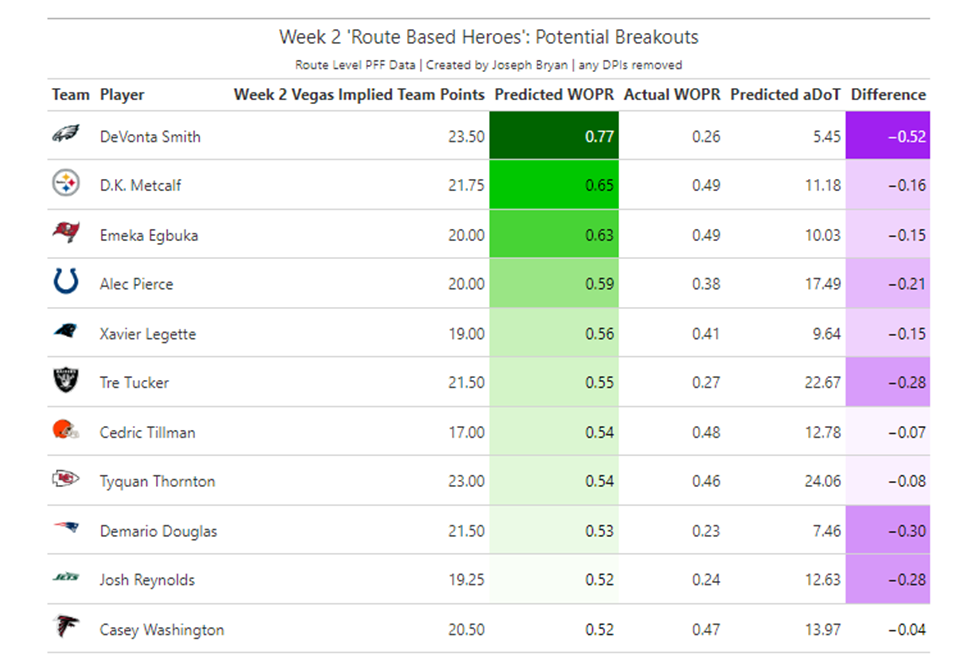
Each week, the top five players in PWOPR from the Route-Based Hero table are highlighted. All players featured on this table carry an outsized probability of delivering a breakout performance.
DeVonta Smith posted the fourth-highest PWOPR in Week 1 but managed just 4.6 PPR points — an unusually low output for that level of opportunity. Since 2021, only one other player has recorded a WOPR–PWOPR differential worse than –0.5: Michael Pittman in Week 13 of 2022, who rebounded with a 16-point performance the following week. If the Eagles are forced into a more pass-heavy script against the Chiefs, who finished 2024 with the seventh-highest PFF run-defense grade, Smith could be in line for a breakout.
D.K. Metcalf ranked 10th in PWOPR in Week 1 and converted that into a respectable 12.6 PPR points. His Week 2 outlook is promising as he faces a Steelers defense that finished 2024 with the 11th-lowest PFF coverage grade and a middle-of-the-pack pass rush (15th). That combination could open the door for Metcalf to turn an elite opportunity into an even bigger fantasy output.
One potential concern for Metcalf is the mismatch between his usage and his quarterback's tendencies — he led the team in Predicted aDOT, while Aaron Rodgers posted the fastest time to throw in Week 1. That gap may cap Metcalf’s ceiling unless the offense adjusts. Still, this week carries added intrigue with the revenge game narrative; Jennifer Eskins’ offseason study showed that players tend to exceed expectations when facing former teams — another reason Metcalf remains a compelling breakout candidate.
Emeka Egbuka’s breakout 23.6-point performance in Week 1 earns him a spot on this list, but it’s his underlying metrics that are especially noteworthy. Ranking 13th in PWOPR despite competing with Mike Evans for targets signals strong separation ability — a key trait in the model. While two touchdowns may not be sustainable, his usage indicates a consistent role moving forward. The matchup against Houston is a mixed bag: the Texans bring elite pass-rush metrics but struggled in coverage. If Tampa Bay’s line holds up, Egbuka is well-positioned for another productive outing.
Alec Pierce’s .59 PWOPR ranked second on the Colts in Week 1, trailing only Michael Pittman. Despite the strong usage signal, his Week 2 outlook is less favorable. He’ll face a Denver defense that ranks top-15 in both coverage and pass-rush grades, and he’s tied to a quarterback who has struggled with deep accuracy, as Daniel Jones ranks just 41st in deep passing grade since 2023. Pierce remains a high-variance option dependent on a few downfield play-action shots connecting.
Xavier Legette quietly posted the third-highest PWOPR of his career in Week 1, ranking 23rd leaguewide, while teammate Tetairoa McMillan wasn’t far behind at 15th. Despite a challenging matchup in Week 2 against a Cardinals defense that led the league in coverage grade, Arizona’s pass rush remains a concern, ranking eighth-worst. With a talented receiver duo and an ascending quarterback shaking off a weather-impacted opener, Carolina profiles as a strong buy-low offense heading into Week 2.
As always, not every player on this list will deliver, but several will likely exceed their average PPR from the past three weeks. A few could even have explosive games.

 © 2026 PFF - all rights reserved.