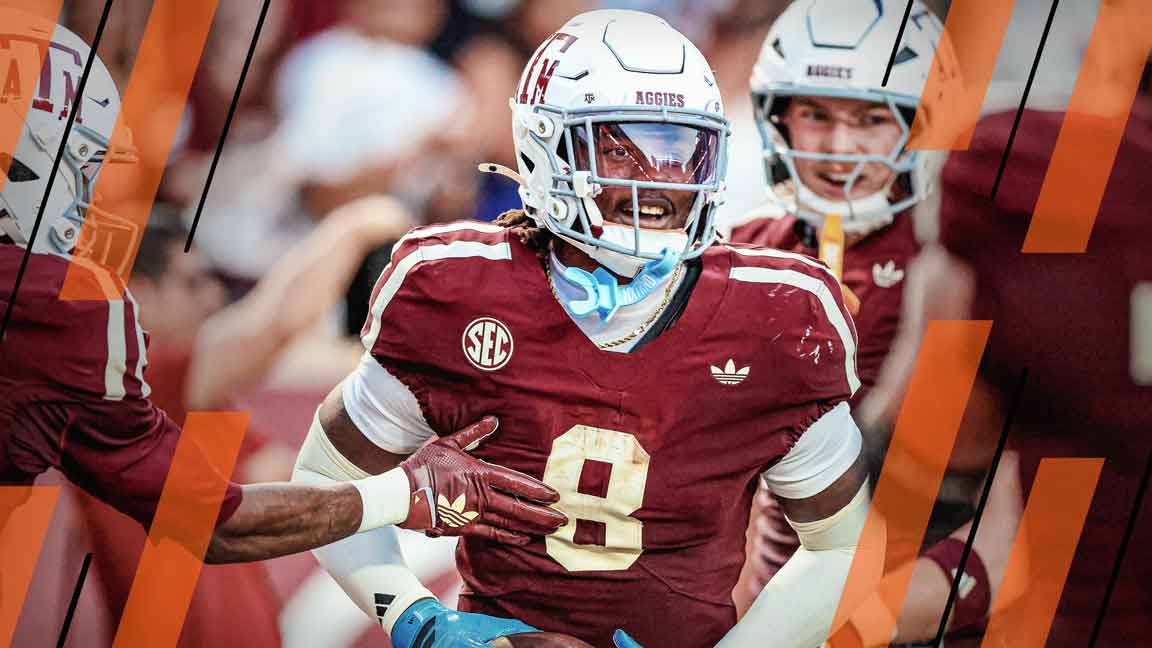
- Seth McGowan has three-down potential: The former Kentucky running back needs some work in pass protection and ball security, but if he improves that, he can leap over multiple rookie running backs in fantasy production.
- Can Le’Veon Moss overcome his injury history? Moss couldn’t finish either of the last two seasons, but was among the highest graded runners when healthy.
- 2026 NFL Draft season is here: Try the best-in-class PFF Mock Draft Simulator and learn about 2026's top prospects while trading and drafting for your favorite NFL team.
Estimated reading time: 5 minutes
The NFL draft is weeks away. While this is not a strong running back class relative to the previous year, there are still a few running backs who will factor into running back rotations this season, and several others who have a shot of joining a rotation.
Here are three running backs expected to go in the third round of dynasty rookie drafts or later who have a chance to factor into running back rotations as rookies, and potentially have fantasy value in their first few years of the league. Stats referenced in this article are how players performed over the last three seasons, and the players are compared to the other 19 players in the rankings.
Seth McGowan, Kentucky
McGowan is a well-rounded running back with the potential to be an NFL starter. While several running backs in this class have unique sizes that might push them into a two-down or a third-down role, McGowan has the size of an every-down running back.
His raw protection was held back by Kentucky’s offense. His 1.6 yards before contact per carry was third-lowest of the top 20 running backs of the class, but his 0.26 avoided tackles per carry were tied for third-best behind Jeremiyah Love and Jonah Coleman.
While McGowan’s speed isn’t elite, his acceleration and change of direction are exceptional, according to tracking data.
Our draft guide notes some bad misses in pass protection and ball security issues. He also didn’t seem dynamic after the catch, which reflected in his receiving stats. Most of those should be fixable at the NFL level with the right coaching. Anyone drafting him will need to be patient, but he could have higher odds of becoming a three-down back than some of the running backs expected to go in the second round of dynasty rookie drafts.
Le’Veon Moss, Texas A&M
Moss is a similarly well-rounded running back with three-down potential. When he was healthy, he was among the better graded running backs of the class. His 90.9 PFF run grade was fourth-best among the top-20 rookies in the class, only behind Jeremiyah Love, Kaytron Allen and Jonah Coleman. His 3.7 yards after contact per attempt also ranked fourth best, while his 32.6% first down or touchdown rate ranked second.
The reason Moss will likely get drafted later is injury concerns. He tore his ACL and MCL in 2024 and then a leg injury cost him the second half of 2025. He didn’t participate in the combine due to the injury. He may be more susceptible to injury, or he could have just been unlucky, but that will likely be enough to make him a pick on day three rather than Day 2. It’s also possible he won’t be the same player once he’s back from injury.
Moss is the perfect kind of player to take in the middle of dynasty drafts because his upside is to work out in a big way as a three-down running back, but his downside is that he won’t have any fantasy value. That is a better gamble than those with a higher floor but a lower ceiling.
Kaelon Black, Indiana
Black is a third ball carrier with a third-down back's size and speed. He’s right in the middle of the pack in terms of height and weight, while his speed, acceleration and change of direction are all above average, relative to the top-20 running backs of the class.
His first problem is a lack of receiving production while at Indiana. He posted a solid 1.38 yards per route run in his final season at James Madison, but he rarely ran routes and was even more rarely targeted while at Indiana. He also never had a snap rate above 45%, as passing downs were the primary time when he was on the field.
Our draft guide noted he is better suited for zone blocking schemes, and the stats played that out. He’s averaged 5.5 yards per attempt on zone runs compared to 4.7 on gap. The guide also noted “he has occasionally been a half-step late in identifying running lanes when operating behind power concepts” and “his run game lacks true difference-making creativity”.
Similar to McGowan, he is a back that needs the right coaching to potentially become an NFL starter, but there is a chance he can become a three-down back.

 © 2026 PFF - all rights reserved.