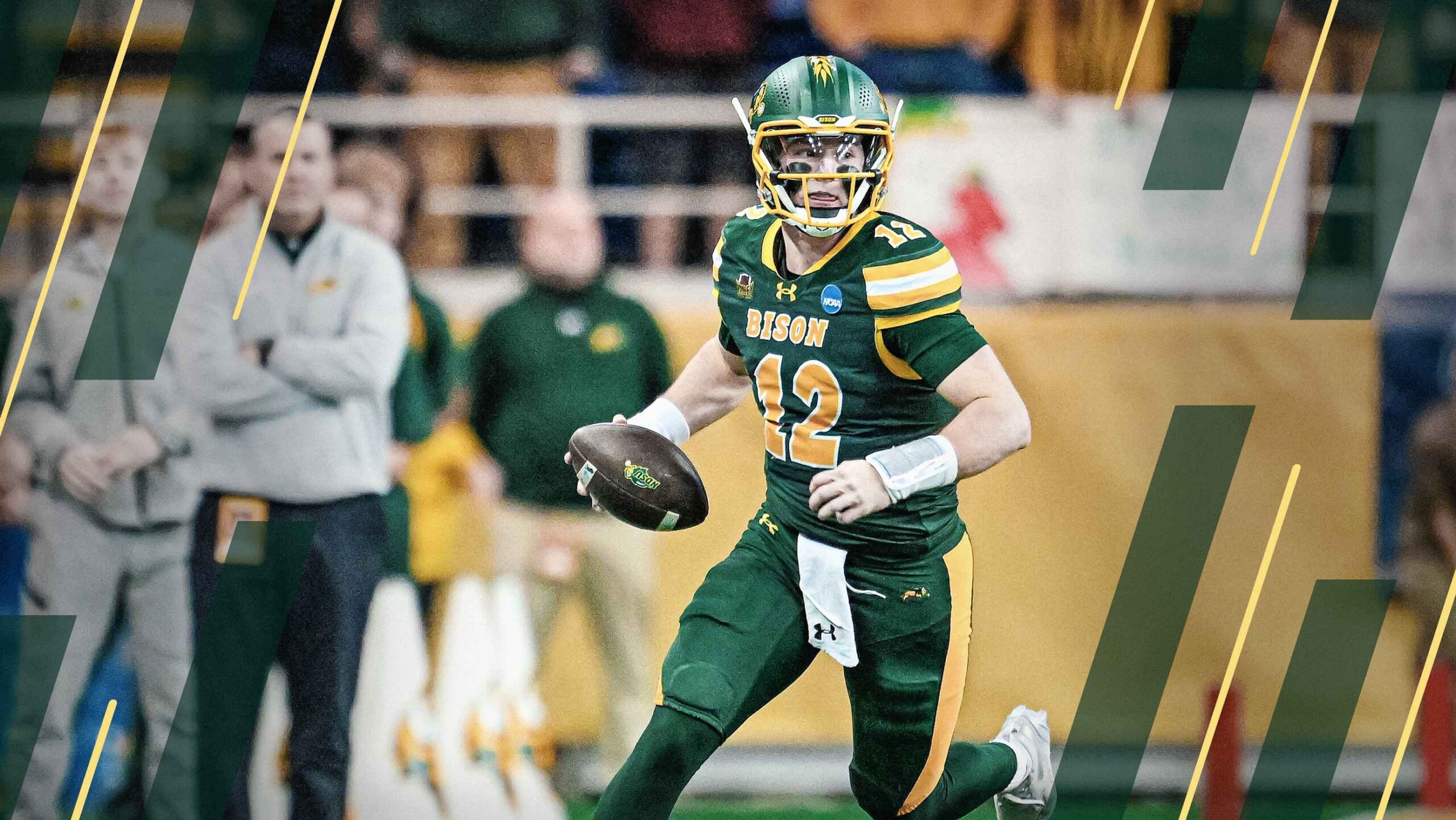
- NDSU's dominance is nearly unparalleled: The Bison have claimed 10 of the past 15 FCS championships and look to match that at the next level.
- A dominant Bison running game: North Dakota State has generated 866 explosive runs since 2018, the most by a wide margin.
- Personnel turnover looms: The Bison will usher in new quarterback Nathan Hayes as well as multiple starters along their offensive line.

North Dakota State has spent the better part of the last 15 years setting the standard in the FCS. While the landscape of college football has changed dramatically through conference realignment, NIL and the transfer portal, the Bison have remained one of the sport’s only true constants, building the most successful dynasty the FCS has ever seen.
Their sustained success is now being rewarded with a long-awaited move to the FBS. Beginning with the 2026 season, North Dakota State will compete as a football-only member of the Mountain West, joining a conference that has undergone significant change following the departures of Boise State, Colorado State, Fresno State, San Diego State and Utah State to the PAC-12.
No program in modern history has entered the FBS with a résumé that compares to North Dakota State’s. The Bison have won 10 of the last 15 FCS national championships, consistently producing NFL talent in the process.
Their star power has not been limited to the second tier of the sport. The Bison have competed successfully against FBS opposition throughout the last decade, with a 9-5 record over their last 14 FBS opponents.
NDSU’s arrival is easily one of the most intriguing storylines of the 2026 college football season. North Dakota State has long demonstrated it can compete with FBS teams once per season, but the challenge is now maintaining that standard across a full season.
With the Bison now eligible to play the Mountain West championship game, bowl games and the College Football Playoff immediately, long-term expectations surrounding the program are only amplified.
North Dakota State arrives in the FBS with a championship pedigree and an established identity that few programs can match. The Bison’s dominance has extended beyond wins and championships, consistently producing elite individual and team performances, captured by PFF.
The school has sent a steady stream of talent to the NFL over the past decade. Former Bison players featured on 4,138 snaps from scrimmage during the 2025 NFL season, all but 14 of which came on offense.
Wide receivers Christian Watson and incoming rookie Bryce Lance are two of the best athletes the NFL Combine has ever seen. Meanwhile, Seahawks offensive linemen Grey Zabel and Jalen Sundell both played every snap of the Super Bowl in February. The program’s exports in the trenches also include Cody Mauch, Cordell Volson and Dillon Radunz.
North Dakota State has a longstanding tradition of elite line play, rushing production and run-blockers at wide receiver, but quarterback remains the position most closely associated with its NFL Draft picks. Carson Wentz and Trey Lance are the obvious examples. Producing two top-three draft selections within five years was an almost unbelievable accomplishment for an FCS program.
Former Day 3 selections Easton Stick and Cam Miller also had their fair share of admirers, but the highest-graded Bison quarterback since PFF began tracking the FCS in 2018 is actually the most recent one. Cole Payton, now with the Philadelphia Eagles, posted a 95.9 PFF grade in his only season as North Dakota State’s starter, the highest grade PFF has ever awarded to an FCS quarterback.
Among teams to have played in the FCS since PFF began tracking the division in 2018, North Dakota State leads the way in both yards per play, at 6.8, and EPA per play, at 0.21. When taking a look at college football as a whole, only Alabama has scored more points than the Bison since 2018.
Total points scored in college football, 2018-25
| School | Team Points Scored |
|---|---|
| Alabama | 4,400 |
| North Dakota State | 4,192 |
| Ohio State | 4,182 |
| Georgia | 3,913 |
| Clemson | 3,860 |
North Dakota State has traditionally operated with a fairly distinctive offensive style, frequently placing multiple players in the backfield while rarely condensing formations. Since 2018, the Bison have run the sixth-most plays with multiple running backs in the formation. The five programs ahead of them are the three service academies and two additional users of the triple option.
NDSU has employed 22 personnel on 11.8% of plays, which is the second-highest of any Division I program. Meanwhile, its 3.6% bunch-formation rate is the second-lowest of any FBS or FCS team over the past nine seasons.
However, those figures are heavily influenced by older North Dakota State teams coached by Matt Entz. Under current head coach Tim Polasek, who took over in 2024, the Bison have moved toward a more traditional offensive structure.
They have used virtually no 22 personnel under Polasek, aligning two or more running backs in the backfield on 10.6% of their plays, exactly matching the college football average. Some traditional elements do remain central to the offense, however. Since Polasek took charge, North Dakota State has used under-center formations at the fifth-highest rate of any non-service academy program in Division I football.
That approach is designed to feed a running game that has long been the foundation of the program’s identity.
Most rushing yards in college football since 2018
| School | Team Rushing Yards |
|---|---|
| North Dakota State | 29,511 |
| Army | 28,836 |
| Air Force | 27,568 |
| Navy | 25,866 |
North Dakota State’s 868 explosive carries of at least 10 yards place the Bison in a category of their own. That is 166 more than the next-closest program, nearby rival Montana State.
The Bison’s pass-play rate has also consistently ranked among the lowest in college football, standing at just 43.4% since 2024. When they have put the ball in the air, however, they have been remarkably productive. Their 20.7% explosive pass-play rate leads all Division I teams since 2024, as does their 94.6 PFF passing grade.
There is no obvious schematic shortcut inflating those numbers, either. North Dakota State’s pressure rate allowed ranks only 69th among Division I offenses, and the Bison have not relied on repeatedly calling one concept while overwhelming opponents with a massive talent advantage. Their screen, play-action and RPO usage rates are all below the college football average. Despite the offense’s run-heavy nature, only two FCS programs have called fewer RPOs since 2024.
Instead, the Bison have simply executed at an exceptionally efficient level. Their 1.5% interception rate ranks 10th in college football, while they have produced the sixth-fewest off-target incompletions of any team. Indiana is the only offense with a higher passer rating than North Dakota State since Polasek took charge in 2024.
The keys to the offense will now be handed to quarterback Nathan Hayes. He has been in the system since arriving in 2022 but has attempted only 63 passes over the past two seasons. Hayes is set to become the first North Dakota State quarterback to take a snap at the highest level of college football.
Hometown tight end Reis Kessel also returns for his redshirt sophomore season as the third-highest-graded returning tight end in college football, carrying an 87.8 PFF grade from last season.

The larger concern surrounds an offensive line that must replace several starters, although this regeneration is undeniably what the program does best, and why NDSU has dominated for so long. This time, it is center Trent Fraley and guard Beau Johnson who have transferred to Michigan State and Vanderbilt, respectively, creating immediate questions at the position group that has traditionally driven North Dakota State’s success.
That will be one of the defining challenges of the Bison’s first FBS season. North Dakota State will no longer enter almost every game with a decisive advantage in physicality, depth and offensive line talent. The program will be tested more consistently by defensive fronts capable of disrupting its running game without committing additional defenders to the box to open up explosive downfield passing opportunities.
Regardless of this, the Bison are better-prepared for the jump than any previous FCS promotion in modern memory. That includes the standout James Madison side underneath Curt Cignetti, a Dukes team that went 19-4 across their first two seasons in the big leagues.
The question is not whether North Dakota State can produce individual performances worthy of the FBS. The Bison have already proven that repeatedly. The real test is whether they can sustain that level over an entire schedule while recruiting, retaining and developing enough depth to compete with established FBS programs in the long run.
North Dakota State is not entering the Mountain West simply to survive its transition and remain ever-present in the middle of the road. This is a program which receives huge support from its state, and everything about the school’s recent history suggests the Bison will expect to become a contender as soon as 2026.


 © 2026 PFF - all rights reserved.