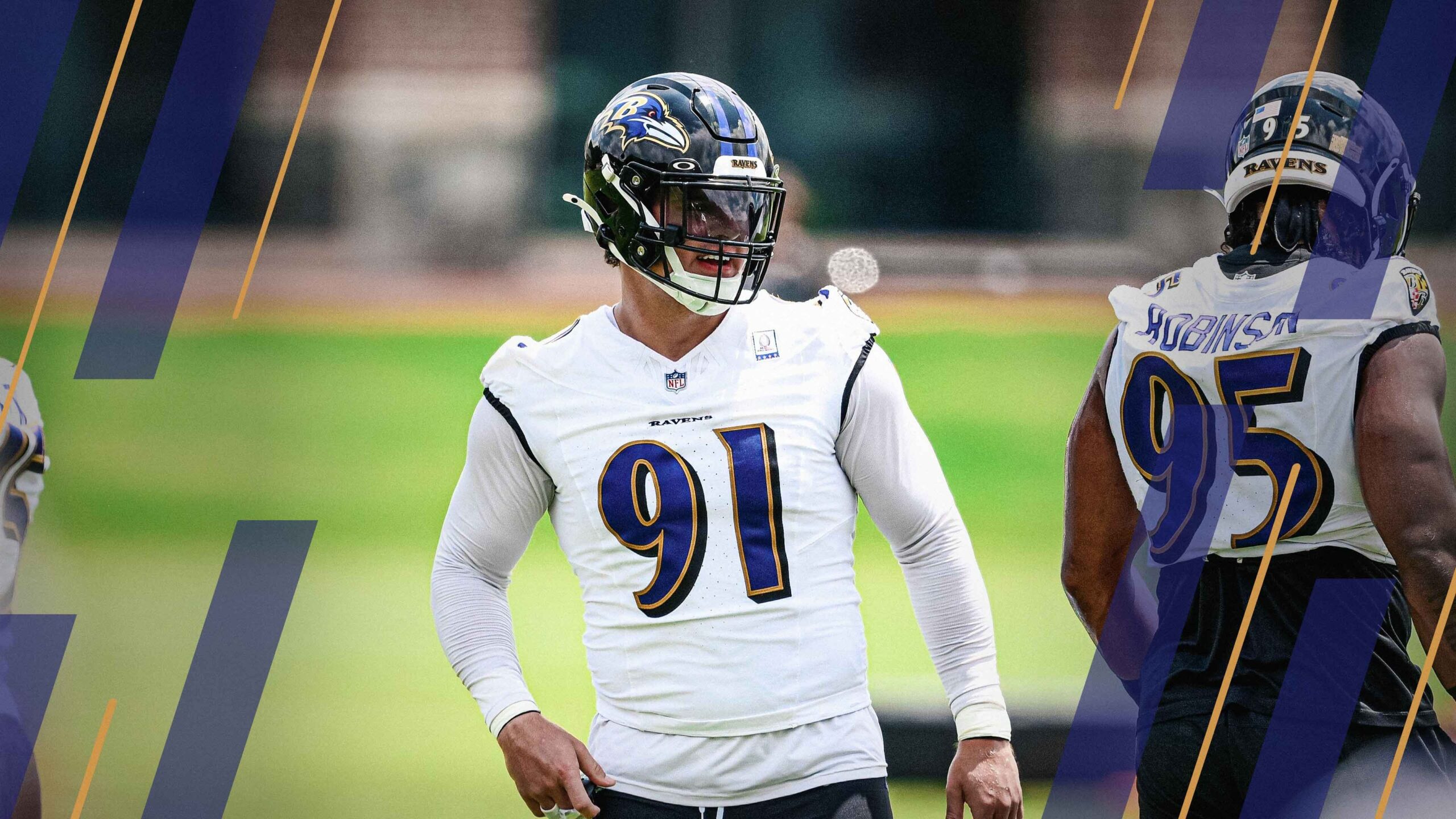
- The Ravens‘ defensive line looks drastically better: Baltimore added Trey Hendrickson, Calais Campbell and Zion Young, plus returns Nnamdi Madubuike.
- Questions for 49ers receivers: With Ricky Pearsall now out for the season, the team's room needs legitimate production and health from Mike Evans, Deebo Samuel and De'Zhaun Stribling.
- The PFF Early Bird Sale Is Here: Save 33% and get PFF+ for just $79.99, our lowest price of the year.

At long last, football returns this week in the form of the Hall of Fame Game. That, coupled with the arrival of training camps, has action firmly on the horizon.
After an offseason that witnessed tremendous turnover around the league for both players and coaching staffs, pieces are starting to be finalized, and momentum is building. While rosters aren’t totally set given injuries and more signings or trades will happen, coaches are becoming more content with the names they possess in a specific room.
Whether due to the chance to greatly improve, featuring high-powered names or with a lot on the line, these five position groups will be squarely in the spotlight during the 2026 season.
Baltimore Ravens defensive line
The Ravens’ 2025 season was a forgetful one, in part because of a defense that ranked 16th in EPA per play and 20th in success rate. A lot of those struggles can be attributed to Baltimore’s defensive line.
Indeed, the Ravens’ defensive line ranked 24th in overall PFF grade last season, including 30th in PFF pass-rush grade. The only Raven pass-rusher to play 75-plus snaps and garner at least a 70.0 PFF pass-rush grade was Odafe Oweh, who played five games before being traded to the Chargers. Other concerns included the loss of Nnamdi Madubuike and Mike Green underwhelming as a rookie.
Fast forward to this offseason, and the unit looks considerably better. The headliner move was signing former Bengals star Trey Hendrickson, who has registered no worse than an 86.9 PFF pass-rush grade in five straight seasons. On top of that, Baltimore reunited with Calais Campbell (69.2 PFF run-defense grade) in free agency and drafted Zion Young (85.0 overall grade) in the second round, while Madubuike has been cleared to practice.
Now coached by one of the sport’s best play-callers in Jesse Minter, Baltimore’s defensive line is poised to go from one of the NFL’s worst to one of its most feared. The room features not only tremendous talent, but also improved depth.
San Francisco 49ers wide receivers
For a team as consistently offensively strong as the 49ers, it might be strange to see a position group on that side featured. However, the team’s receiver corps is currently worrisome.
Although the 49ers earned the sixth-best team PFF receiving grade last season, their receivers themselves finished 23rd in the metric. The only 49ers to finish with at least 1.50 yards per route run were George Kittle, Christian McCaffrey and Ricky Pearsall, although two of the three appeared in 12 or fewer games.
With Pearsall already ruled out for the year due to a knee injury and staple Jauan Jennings gone, head coach Kyle Shanahan has a much thinner unit to work with. San Francisco did sign Mike Evans in free agency, but he finished with a career low in receiving grade (71.2) and yards per route run (1.62) along with an 11.8% drop rate in 2025. Other veterans include a reunion for Deebo Samuel (70.2 receiving grade) and Christian Kirk (61.4).
The 49ers will be counting considerably on 33rd overall pick De’Zhaun Stribling, who averaged 1.68 yards per route run and 6.0 yards after the catch per reception across his five-year college career. But given the age of the room’s featured options and Stribling’s inexperience, its consistency and ability to separate is a real question.
While McCaffrey’s receiving prowess will help, any further wideout injury may be insurmountable — especially with Kittle already recovering from a torn Achilles himself. Considering the 49ers’ 29th-ranked PFF rushing grade last season, it’s easy to start getting anguished about if this offense can repeat its top-10 efficiency.
New York Giants secondary
The Giants have naturally attracted more attention as John Harbaugh gets to work in his first season on the sidelines. New York has several positions of interest, but its secondary is the most curious.
The team’s defense lagged to 27th in EPA per play last season, and its secondary was a huge part of that with the 25th overall grade. More specifically, New York placed 18th in PFF coverage grade and 32nd against the run. Among the seven Giant cornerbacks or safeties to play at least 250 coverage snaps, only one — Cor’Dale Flott — reached a 66.0 coverage grade, and he’s now in Tennessee.
Although the group was ineffective in 2025, it returns a high-upside core reflected by both salary and draft status. Veterans Jevon Holland (53.0 coverage grade) and Paulson Adebo (57.9) look to play to their lofty contracts, while Tyler Nubin, Andru Phillips and second-round newcomer Colton Hood boast legitimate talent. Even free-agent signees Ar’Darius Washington and Greg Newsome II have flashed potential over the course of their careers.
Working under new defensive coordinator Dennard Wilson is defensive backs coach Addison Lynch. The two certainly have a lot of pedigree on their hands, and their ability to mold their ball of clay into a strong unit will define how well the Giants can play right away under Harbaugh. This room has a wide range of outcomes, from being close to the top 10 or near the bottom again.

Buffalo Bills linebackers
The Bills are also a team with intrigue at a slew of positions, but none feels as unknown as linebacker.
Buffalo’s linebackers were poor yet again in 2025, compiling the 24th overall PFF grade with the 28th-ranked PFF run-defense grade. The team’s highest-graded player was veteran Shaq Thompson, who recorded a 69.0 mark and strong 72.2 coverage grade across 545 snaps.
However, Thompson remains unsigned, and longtime veteran Matt Milano is also gone. That leaves Terrel Bernard and Dorian Williams as the holdovers, who slotted 50th and 61st, respectively, out of 72 qualified linebackers in overall grade last year. Buffalo very well may have to count on fourth-round rookie Kaleb Elarms-Orr, who produced an 84.4 mark at TCU.
The Bills are hoping new defensive coordinator Jim Leonhard will breathe life into a defense with question marks at every level, especially as it ushers in new regular starters. What Leonhard makes of this linebacker room figures to drive how far Buffalo makes it in the AFC playoff race.
Las Vegas Raiders offensive line
Expectations are fairly tempered for the Raiders as the Klint Kubiak era gets underway. Nevertheless, eyes should remain locked in on Las Vegas’ offensive line.
As part of one of the sport’s worst offenses, the Raiders’ offense line played to the 29th overall PFF grade, finishing no better than 26th in both pass- and run-blocking. Right tackle D.J. Glaze was the only initial member to start the entire season, with eight separate players appearing on at least 250 blocking snaps. The only one of those names to finish above a 64.0 overall grade was Kolton Miller, who exited in Week 4.
Las Vegas’ room looks improved going into 2026, especially after signing Tyler Linderbaum, the second-most-valuable center by PFF Wins Above Replacement since 2023. Having Miller — who’s earned at least an 80.2 overall grade in five straight seasons — back at left tackle will be a major plus, while third-year starters Jackson Powers-Johnson and Glaze bring both talent and continuity. The Raiders also have intriguing depth in third-round picks Trey Zuhn III and Charles Grant, both of whom could crack the lineup.
Kubiak and offensive line coach Rick Dennison have established a solid track record of late, including helping the Seahawks’ group gel during the team’s title run last year to finish 12th in PFF run-blocking grade. If the tandem can work similar magic in 2026, it should create a robust offensive foundation on a Las Vegas team wielding serious young firepower.


 © 2026 PFF - all rights reserved.