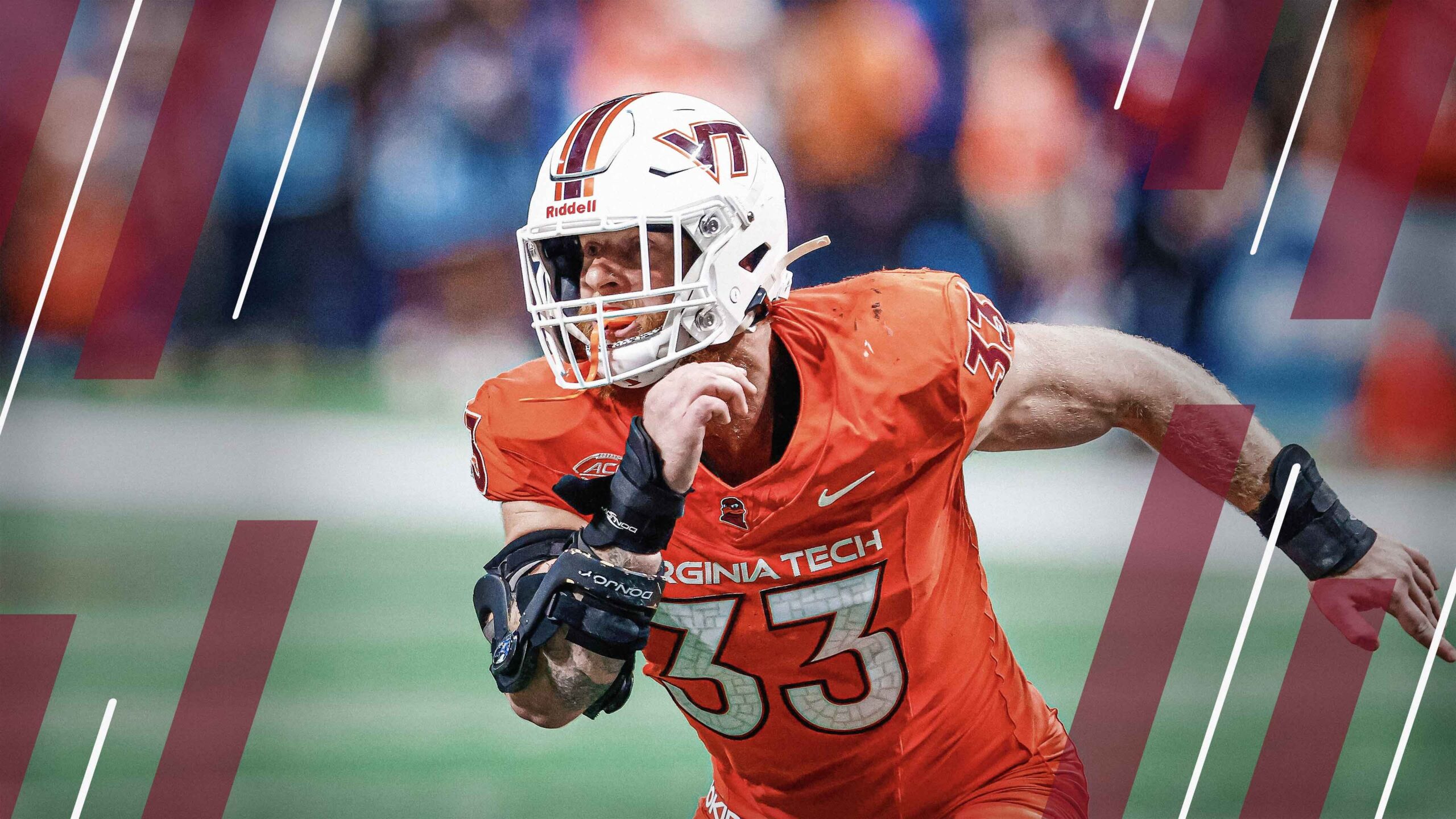
- Ben Bell is an outstanding pass rusher: The Virginia Tech edge defender recorded the best pass-rush win rate in the country since 2023, thanks to his unreal athleticism.
- Febechi Nwaiwu was nearly untouched in pass protection: The former Oklahoma guard permitted only two pressures last year and has played four offensive line spots in his career.
- 2026 NFL Draft season is here: Try the best-in-class PFF Mock Draft Simulator and learn about 2026's top prospects while trading and drafting for your favorite NFL team.
Estimated Reading Time: 11 minutes

While the first night of the NFL Draft features the most thrilling players and prospects expected to make immediate contributions, the remaining two days still offer tremendous value for filling holes and finding unsung contributors.
On Day 3 in particular, prospects often have difficult-to-ignore flaws but can still round into quality players. Consider the likes of Jackson Hawes, Jacory Croskey-Merritt, Chimere Dike and Kyle Monangai, who all were sparkplugs as rookies despite being taken in the fourth round or later.
Which prospects could fit similar criteria in 2026? Using advanced PFF metrics, these eight names might qualify.
OL Brian Parker II, Duke
PFF Big Board Rank: 126
Parker enjoyed a strong final season at Duke, compiling an 85.5 overall PFF grade with 83.4-plus marks in both pass protection and run-blocking. While he played both tackle spots with the Blue Devils, Parker is anticipated to kick inside due to his 32 7/8-inch arms, which makes him more of a projection.
While Parker’s work in pass protection is under more scrutiny after surrendering 15 hurries and three sacks last year, he solidified himself as a dominant run-blocker. Indeed, Parker’s 18.1% impact block rate is far higher than the consensus top tackles in this year’s class, like Francis Mauigoa (14.3%) and Spencer Fano (13.6%). On top of that, Parker placed in the 92nd percentile in positively graded run blocks.
A projected Round 4 selection, Parker has the chance to bolster a team’s run game immediately — and might round into a superior pass protector if he slides to guard or center.
EDGE Ben Bell, Virginia Tech
PFF Big Board Rank: 306
The 2026 NFL Draft is littered with impressive edge defenders, albeit with major questions surrounding even some in contention to be taken in the top 10. Bell will probably hear his name called later, but his production can’t be discounted.
While Bell is an older, more well-traveled prospect, he was a strong pass-rusher no matter which helmet he donned. Consider that Bell played to an 83.8 PFF pass-rush grade or better in each of the last five years. Additionally, since 2023, Bell’s 25.8% pass-rush win rate is tops among qualified edge rushers, and his 93.5 pass-rush grade is fourth.
Although Bell is very small for an edge defender — measuring 6 feet with 30 7/8-inch arms — he compensates by being an elite athlete. According to PFF’s In-Game Athleticism score, Bell tied as the most athletic college football player in the nation last year (minimum 400 snaps) with a 100.0 percentile ranking. That was reinforced by a reported 2.56-second 20-yard split and 6.89-second 3-cone time from his Pro Day.
Bell’s size, high missed tackle rate (22.7% in his career) and penalties (8 in 2025) all narrow his path to making a roster. But betting on a great pass-rusher with top-tier athletic ability feels wise for a late-round flier.
WR Hank Beatty, Illinois
PFF Big Board Rank: 319
A core part of Illinois’ offense over the last two years, Beatty’s draft stock isn’t prolific, given concerns about his size and athletic profile. However, his advanced metrics suggest that he can still be a very valuable player in the NFL.
As a receiver, Beatty was both efficient and reliable. Last season, he secured an 81.3 PFF receiving mark with 2.51 yards per route run, which placed 14th among draft-eligible receivers — and ahead of KC Concepcion, Denzel Boston and Jordyn Tyson. Moreover, Beatty’s 88 targets without a drop were the most in college football. He also brought similarly dynamic plays to the return game, producing a 78.0-plus PFF punt return grade in both 2024 and 2025.
In addition to flashing as a playmaker, Beatty proved to be a strong blocker for the Illini. In 2025, his 68.3 PFF run-blocking mark was 27th among qualified wideouts, including 11th in this year’s receiver bunch.
Athletic limitations are certainly important at a position like receiver, but Beatty’s profile suggests they could be mitigated with his other traits. Even in a deep class, Beatty could be an uncut gem who can contribute more than expected at the next level.
TE Carsen Ryan, BYU
PFF Big Board Rank: 303
The 2026 tight end contingent is a less heralded one, with only one prospect (Kenyon Sadiq) sitting in the top 50 of PFF’s Big Board. Even with fewer transcendent talents, this year’s crop presents late-round rotational players — and Ryan could be among those to carve out a role.
Despite being the 26th-ranked tight end on the board, Ryan presents upside due to his receiving prowess. Ryan played to an 82.6 PFF receiving grade with 2.04 yards per route run and 7.5 yards after the catch per reception last year, all of which were seventh or better among qualified tight ends. Further, Ryan sat in the 93rd percentile in separation rate, including the 84th percentile in space gained against single coverage.
What also makes Ryan intriguing is that he isn’t exclusively a receiving-oriented tight end. The Cougar produced at least a 73.1 PFF run-blocking grade in three of his four collegiate seasons. In his lone year in Provo, Ryan sat in the 78th percentile in negatively graded run blocks, displaying his consistent ability to avoid mistakes on the ground.
The aforementioned Hawes finished 2025 as the third-highest-graded tight end in the NFL, primarily due to his blocking skill mixed with efficient receiving. Perhaps Ryan could follow suit as another Day 3 choice.
G Febechi Nwaiwu, Oklahoma
PFF Big Board Rank: 349
The final four rounds of the draft often involve teams taking shots on players who can secure a roster spot because of their excellence in a few (or even one) areas. That’s certainly the case with Nwaiwu.
Simply put, Nwaiwu was one of the most effective pass protectors in college football last year. His 91.6 PFF pass-blocking grade placed third among qualifiers at all offensive line positions, and his 0.4% pressure rate was the best among Power Four guards.
Another pro in Nwaiwu’s game is versatility. Across his five-year college career, Nwaiwu played at least 70 snaps at every position but left tackle. That kind of experience is always relished in a sport where replacement offensive linemen consistently earn meaningful playing time.
Although Nwaiwu isn’t as polished in the run game — finishing below a 60.0 PFF run-blocking grade in each of the past two seasons — his excellence in pass protection may single-handedly be enough to merit a 53-man spot.
EDGE Keyshawn James-Newby, New Mexico
PFF Big Board Rank: 288
James-Newby didn’t play at marquee schools across his three-year college tenure, suiting up for Idaho and New Mexico. But don’t let that fool you: He’s an elite pass-rusher.
James-Newby posted at least an 85.1 PFF pass-rush grade and 43 pressures in every season of his career. Beyond that, his 168 pressures are the most among edge rushers in the last three years, and his 17.9% pressure rate ties for 11th.
The 23-year-old prospect does have weaknesses in his game, including his tackling (28.8% miss rate) and size. But the ability to fluster the quarterback can play anywhere, even if it makes James-Newby a designated pass-rusher type of player.
S Cole Wisniewski, Texas Tech
PFF Big Board Rank: 200
Former Red Raider stars David Bailey and Jacob Rodriguez are projected top-50 selections after a sensational year on Texas Tech’s defense. Another player on the unit who shouldn’t be forgotten is Wisniewski.
After transferring up from FCS powerhouse North Dakota State, Wisniewski thrived in Lubbock with an 83.9 overall PFF grade, which ranked 19th among qualified safeties. Of note, Wisniewski received at least a 74.7 mark in coverage, run defense, tackling and even pass-rushing. Being that well-rounded is rare for any safety prospect.
On top of that, Wisniewski was one of the more athletic safeties in the nation. Per PFF’s In-Game Athletic Metric, Wisniewski’s 99.4th percentile score tied for 12th at the position, and his change of direction was in the 99.9th percentile.
Being a taller safety can have limitations matching faster receivers downfield, and Wisniewski’s age (24) is another potential negative. Nonetheless, there’s a lot that intrigues about his combination of athleticism, coverage ability and run-stopping acumen.
LB Jimmy Rolder, Michigan
PFF Big Board Rank: 346
Even in a good linebacker class with promising players extending into Day 3, Rolder is a name that shouldn’t go uncovered.
Rolder played just 909 snaps in four seasons at Michigan due to injury, but he was a game-wrecker when on the field. Rolder was terrific as a downhill player, amassing at least an 80.0 PFF run-defense grade in 2024 and 2025. Despite his activity, Rolder missed only 4.3% of his tackles over that span, which ranks in the 99th percentile among linebackers.
Rolder’s role at the next level could be more situational, given his struggles in coverage after allowing 80.1% of his 2025 targets to be hauled in. However, his athleticism (88.5 In-Game Athletic Score) meshed with his clean play around the line of scrimmage make him a possible diamond in the rough.

 © 2026 PFF - all rights reserved.